

This article has been written to bring light to an area of Scripture that many place in darkness: when is New Moon Day?
There are several different methods used today. Some begin the month with the astronomical conjunction or dark moon. Others use the first visible crescent. Others believe the full moon is the New Moon.
They cannot all be correct.
So rather than beginning with tradition, astronomy, a modern calendar, or what any particular group teaches, we are going to look at the entirety of Scripture.
Psalm 119:160
“The entirety of Your word is truth,
And every one of Your righteous judgments endures forever.”
And:
Deuteronomy 12:32
“Whatever I command you, be careful to observe it; you shall not add to it nor take away from it.”
This principle is important throughout this study.
We should not expect every truth in Scripture to necessarily be contained in one isolated sentence. Scripture often provides one witness here, another witness there, and another somewhere else. When those witnesses are brought together, something that was not immediately visible can become very clear.
This is also where faith enters the picture.
Hebrews 11:1
“Now faith is the substance of things hoped for, the evidence of things not seen.”
Faith is not the absence of evidence. Scripture describes faith itself as the evidence of things not seen.
That principle will become very important as we examine the New Moon, the Sabbaths, and the pattern of light that Yahuwah has placed both in the heavens and in His Word.
What Are the Different Methods?
There are three primary methods we will examine.
Method 1: The Dark Moon or Conjunction
Those using this method identify the New Moon with the period when the moon cannot be seen, generally around astronomical conjunction.
Some declare the conjunction itself as the beginning of the month. Others begin New Moon Day following the conjunction.
Method 2: The First Visible Crescent
Those using this method watch for the first visible light of the moon following its period of invisibility.
The crescent is observed in the western sky following sunset. New Moon Day then begins with the following day.
Method 3: The Full Moon
Those using this method believe the fully illuminated moon represents the New Moon and begin the month from the full moon.
We Must Consider the Entire Testimony
Someone can take an individual verse and attempt to make it support almost any one of these positions.
That is why our opening Scripture is so important:
“The entirety of Your word is truth.”
We are not going to decide what New Moon Day is from one verse alone.
Instead, we will ask:
- What did Yahuwah appoint the heavenly lights to do?
- What role does the moon have?
- What does chodesh tell us?
- Does Scripture distinguish the New Moon from the full moon?
- Is the New Moon something observable?
- How were Yahuwah’s appointed times calculated?
- What pattern do the Sabbaths produce?
- What pattern of light appears in the heavens?
- What pattern of Light appears in Scripture?
When all these witnesses are considered together, they point in one direction.
The Foundation: The Lights Determine Appointed Times
The first place we should begin is the beginning itself.
Genesis 1:14
Elohim said:
“Let there be Lights in the firmament of heaven to separate the day from the night and be for signs, appointed times, days, and years.”
Before there was a Gregorian calendar, before there was a Julian calendar, before there was an International Date Line, Yahuwah had already placed His timekeepers in the heavens.
The Lights were appointed for:
- signs,
- appointed times,
- days,
- and years.
Psalm 104 goes further and identifies the moon specifically:
Psalm 104:19
“He created the moon for the appointed times.
The sun knows its going down.”
The moon therefore has a specific relationship with Yahuwah’s appointed times.
That means the question before us is not simply:
What do people call a New Moon today?
The question is:
What sign in the moon did Yahuwah provide for recognising the beginning of His month?
Exodus 12 – The Beginning of the Months
In Exodus 12, Yahuwah speaks directly to Moses and Aaron about the beginning of the year:
Exodus 12:1-2
Yahuwah spoke to Moses and Aaron in the land of Egypt, saying:
“This new moon is the beginning of new moons. It is the first new moon of the year.”
The word translated here as “new moon” or “month” is the Hebrew word chodesh.

This is fundamental to the Scriptural calendar.
From the beginning of the first chodesh, Yahuwah then begins identifying days by number.
The lamb was selected on the 10th day after the new moon.
Passover occurred on the 14th day after the new moon.
The appointed time of Unleavened Bread began on the 15th day after the new moon.
The calendar and the days are therefore being counted from the beginning of the chodesh.
Once the beginning of the month is established, its other appointed days can be known.
Without knowing the beginning, none of the other dates can be determined. And that is something many people do not think about when using the Gregorian calendar.
The Appointed Times Are Counted from the New Moon
Leviticus 23 gives Yahuwah’s appointed times.
For example:
Leviticus 23:5-6
“On the fourteenth of the first new moon in the evening is Yahuwah’s Passover.
And on the fifteenth day of the same new moon is the Feast of Unleavened Bread to Yahuwah…”
The dates are counted from the beginning of the month.
The same principle applies to Trumpets, Atonement and Booths in the seventh month.
So the New Moon is not an unimportant side issue.
The New Moon establishes the month, and the month establishes the appointed days within it.
If the beginning is wrong, every date counted from it will also be wrong.
What Is a Sign and How Is It Used?
The word “sign” comes from the Hebrew word ‘owth. It is also the same word we see translated as “mark.” It represents a warning or proof of an event and is designed to bring that event to remembrance.

A good way to think about a sign is to consider a “give way” sign on a road.
Now, I am going to point out something that might seem obvious, but it appears that many people flip this idea around when it comes to the scriptures:
- A give way sign is seen before you reach the intersection. Its purpose is to warn you that if you proceed and do not give way, an accident may occur.
A sign therefore provides information that can be acted upon. In the case we are examining, that becomes particularly important because New Moon Day had to be recognised before its commands could be kept.

Not observing the sign before the event can result in dire consequences.
In Genesis 1:14 we read that the Lights were to act as signs and were connected with appointed times, days and years.
Genesis 1:14
Elohim said: “Let there be Lights in the firmament of heaven to separate the day from the night and be for signs, appointed times, days, and years.”
In the particular case we are examining, the sign must be useful in identifying the approaching New Moon Day. If the people were required to recognise and keep that day when it arrived, then the heavenly sign had to provide information they could act upon beforehand.
The question therefore becomes: what visible sign in the moon announces that the new month is about to begin?
So What Is the New Moon?
Here, we will start to lay out the items which scripture provides, so we can know which day is new moon day and which days are not. We already know the sun, moon, and stars were to be used as signs. We have seen that, in this application, the sign must allow the approaching New Moon Day to be recognised. So, what is the sign of the new moon?
When I started studying this, I found Deuteronomy 16:1, which is similar to what we read in Exodus 12:1-2. Here in Deuteronomy, it says:
Deuteronomy 16:1
1 Observe the chodesh of Abib and keep the Passover of Yahuwah Elohim.
The word “observe” comes from the Hebrew word shamar. It means “to keep, to guard, to observe, or to watch for.”

If we sat in a room with no light, we would not see anything, nor would we know what time of the day it was. We would be lost. We would quickly realize that in order to see anything, you need light.
If we are to guard something, observe something, or watch for something, we need light. These things cannot be done in the darkness. To observe the new moon, then, it would seem that we are going to need light. Scripture repeatedly contrasts the things of Yahuwah with darkness, even describing the spiritual powers against which we wrestle as ‘the rulers of the darkness of this age.’
Ephesians 6:12
For we do not wrestle against flesh and blood, but against principalities, against powers, against the rulers of the darkness of this age, against spiritual hosts of wickedness in the heavenly places.
Scripture confirms this in the following passages:
Isaiah 9:2
“The people who walked in darkness have seen a great light; those who dwelt in the land of the shadow of death, upon them light has shined.”
Appointed Time of Trumpets (Leviticus 23)
When we view Leviticus 23, we see the appointed time of Trumpets spoken of. The appointed time of Trumpets occurred on the first day of the seventh new moon. Here is the scripture:
Leviticus 23:23-24
23 Yahuwah spoke to Moses, saying,
24 “Speak to the children of Israel, saying: ‘In the seventh new moon, on the first day of the new moon, you shall have a sabbath-rest, a memorial of blowing of trumpets, a holy convocation.’”
As we are aware, day is Light (Genesis 1:5). The trumpets were to sound all day upon the appointed time of Trumpets, which was the first day of the new moon.
In order for this to occur, one must know before the day starts that the following day is to be the appointed time of Trumpets. Knowing in the evening, after the sun has set that the day that has just passed was the appointed time of Trumpets, is no help. And what if they celebrated it, and then found the new moon was not seen? They would have celebrated it too early.
So, we have already ruled out one method of determining the new moon. The method which uses the darkness. It cannot be the new moon, as it cannot be seen. Also, we can see that the new moon was seen before the day occurred. It was given as a sign.
Can You See New Moon Day in Scripture?
Consider, when we sit in the light, we can see all the things which the light reflects off. It works as a lamp to our feet. New Moon Day is an event we see in the scriptures. If we were to say there is no light upon the new moon, but in His word we see it, then we are quite literally flipping around what He shows us.
That is, we would be saying the new moon is in darkness when He provides it to us as light in His word. We find that His word is light in Psalms 119:
Psalm 119:105
“Your word is a lamp to my feet and a light to my path.”
If we are to follow the Father, then we need to recognise what His Word places in the Light and what remains hidden from direct view.
There is an important distinction here: hidden does not mean absent.
Something may not be directly seen, yet the surrounding testimony can still reveal that it is there. This distinction will become especially important when we later examine the fourth Sabbath and the relationship between Light, things hidden, and faith.
And Then There Were Two…
The only two methods left to distinguish between are the first visible crescent and the full moon. How do we know which one is the new moon?
Witness One: Scripture Distinguishes the New Moon from the Full Moon
One of the clearest witnesses comes from Psalm 81.
Psalm 81:3
“Blow the trumpet at the New Moon (chodesh)
and at the full moon (keseh),
on our feast day.”
This is very important.
The verse uses two different words.
- Chodesh — New Moon/month
- Keseh — full moon

If the New Moon and the full moon were the same thing, why does Scripture distinguish between them?
Psalm 81 does not simply tell us about a moon.
It identifies the chodesh and the keseh separately.
This fits perfectly with the seventh month.
The month begins with the appointed time of Trumpets:
Leviticus 23:23-24
Yahuwah spoke to Moses, saying,
“Speak to the children of Israel, saying: ‘In the seventh new moon, on the first day of the new moon, you shall have a Sabbath-rest, a memorial of blowing of trumpets, a holy convocation.’”
Then, on the 15th day of the same month, comes the appointed time of Booths.
Around that time the moon reaches its fullness.
Numbers also tells us that trumpets were sounded at both beginnings of months and appointed feasts:
Numbers 10:10
“Also in the day of rejoicing, at your appointed feasts, and at the beginnings of your months, you shall sound the trumpets…”
So Psalm 81:3 gives us something very significant:
The New Moon and the full moon are not being presented as the same lunar event.
This rules out the full moon as the beginning of the month.
Witness Two: The New Moon Is Something That Can Be Recognised
Deuteronomy says:
Deuteronomy 16:1
“Observe the chodesh of Abib, and keep the Passover to Yahuwah Elohim…”
The word translated “observe” is the Hebrew shamar.
It carries the idea of keeping, guarding, watching and observing.


This verse by itself is not the entirety of the case.
But it fits the pattern.
Yahuwah gave the moon for appointed times, and Israel was commanded to guard and observe the month of Abib so that Passover could be kept at its correct time.
The question then becomes:
What does the moon provide that can actually identify the beginning?
There is a period every month when the moon disappears from human sight.
Then something remarkable occurs.
Light returns.
Witness Three: The First Visible Light Appears in the West
Near the end of a lunar month, the moon disappears from sight.
Then, following sunset, the first thin crescent becomes visible low in the western sky.

This is the first visible appearance of the moon after it has been hidden.
The moon has been renewed.
This also fits beautifully with:
Psalm 104:19
“He created the moon for the appointed times.
The sun knows its going down.”
The moon appointed for the moedim becomes visible in connection with the going down of the sun.
That does not mean Psalm 104:19 alone defines the crescent. But it fits exactly with what we can see.
Remember the principle of this study:
the entirety of His Word is truth.
This witness is added to the others.
Light and Darkness
There is another pattern running through Scripture which should not be ignored.
Yahuwah continually uses Light to represent revelation, truth and the ability to see.
Psalm 119:105
“Your word is a lamp to my feet
and a light to my path.”
Isaiah 8:20
“To the law and to the testimony! If they do not speak according to this word, it is because there is no light in them.”
Isaiah 5:20
“Woe to those who call evil good, and good evil; who put darkness for light, and light for darkness; who put bitter for sweet, and sweet for bitter!”
John 8:12
“I am the light of the world. Whoever follows Me shall not walk in darkness, but have the light of life.”
John 9:4-5
“I must work the works of Him who sent Me while it is day; the night is coming when no one can work. As long as I am in the world, I am the light of the world.”
John 12:35-36
“Walk while you have the light, lest darkness overtake you…”
Ephesians 5:8-14
8 For you were once darkness, but now you are light in Yahuwah. Walk as children of light,
9 for the fruit of the Spirit is in all goodness, righteousness, and truth,
10 finding out what is acceptable to Yahuwah.
11 And have no fellowship with the unfruitful works of darkness, but rather expose them.
12 For it is shameful even to speak of those things which are done by them in secret.
13 But all things that are exposed are made manifest by the light, for whatever makes manifest is light.
14 Therefore He says:
“Awake, you who sleep,
Arise from the dead,
And Messiah will give you light.”
Scripture repeatedly uses Light to describe that which makes something known, visible and understandable. Darkness, by contrast, conceals.
The moon works in a similar way. It does not produce its own light; it reflects the light of the sun. As that reflected light increases and decreases throughout the month, different portions of the moon become visible to us.
In the same way, the Light of Yahuwah’s Word reveals things to us. Some things are stated directly, while others become visible through the pattern created by the testimony surrounding them.
This is where the physical moon and the Light of Scripture begin showing an extraordinary pattern.
The first visible crescent begins with only a small amount of light.
Night after night, the illuminated portion grows.
Around the middle of the month, the moon reaches fullness.
Then its visible light decreases again.
Eventually, it disappears.
Now look at the dates upon which Scripture shines its own Light.
The Pattern of the Sabbaths
When the month begins with New Moon Day, followed by six work days and then the Sabbath, the Sabbaths occur upon:
- the 8th,
- the 15th,
- the 22nd,
- and the 29th.
The pattern is:
New Moon Day
then:
six work days → Sabbath
six work days → Sabbath
six work days → Sabbath
six work days → Sabbath
This produces Sabbaths upon the 8th, 15th, 22nd and 29th days.
Now something very interesting happens when we examine Scripture.
We find considerable Light upon the events around the middle of the month, particularly the 14th, 15th and 16th.
The 15th has an extraordinary amount of Scriptural testimony associated with it.
When we look through Scripture, an interesting pattern appears. We find direct Scriptural Light upon New Moon Day and upon the first, second and third Sabbaths of the month.
Yet the fourth Sabbath is different. We do not find an event directly identified upon it in the same way. It is hidden from direct view, even though the established pattern of six work days followed by a Sabbath tells us that it must be there.
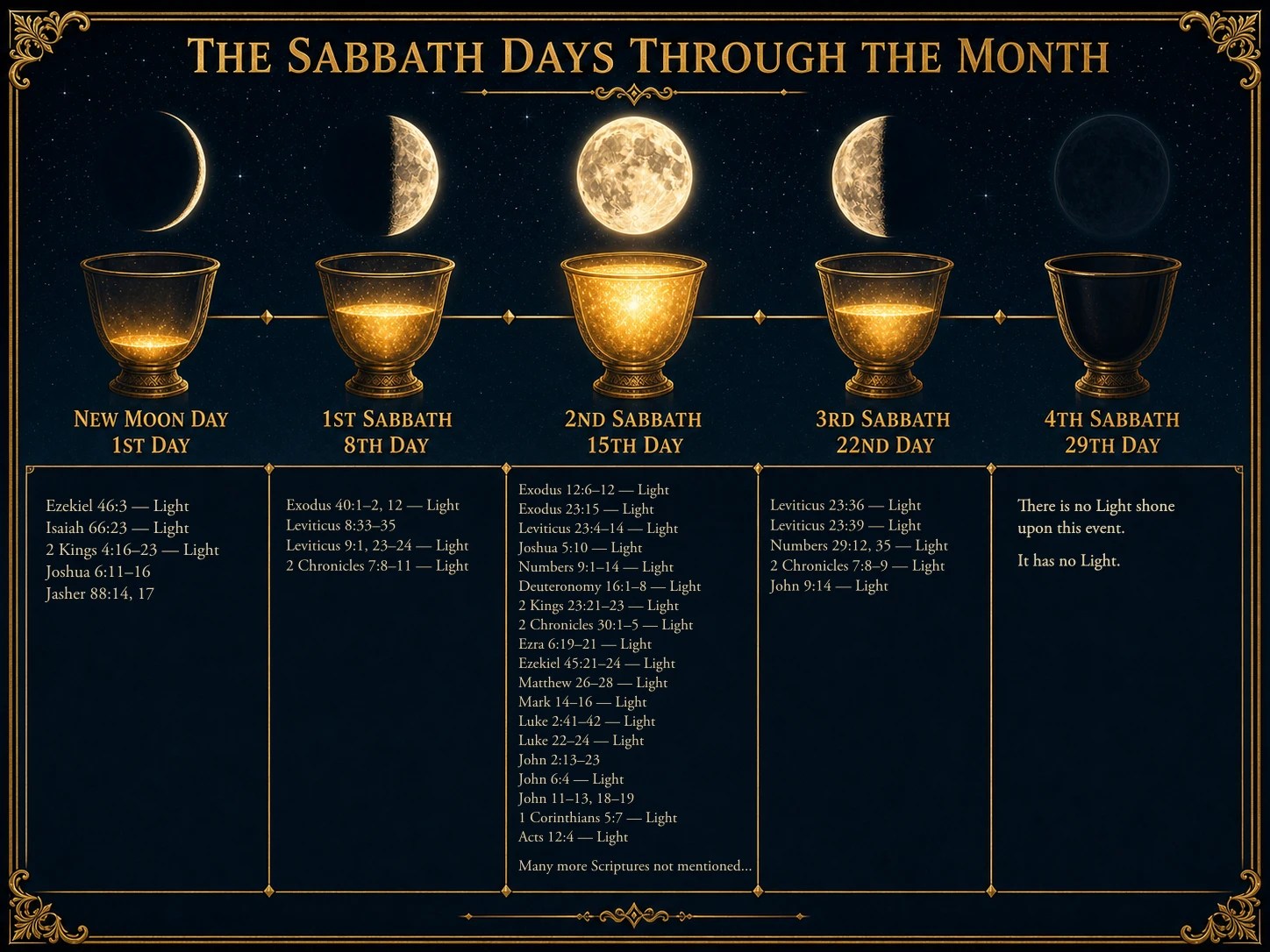
The liquid shown in each cup represents the amount of Scriptural Light found upon that particular point in the month—that is, the number of passages which allow us to see events occurring around those days.
The 15th actually has considerably more Scriptural references than are shown in the image. I stopped adding them because the difference was already apparent.
Each passage is another witness—another source of Light.
As the witnesses accumulate, the Light becomes greater.
This is especially noticeable around the 14th, 15th and 16th days of the month, where Scripture provides an extraordinary amount of detail.
The 15th is especially significant. It is the Sabbath upon which Yahushua rested following the crucifixion, and it is also the first day of the appointed time of Booths. Scripture repeatedly shines Light upon this part of the month.
By contrast, the fourth Sabbath is not directly illuminated in the same manner.
Yet its absence does not mean it does not exist. The surrounding pattern tells us where it must be.
In this way, even the absence of direct Light becomes part of the evidence.
Now compare this with the moon.

The physical light of the moon increases toward the middle of the month.
Likewise, the Scriptural Light becomes especially strong around the middle of the month.
Then both decrease toward the end.
The fourth Sabbath is the one Sabbath that is not directly shown in the same manner.
And at that same point in the lunar cycle, the moon’s visible Light is disappearing.
Is this one observation, taken alone, enough to establish the calendar?
No.
But that is not how this study works.
It is another witness.
And when it is added to everything else, the pattern becomes difficult to ignore.
Faith and the Sabbath That Is Not Directly Seen
This brings us back to faith.
Hebrews 11:1
“Faith is the substance of things hoped for, the evidence of things not seen.”
We do not require a verse saying:
“The fourth Sabbath occurs on the 29th day.”
Why?
Because once the pattern is established, the fourth Sabbath necessarily follows.
If we have:
New Moon Day,
then six work days,
then Sabbath,
followed by another six work days and Sabbath,
and another,
and another,
the fourth Sabbath is known even if we do not have a verse describing an event occurring specifically upon that day.
It is evidence of something not directly seen.
This is an important distinction.
Something does not cease to be true simply because we cannot point to one verse which states it in isolation.
The evidence may instead be found in everything surrounding it.
If Yahuwah establishes six working days followed by a Sabbath, and that pattern has already been demonstrated repeatedly within the month, then the final Sabbath is revealed by the pattern even if Scripture does not record a particular event occurring upon that day.
The absence of a direct statement does not remove the evidence.
In this case, the surrounding witnesses are the evidence.
That is why the entirety of His Word must be considered together.
The same principle appears elsewhere in our faith.
Scripture says:
John 1:18
“No one has seen Elohim at any time…”
Yet we believe He exists.
Why?
Because of the testimony He has provided.
We see the evidence of Him everywhere, even though we have not seen Him directly.
Similarly, the fourth Sabbath is not absent because it is not directly described.
The surrounding testimony reveals where it must be.
Exodus 10 – Light When Others See Darkness
There is an interesting picture of this principle during the ninth plague.
Exodus 10:21-23
Yahuwah said to Moses,
“Stretch out your hand toward heaven, that there may be darkness over the land of Egypt, darkness which may even be felt.”So Moses stretched out his hand toward heaven, and there was thick darkness in all the land of Egypt three days.
They did not see one another; nor did anyone rise from his place for three days.
But all the children of Israel had light in their dwellings.
When others were in darkness, Yahuwah’s people had Light.
The Light was there for those who followed Him.
Likewise, near the end of the lunar month, the moon’s illuminated side has not ceased to exist simply because we cannot see it from Earth.
Imagine standing upon the opposite side of the moon.
What appears dark and hidden to us would be illuminated from the opposite perspective.
The Light still exists.
It is simply hidden from our sight.
Witness Four: The Hebrew Word Chodesh
We now return to the Hebrew word translated “New Moon” and “month”:
Chodesh.

The word is connected with the idea of renewal.
Something is being made new again.
This already fits the moon remarkably well.
It disappears.
Then its Light returns.
It begins again.
There is also an interesting ancient-Hebrew word-picture interpretation worth considering.
I do not rest the entire case upon this witness alone. Remember: we are examining the whole testimony.
But once again, it fits the same pattern.

The first letter is Chet/Het, represented in the ancient pictographs by a tent wall.

The second is Dalet, represented by a tent door.

The wall and doorway produce edges which meet at a point as in the Hebrew letter Beyt.


A similar idea can be seen in the meeting edges of a sword.

The Hebrew root associated with chad carries the idea of sharpness or a sharp point.

For example:
Proverbs 5:4
“But her end is bitter as wormwood, sharp as a two-edged sword.”
And:
Isaiah 49:2
“He has made my mouth like a sharp sword…”
The concept of joined points also appears in the related idea of unity.

The Vav carries the ancient picture of joining, hooking or securing.

The Shin is represented by two front teeth and carries associations with sharpness.

When these ideas are brought together, the ancient-Hebrew word-picture interpretation produces an image remarkably similar to:
Two joined sharp points.
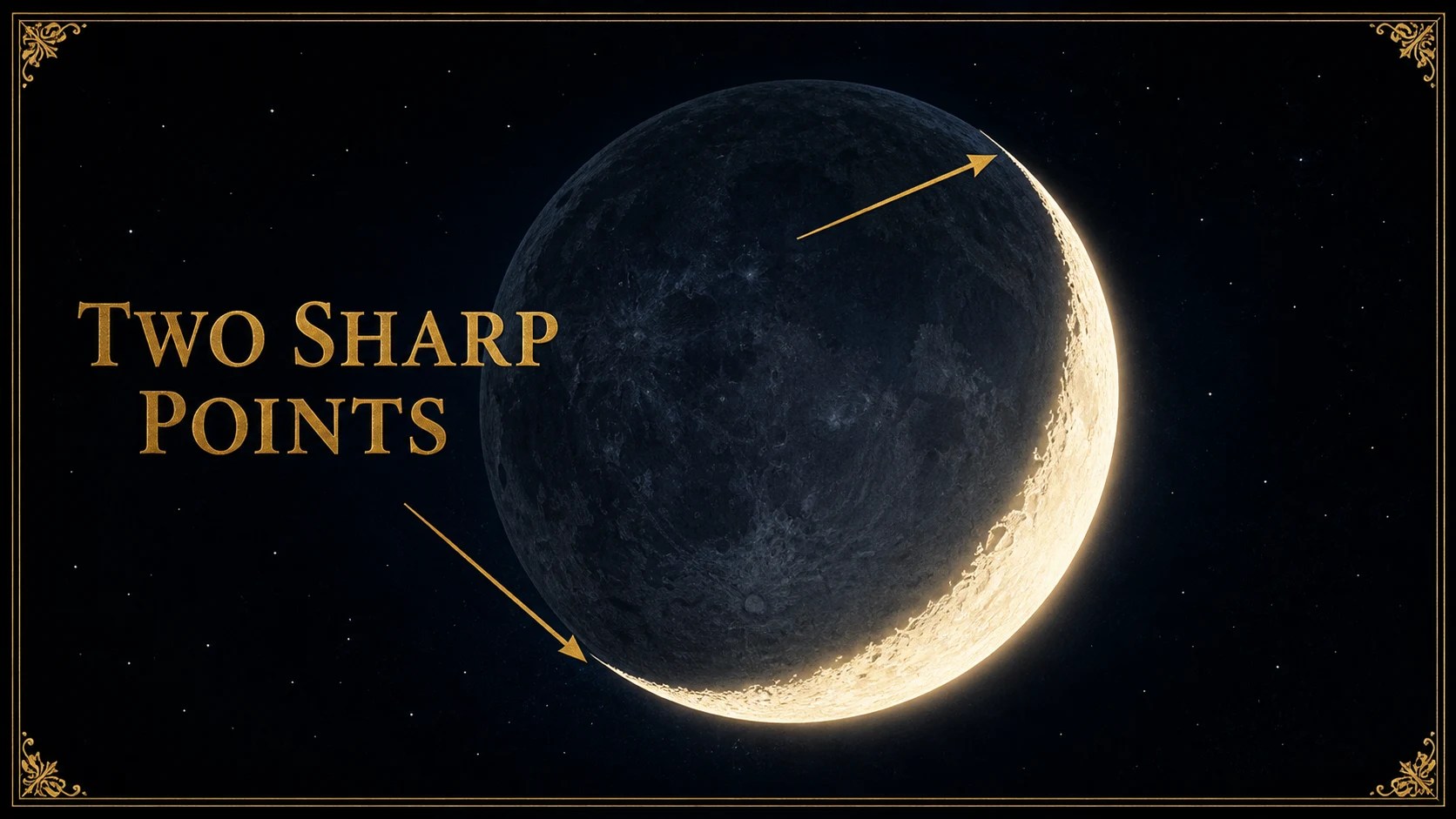
And what do we see when the moon first reappears?
A crescent.
Two illuminated points joined together by the newly visible Light.
Again, this is not the only witness.
But it agrees with the witnesses already established.

The related action is renewal.
The moon is renewed.
The month is renewed.
The Light returns.

Passover, the Sabbath and First Fruits
Now that we have established the beginning of the month, we can look at what happens when the days are counted from it.
Leviticus tells us:
Leviticus 23:5-6
“On the fourteenth… is Yahuwah’s Passover.
On the fifteenth day… is the Feast of Unleavened Bread…”
And:
Leviticus 23:10-11
“He shall wave the sheaf before Yahuwah… on the morrow after the Sabbath the priest shall wave it.”
When these passages are considered together with the chronology that follows, an important sequence emerges:
14th — Passover / preparation
15th — Sabbath
16th — day after the Sabbath / First Fruits
That same pattern appears again in the accounts surrounding Yahushua’s death and resurrection.
The 14th – Preparation
Mark 15:42
“When evening had come, because it was the preparation day, that is, the day before the Sabbath…”
Luke 23:53-54
“It was the preparation day, and the Sabbath was approaching.”
John 19:30-31
“Therefore, since it was the preparation, and the bodies should not remain on the stake on the Sabbath…”
The day of Passover was followed by the Sabbath.
The Day After the Sabbath
Then we are told:
Mark 16:1-2
“When the Sabbath was past… very early on the first day of the week, they came to the tomb…”
Matthew 28:1
“After the Sabbath, toward dawn on the first day of the week…”
Luke 24:1
“On the first day of the week, at early dawn…”
The sequence is again:
Preparation day → Sabbath day → first day of the week.
In the calendar pattern being examined, these correspond with:
14th → 15th → 16th.
Luke 24 – “The Third Day Since”
Luke then gives another important witness.
Luke 24:13-21
Two disciples were travelling that same day toward Emmaus.They spoke about the things concerning Yahushua:
“The chief priests and our rulers delivered Him to be condemned to death, and crucified Him… Indeed, besides all this, today is the third day since these things happened.”
This occurs on the first day of the week.
Again we find Scripture shining considerable Light upon this section of the month.
The 14th, 15th and 16th become some of the clearest dates in the entire Scriptural record.
And what does the moon look like at this point?
It is at or near its greatest visible Light.
This is the pattern we saw earlier.
So How Is the Sabbath Counted from an International Date Line?
It is not.
Scripture never tells us to count Yahuwah’s appointed times from a man-made International Date Line.
Genesis tells us:
Genesis 1:14
“Let there be Lights… for signs, appointed times, days and years.”
Psalm tells us:
Psalm 104:19
“He created the moon for appointed times.”
The modern world uses an International Date Line because the civil calendar requires a fixed location where one humanly defined date changes to another.
But Yahuwah’s calendar is not established by the Gregorian calendar.
His appointed times are established by the Lights He placed in the heavens.
The sun identifies the daily cycle.
The moon establishes the monthly cycle.
And from the beginning of that month the appointed dates are counted.
Common Objections
Claim: “The Moon Was Created to Rule ALL Night”
Genesis, Jeremiah and Psalms speak of the moon and stars ruling by night.
For example:
Psalm 136:9
“The moon and stars to rule by night…”
But Scripture does not say the moon must be visible all night.
Nor does it say that the New Moon must rise in the east and remain visible until the west.
Those ideas have been added to the text.
A first visible crescent is quite literally a light seen by night.
Nothing in these Scriptures requires a full moon.
Claim: The New Moon Must Be a Fully Developed Lunar Phase
Some argue that the New Moon must be full because renewal means being restored to completeness.
But renewal is a process.
A child does not suddenly appear fully mature.
A plant does not emerge from the ground fully grown.
Renewal begins and develops.
The moon works in the same manner.
It begins with a small amount of visible Light.
Its Light increases.
It reaches fullness.
Then the visible Light decreases.
The word chadash carries the concept of renewing.

The related adjective can mean new or fresh.
The full moon is not the beginning of that renewal.
It is the maturity or fullness reached after the renewal has already begun.
Claim: All Ruling Luminaries Must Rise in the East
Ezekiel 46:1
“Thus says the Sovereign Elohim: ‘The gate of the inner court that looks toward the east shall be shut the six working days; but on the Sabbath it shall be opened, and on the day of the New Moon it shall be opened.’”
This passage certainly tells us that the eastern gate was opened on the Sabbath and on New Moon Day.
But notice what it does not say.
It does not say the New Moon rises through the eastern gate.
It does not say the moon must rise in the east on New Moon Day.
It does not say that the direction of the gate determines the phase of the moon.
The passage is describing when the gate was to be opened, not where the New Moon must appear in the sky.
Some use Matthew 24:27:
“As the lightning comes from the east and flashes to the west…”
But the verse is talking about lightning and the coming of the Son of Man.
It does not define the New Moon.
The first visible crescent appears in the western sky near sunset.
Nothing in Scripture says the New Moon must first appear in the east.
Revelation 12 – The Woman and the Moon
Revelation says:
Revelation 12:1
“A great sign appeared in heaven: a woman clothed with the sun, with the moon under her feet…”
Some have claimed the Greek word selene means a brilliant or full moon.
It does not.
Selene is simply the Greek word for moon.
The same Greek word is used throughout the New Testament simply to identify the moon.
For example, selene is found in:
- Matthew 24:29
- Mark 13:24
- Luke 21:25
- Acts 2:20
- 1 Corinthians 15:41
- Revelation 6:12
- Revelation 8:12
- Revelation 21:23
This is important because some of these passages describe the moon when it is not giving its light.
Matthew 24:29 says:
“The sun will be darkened, and the moon will not give its light…”
Revelation 8:12 similarly speaks of part of the moon being darkened.
Therefore, the use of the word selene cannot establish that Revelation 12 is describing a specifically full or “brilliant” moon.
It is simply the Greek word for the moon.
The lunar phase must therefore be determined from other evidence, not from the word selene itself.
Therefore Revelation 12:1 cannot be used to establish that the moon under the woman’s feet was necessarily full.
A configuration resembling this sign occurred on 23 September 2017, when the moon near the woman’s feet was a crescent.

Psalm 81 Again – New Moon and Full Moon
This deserves repeating because it is such an important distinction:
Psalm 81:3
“Blow the trumpet at the New Moon (chodesh)
and at the full moon (keseh)…”
The New Moon and full moon are distinguished within the same verse.
This harmonises beautifully with the seventh month:
1st — Trumpets / New Moon
15th — Booths / full moon
The full moon therefore belongs near the middle of the month.
It does not begin it.
Claim: The “Father of Lights” Requires a Full Moon
James says:
James 1:17
“Every good gift and every perfect gift is from above, and comes down from the Father of lights, with whom there is no variation or shadow of turning.”
This Scripture is describing the Father.
It teaches that Yahuwah does not change.
It does not teach that the New Moon must be full.
The moon, by contrast, visibly changes throughout the month.
So this passage should not be made to say something about the lunar phase that it does not actually say.
Claim: The New Moon Must Be Observed Everywhere at the Same Time
Another objection concerns how the New Moon can be observed across different parts of the earth.
The lunar cycle is approximately 29½ days long. For this reason, an observational lunar month will contain either 29 or 30 days.
At the end of the month, the moon disappears from sight. The first visible crescent then begins to appear again as visibility progresses across different geographical locations.
This means that observers in different places may not necessarily see the first crescent upon the same evening.
But Scripture never tells us that every person upon the earth must observe the New Moon simultaneously.
What Scripture tells us is:
Deuteronomy 16:1
“Observe the chodesh of Abib, and keep the Passover to Yahuwah Elohim…”
The word chodesh can be translated as “month” or “new moon.” The word translated “observe” is the Hebrew shamar, meaning to keep, guard, observe or watch carefully.
The important point is that the month was something which had to be recognised and guarded so that the appointed times could then be counted correctly.
There is also an important practical distinction between the full moon and the first visible crescent.
With the full moon, one could continually ask:
Is it completely full yet?
Its illumination gradually increases and then gradually decreases. Determining the exact instant of maximum fullness requires calculation.
The first visible crescent presents a much simpler observable distinction.
The moon was not visible.
Then it is visible.
Light has returned.
The moon has been renewed.
That observable transition is exactly what we would expect from a visible sign marking the beginning of a renewed month.
This also explains naturally why months may contain either 29 or 30 days.
The beginning is not established by forcing the moon into a predetermined number of days.
The beginning is established when the sign Yahuwah placed in the heavens becomes visible.
Claim: A Conjunction Is More Accurate Because It Can Be Calculated Everywhere
Mathematical precision does not determine whether something is Scriptural.
The question is not:
What can modern astronomy calculate most precisely?
The question is:
What did Yahuwah appoint as the sign?
An astronomical conjunction is invisible.
It can only be known through calculation.
But Genesis 1:14 directs us toward the Lights themselves.
When the crescent returns, there is no need to imagine the Light.
It is there.
It can be seen.
The moon which was hidden has been renewed.
The Crucifixion Darkness Does Not Establish a Full-Moon New Moon
Another argument points to the darkness at the crucifixion.
But Scripture tells us specifically what was darkened:
Luke 23:44-45
“There was darkness over all the earth until the ninth hour. Then the sun was darkened…”
The passage does not establish the phase of the moon.
Likewise, Matthew 24 speaks of a future event:
“The sun will be darkened, and the moon will not give its light…”
That is not a definition of the New Moon.
Amos similarly says:
“I will make the sun go down at noon, and I will darken the earth in broad daylight.”
Again, the subject is Yahuwah supernaturally darkening the day.
None of these passages identify the full moon as New Moon Day.
The Rejected Cornerstone
Psalm 118 says:
“The stone which the builders rejected has become the chief cornerstone…”
And Peter applies this to Messiah:
1 Peter 2:9
“…that you may proclaim the praises of Him who called you out of darkness into His marvelous light.”
This again reveals the Scriptural pattern.
Messiah is Light.
The Word is Light.
Truth is Light.
And the greatest concentration of Scriptural testimony concerning Yahushua’s death and resurrection falls around the same period of the month when the moon reaches its greatest visible Light.
Once again, this does not stand alone.
It joins the other witnesses.
What About World’s Last Chance and the Conjunction?
World’s Last Chance once taught the first visible crescent and later changed its position to the day following lunar conjunction.
They explained their change in position this way:
“World’s Last Chance is overjoyed to share what we sincerely believe to be advancing light on our Creator’s calendar. In His great mercy and longsuffering, Yahuwah has borne long with us as we espoused what we now recognize to be an error. Praise His Name! Since we first accepted the glorious light of Yahuwah’s luni-solar calendar and its divine role in determining all of the Feast Days, including the Seventh Day Sabbath, we have in our ignorance proclaimed that New Moon Day was determined by the first visible crescent. We now, after much prayer and study, repent of this error and would like to humbly share our conviction that New Moon Day is to be observed, beginning at dawn, on the day following the moon’s conjunction with the sun (as opposed to the day following the first visible crescent).”
Their statement describes this as “advancing light.”
But this raises an important question:
Where is the Light?
The position being proposed identifies the beginning of the month with an event that is itself hidden from human sight.
The conjunction cannot be observed by looking into the heavens. It must be calculated.
Yet Genesis tells us:
Genesis 1:14
“Let there be Lights in the firmament of heaven… for signs, appointed times, days, and years.”
And Psalm 119 tells us:
Psalm 119:105
“Your word is a lamp to my feet and a light to my path.”
If something is described as “advancing light,” we should be able to ask where that Light can be found in the testimony Yahuwah has provided.
The first visible crescent presents the opposite picture to conjunction.
The moon has been hidden.
Then Light appears.
The moon is renewed.
The new month is announced.
This harmonises with the pattern we have seen throughout this study: the physical Light in the heavens and the Light provided in Yahuwah’s Word work together as witnesses.
The Witnesses Together
Now let us bring everything together.
We have seen that:
- Yahuwah appointed the heavenly Lights for signs, appointed times, days and years.
- He specifically appointed the moon for the appointed times.
- Chodesh identifies the beginning of the Scriptural month.
- The appointed days are counted from that beginning.
- Scripture distinguishes chodesh from the full moon.
- The full moon therefore cannot itself be the New Moon.
- The conjunction is invisible and requires calculation.
- The first visible crescent is the first returning Light of the moon.
- It is seen before the following New Moon Day begins.
- The Hebrew concept of chodesh/chadash is connected with renewal.
- The ancient-Hebrew word-picture interpretation also fits the two pointed crescent.
- The monthly Sabbath sequence produces the 8th, 15th, 22nd and 29th.
- Scripture shines extraordinary Light around the middle of the month.
- The moon likewise reaches its greatest Light around the middle of the month.
- The final Sabbath is known through the established pattern even though it is not directly illuminated in the same way.
- This reflects the Scriptural principle of faith: evidence of things not seen.
No one of these witnesses was intended to stand alone.
Together they form the testimony.
Conclusion – The Entirety of His Word Is Truth
We began this study with:
Psalm 119:160
“The entirety of Your word is truth.”
That is where we should finish.
If we isolate one passage, arguments can be made in many directions.
But when we allow the Scriptures to illuminate one another, a consistent pattern appears.
The moon was appointed for Yahuwah’s appointed times.
The beginning of the month is called chodesh.
The full moon is distinguished from that beginning.
The astronomical conjunction is hidden.
Then the first Light returns.
The crescent appears.
The moon is renewed.
The month can begin.
The appointed days can then be counted in their proper order.
The Sabbath pattern follows.
The appointed times follow.
And the Light seen in the heavens reflects the Light Yahuwah has placed throughout His Word.
This is why I believe the first visible crescent is the sign of the New Moon.
Not because one isolated verse contains the words:
“The first visible crescent is New Moon Day.”
But because the entire testimony points to it.
Faith does not require us to ignore what is unseen.
Faith allows us to recognise what is unseen through the evidence Yahuwah has provided.
Hebrews 11:1
“Faith is the substance of things hoped for, the evidence of things not seen.”
When the witnesses are brought together, the pattern is no longer hidden.
It is brought into the Light.


Leave a Reply