

Yahuwah’s Alarm Before the Final Harvest
“Speak unto the children of Israel, saying, In the seventh month, in the first day of the month, shall ye have a sabbath, a memorial of blowing of trumpets, an holy convocation.”
— Leviticus 23:24
Among Yahuwah’s appointed times, the Day of Trumpets is unusual.
Passover recalls deliverance. Unleavened Bread speaks of separation from corruption. First Fruits begins the wheat harvest. PEntecost begins the wheat harvest. Atonement deals with cleansing and judgment. Tabernacles speaks of gathering and dwelling with Yahuwah.
But when Yahuwah commands the first day of the seventh month to be observed, He gives remarkably little explanation of what historical event it commemorates.
He calls it a memorial of teruah.
That should cause us to pay attention.
What is teruah?
Why does this appointed day occur on the first day of the seventh month?
Why does Scripture repeatedly connect trumpet blasts with warning, gathering, kingship, judgment and the approaching Day of Yahuwah?
And does Yom Teruah actually represent the return of Yahushua itself, or is it the alarm announcing that the final prophetic events are approaching?
YOM TERUAH — A DAY OF ALARM
The command appears in Leviticus:
“In the seventh month, in the first day of the month, shall ye have a sabbath, a memorial of blowing of trumpets, an holy convocation.”
— Leviticus 23:24
Numbers gives a similar instruction:
“And in the seventh month, on the first day of the month, ye shall have an holy convocation; ye shall do no servile work: it is a day of blowing the trumpets unto you.”
— Numbers 29:1
The Hebrew expression is commonly rendered Yom Teruah — a day of teruah.
Teruah can describe a loud acclamation, trumpet blast, alarm, battle cry or shout.
That means the day carries a broader meaning than simply playing a musical instrument.
Throughout Scripture, teruah announces that something important is happening or approaching.
People are summoned.
An army is warned.
A king is proclaimed.
Yahuwah’s people are called to attention.
This gives us our first clue to the prophetic meaning of the day:
Yom Teruah is an announcement.
THE PURPOSE OF THE TRUMPET
Numbers 10 gives us one of the clearest explanations of how trumpets functioned among Israel.
They were used:
- to assemble the congregation,
- to move the camps,
- to sound alarm in war,
- to call Yahuwah’s people to attention,
- and at appointed celebrations and offerings.
Yahuwah said:
“And if ye go to war in your land against the enemy that oppresseth you, then ye shall blow an alarm with the trumpets…”
— Numbers 10:9
The trumpet therefore carried an unmistakable message:
Wake up.
Listen.
Prepare.
Something is happening.
That meaning continues throughout Scripture.
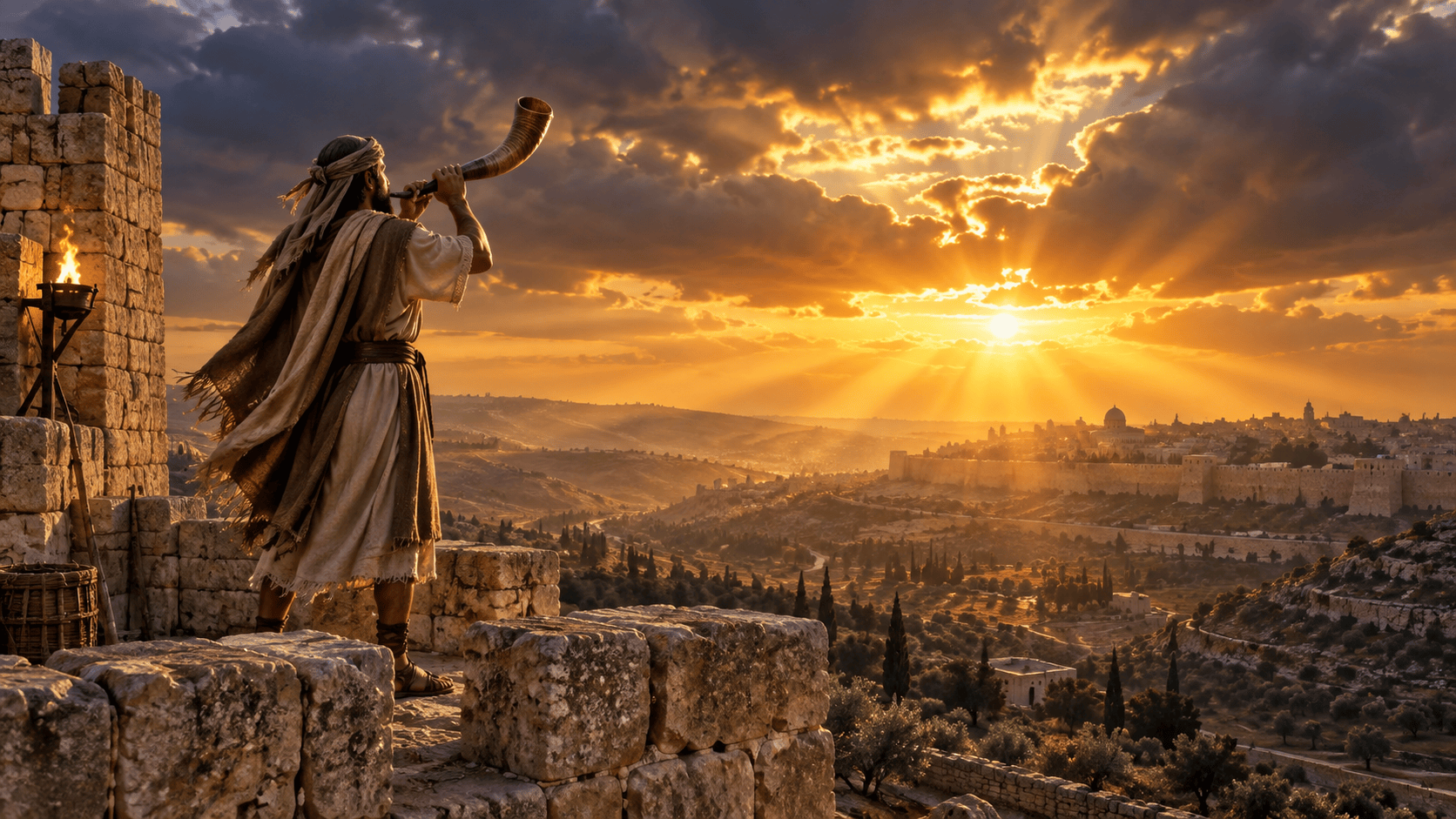
THE WATCHMAN AND THE WARNING
Ezekiel gives us perhaps the clearest picture of the trumpet as a warning.
“If when he seeth the sword come upon the land, he blow the trumpet, and warn the people…”
— Ezekiel 33:3
Notice the order.
The watchman sees danger approaching. Then he sounds the trumpet. Then the people must decide how they will respond.
The trumpet does not sound after everything is over.
It sounds before the approaching event, while there is still opportunity to hear the warning.
That principle becomes extremely important when we consider the prophetic meaning of Yom Teruah.
The trumpet says: Something is coming. Prepare yourself.
THE TRUMPET AND THE KING
Trumpets were not only associated with danger. They were also connected with the announcement of a king.
When Solomon was made king, David instructed:
“And let Zadok the priest and Nathan the prophet anoint him there king over Israel: and blow ye with the trumpet, and say, God save king Solomon.”
— 1 Kings 1:34
The trumpet announced the king.
Psalm 47 contains an even more striking image:
“God is gone up with a shout, Yahuwah with the sound of a trumpet.”
— Psalm 47:5
So the biblical trumpet can announce both: warning and kingship.
That combination becomes very significant when we look toward the return of Yahushua.
The alarm sounds. The King approaches.
THE TRUMPET AND THE DAY OF YAHUWAH
The prophets repeatedly connect trumpet imagery with the approaching Day of Yahuwah.
Joel declares:
“Blow ye the trumpet in Zion, and sound an alarm in my holy mountain… for the day of Yahuwah cometh, for it is nigh at hand.”
— Joel 2:1
Again, notice the sequence. The trumpet sounds because the Day is approaching.
Zephaniah similarly describes the Day of Yahuwah as:
“A day of the trumpet and alarm…”
— Zephaniah 1:16
The trumpet therefore becomes a prophetic signal. It announces that ordinary life cannot continue indefinitely.
Judgment approaches. The King is coming. Yahuwah’s people are being called to attention.
YAHUSHUA AND THE GREAT TRUMPET
Yahushua Himself connects His future gathering of the elect with a trumpet:
“And he shall send his angels with a great sound of a trumpet, and they shall gather together his elect…”
— Matthew 24:31
Paul uses the same imagery:
“For the Lord himself shall descend from heaven with a shout, with the voice of the archangel, and with the trump of Elohim…”
— 1 Thessalonians 4:16
And again:
“In a moment, in the twinkling of an eye, at the last trump… the dead shall be raised incorruptible…”
— 1 Corinthians 15:52
There is therefore no question that trumpet imagery is deeply connected with Yahushua’s return, resurrection and gathering.
But we should be careful not to make Scripture say more than it actually says.
None of those passages specifically says:
“Yahushua will return on the Feast of Trumpets.”
That distinction matters.
The trumpet is present The gathering is present. The resurrection is present. The King is approaching.
But Scripture never explicitly identifies the first day of the seventh month as the exact date of Yahushua’s return.
Yom Teruah has a different role.
It is the alarm announcing the final sequence, rather than every final event occurring on that single appointed day.
THE SEVENTH-MONTH SEQUENCE
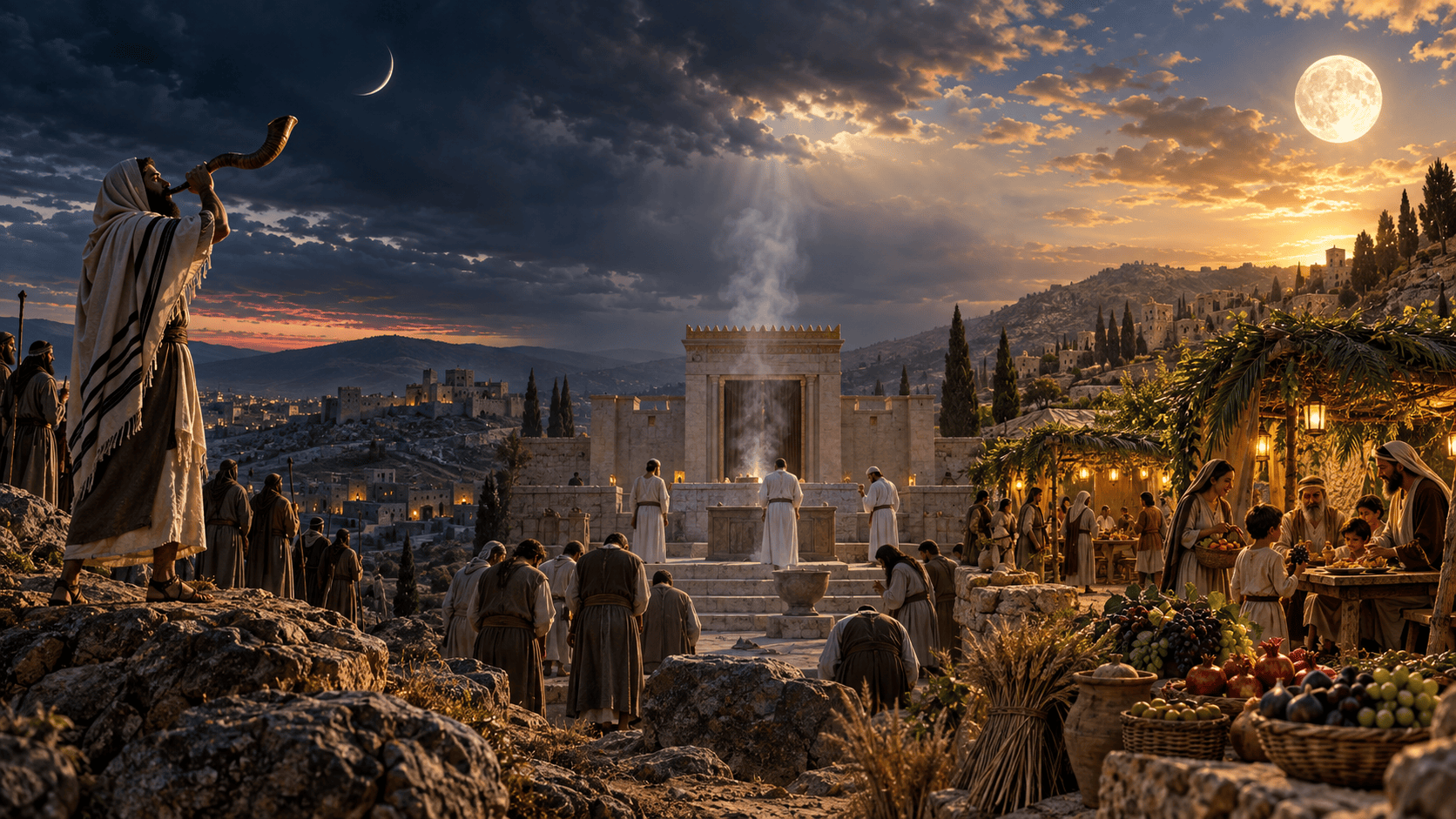
Consider the order Yahuwah established in the seventh month:
Day 1 — Trumpets
Day 10 — Atonement
Day 15 — Tabernacles
This sequence is remarkable.
Trumpets comes first.
Then Atonement.
Then Tabernacles.
Prophetically we can see a powerful progression:
warning and announcement → judgment and reconciliation → ingathering and dwelling
Trumpets awakens.
Atonement confronts sin, judgment and reconciliation.
Tabernacles speaks of gathering and dwelling with Yahuwah.
That progression makes excellent sense if Yom Teruah represents the warning that the final prophetic events are approaching.
The alarm sounds first.
IS TRUMPETS THE FINAL HARVEST?
This question becomes particularly important when we consider the biblical harvest pattern.
Yahushua says:
“The harvest is the end of the world…”
— Matthew 13:39
Paul calls Yahushua:
“Christ the firstfruits of them that slept.”
— 1 Corinthians 15:20
First Fruits therefore has a clear connection with Messiah’s resurrection.
Then Scripture identifies Shavuot which many know as Pentecost, with the wheat harvest:
“The feast of weeks, of the firstfruits of wheat harvest…”
— Exodus 34:22
And Yahushua specifically uses wheat in His end-of-the-age harvest parable.
Revelation 14 also presents a grain harvest followed by a separate grape judgment. So Scripture already gives us a substantial harvest framework.
That raises an important question.
Why should we move the entire final harvest to Yom Teruah simply because a trumpet sounds? A trumpet can announce a harvest without itself being the harvest.
That would be entirely consistent with the trumpet’s function throughout Scripture.
The alarm comes first. The event follows.
THE MIDNIGHT CRY
Yahushua’s parable of the ten virgins fits the theme of Yom Teruah remarkably well.
Ten virgins wait for the bridegroom.
Five are wise. Five are foolish.
Then suddenly:
“And at midnight there was a cry made, Behold, the bridegroom cometh; go ye out to meet him.”
— Matthew 25:6
The cry wakes everyone. But the cry does not make them ready. It reveals who was already prepared.
That distinction is crucial.
The wise virgins had oil. The foolish discovered too late that they were not prepared.
Preparation cannot be left until the alarm sounds. When the cry finally comes, there is no longer time to begin the entire preparation process.
That is precisely the purpose of a warning.
YAHUWAH WARNS BEFORE HE ACTS
This pattern appears again and again throughout Scripture.
Noah was warned before the Flood.
Abraham was informed before the destruction of Sodom.
Moses was told what Yahuwah was about to do before Egypt was judged.
Prophets were sent to Israel before judgment came.
The watchman sounded his trumpet before the sword struck.
Amos expresses the principle:
“Surely the Lord Yahuwah will do nothing, but he revealeth his secret unto his servants the prophets.”
— Amos 3:7
Yahuwah does not delight in His people walking blindly toward destruction.
He warns. He reveals. He calls people to repentance.
Hosea says:
“My people are destroyed for lack of knowledge: because thou hast rejected knowledge…”
— Hosea 4:6
Notice that the problem is not simply lack of information.
The knowledge had been rejected. There is an important difference between not knowing and refusing to hear.
A MEMORIAL OF TERUAH
Leviticus calls Yom Teruah a:
“memorial of teruah.”
The Hebrew word translated memorial is zikaron, carrying the idea of remembrance. Numbers 10 gives us an interesting parallel.
When the trumpet was sounded in battle:
“Ye shall be remembered before Yahuwah your Elohim…”
— Numbers 10:9
And regarding the trumpet at appointed occasions:
“They shall be to you for a memorial before your Elohim…”
— Numbers 10:10
That introduces another dimension to Yom Teruah:
remembrance.
Yahuwah remembers His covenant. His people remember Yahuwah. The trumpet calls everyone back to attention.
THE FINAL TRUMPET AND THE KINGDOM
Eventually trumpet imagery reaches one of its greatest prophetic expressions in Revelation:
“And the seventh angel sounded; and there were great voices in heaven, saying, The kingdoms of this world are become the kingdoms of our Lord, and of his Messiah; and he shall reign for ever and ever.”
— Revelation 11:15
Here the trumpet announces kingdom. The King receives His dominion.
Throughout Scripture we therefore find the same themes returning:
warning
awakening
gathering
remembrance
judgment
kingship
These themes help us understand what Yom Teruah may be prophetically announcing.
WHAT YOM TERUAH IS TELLING US
I do not believe Scripture requires us to conclude that Yahushua must physically return on Yom Teruah simply because His return is accompanied by a trumpet. The wheat harvest is for that.
Instead, I believe Yom Teruah carries something broader and perhaps even more profound.
It is Yahuwah’s alarm.
It says:
Wake up.
Watch.
Listen.
Prepare.
The King is approaching.
Judgment is coming.
The harvest is nearing.
Do not be asleep when the cry is heard.
This also fits beautifully with the order of the seventh-month appointments:
Trumpets announces.
Atonement judges and reconciles.
Tabernacles gathers and dwells.
HOW WAS YOM TERUAH IDENTIFIED?
After understanding what the day means, there remains an important practical question.
Yom Teruah occurs on the: first day of the seventh new moon.
So how did Yahuwah’s people know when that day was approaching?
This brings us back to the calendar Yahuwah established.
Genesis says:
“Let there be lights in the firmament of the heaven… and let them be for signs, and for seasons, and for days, and years.”
— Genesis 1:14
The Hebrew translated seasons is moedim — appointed times.
Psalm 104 says:
“He appointed the moon for seasons…”
— Psalm 104:19
The moon therefore has a direct relationship with Yahuwah’s appointed times.
And Yom Teruah is especially significant because it occurs on the first day of the seventh new moon.
THE SIGN BEFORE THE APPOINTED DAY
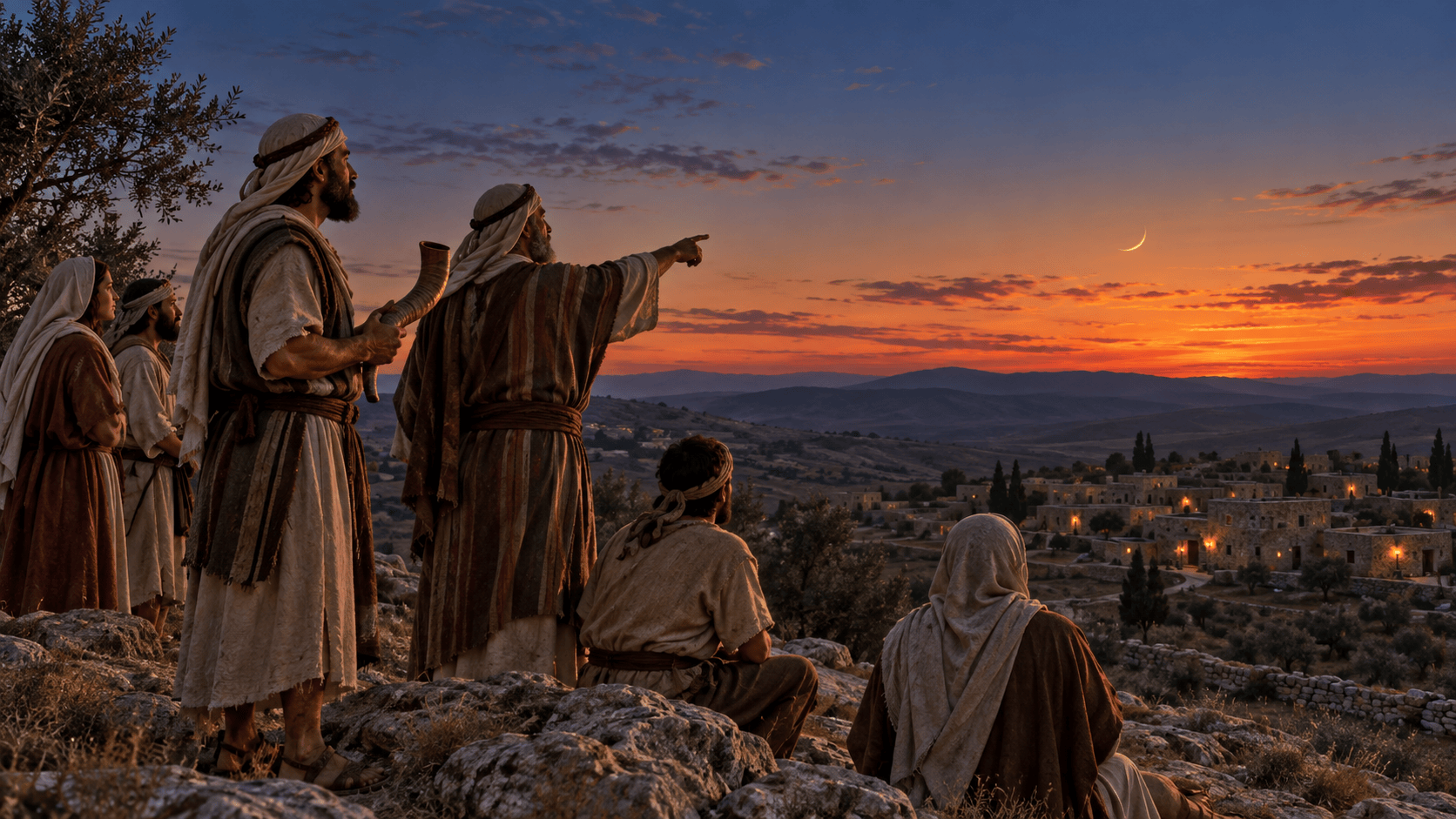
I believe the first visible crescent functions as the visible sign announcing that New Moon Day is approaching.
The crescent itself is not New Moon Day in my understanding. It is the sign before it.
That fits the biblical function of a sign remarkably well as we see in Genesis 1:14.
A sign communicates something.
It points toward something.
It gives knowledge.
The watchman sees the approaching danger before sounding his trumpet.
The trumpet warns the people before the sword arrives.
Likewise, the heavens can provide a visible announcement that an appointed day is approaching.
The account of David and Jonathan is particularly interesting:
“Behold, tomorrow is the new moon…”
— 1 Samuel 20:5
David knew beforehand that the following day would be New Moon.
The passage does not explicitly tell us how that knowledge had been established, so we should not force a method into the text that it does not state.
But it does establish something important:
New Moon could be known before New Moon Day arrived.
That fits naturally with the first visible crescent functioning as an announcement.
The sign appears.
The approaching day is identified.
The appointed time follows.
WHY I DO NOT BEGIN THE MONTH AT INVISIBLE CONJUNCTION
Some believe New Moon begins at astronomical conjunction.
But conjunction is not ordinarily visible to the naked eye. It is hidden.
It is an astronomical moment when the moon lies approximately between the earth and sun.
Today that instant can be calculated using clocks, mathematics, astronomical tables and computer software.
Ancient Israel did not possess those things.
But Israel did possess the thing Yahuwah Himself placed in the heavens:
a visible sign.
That is why I believe the observable crescent fits the biblical pattern much more naturally.
Yahuwah’s people could actually look.
They did not need an atomic clock.
They did not need astronomical software.
They did not need to calculate an invisible instant.
The heavens themselves announced that the appointed day was approaching.
THE SIGN AND THE TRUMPET TELL THE SAME STORY
This brings the study together beautifully.
The visible crescent announces the approaching appointed day.
The trumpet announces approaching events.
The watchman sounds his warning before danger arrives.
The prophets warn before judgment.
The midnight cry comes before the bridegroom is met.
Again and again we see the same principle:
sign → announcement → preparation → event
And this may be one of the deepest lessons contained within Yom Teruah.
Yahuwah does not merely tell His people that something happened.
He calls them to watch beforehand.
The heavens announce.
The trumpet sounds.
The people prepare.
The King approaches.
CONCLUSION
Yom Teruah is far more than an ancient ceremonial observance.
It is a prophetic alarm.
Its trumpet imagery speaks of warning, gathering, remembrance and kingship.
The prophets connect the trumpet with the approaching Day of Yahuwah.
Yahushua connects His gathering with a great trumpet.
Paul connects the resurrection with the last trumpet.
Revelation connects the trumpet with the establishment of the Kingdom.
Yet Scripture never explicitly says that Yom Teruah itself must be the exact day on which Yahushua returns.
Perhaps that is because its function is different.
Perhaps it is the warning before the event.
The watchman sees what is coming.
The trumpet sounds.
The wise prepare.
The sleeping awaken.
The King approaches.
And the question is therefore not merely:
Can we hear the trumpet?
The far more important question is:
When Yahuwah sounds the alarm, will we be ready?
“Blow ye the trumpet in Zion, and sound an alarm in my holy mountain… for the day of Yahuwah cometh, for it is nigh at hand.”
— Joel 2:1
View the next article here:
References
Passover (Pesach) – Deliverance through the Lamb
- Exodus 12:1–14 – Original institution of Passover in Egypt
- Leviticus 23:5 – Command for annual observance
- Numbers 9:1–5 – Passover kept in the wilderness
- Deuteronomy 16:1–8 – Observance in the land
- John 1:29 – “Behold, the Lamb of God…”
- Matthew 26:17–29 – The Last Supper at Passover
- 1 Corinthians 5:7 – “Messiah our Passover is sacrificed for us”
- Revelation 5:6–9 – The Lamb slain and exalted
Unleavened Bread (Chag HaMatzot) – The removal of sin
- Exodus 12:15–20 – Command to remove leaven
- Leviticus 23:6–8 – Feast of Unleavened Bread instituted
- Deuteronomy 16:3–4 – “Bread of affliction” reminder
- 1 Corinthians 5:6–8 – “Purge out the old leaven”
- 2 Corinthians 5:21 – Messiah who “knew no sin”
- John 19:31–42 – Yahshua’s body laid in the tomb during this feast
First Fruits (Yom HaBikkurim) – Resurrection and new life
- Leviticus 23:9–14 – Offering the first sheaf of barley
- Exodus 23:19 – “First of the firstfruits” offered to Yahuwah
- 1 Corinthians 15:20–23 – Messiah the “firstfruits” of the resurrection
- Matthew 28:1–6 – Resurrection on First Fruits
- John 20:1–18 – The risen Messiah appears
- Romans 8:23 – Believers as “firstfruits” awaiting redemption
- James 1:18 – “A kind of firstfruits of His creatures”
Shavuot (Pentecost) – The wheat harvest and the Spirit
- Leviticus 23:15–22 – Count fifty days and offer new grain
- Deuteronomy 16:9–12 – Count from putting the sickle to the grain
- Exodus 19:1–8 – Torah given at Sinai (also in the third month)
- Acts 2:1–4 – Spirit poured out at Pentecost
- Daniel 12:11–13 – 1,335 days and the end-time harvest
- Jubilees 1:1; 15:1; 16:13 – Covenant and harvest timing
- Matthew 13:39 – “The harvest is the end of the age”
- Joel 3:13 – “Put in the sickle, for the harvest is ripe”
- Revelation 14:15–16 – “The harvest of the earth was reaped”
Trumpets (Yom Teruah) – The alarm and awakening
- Leviticus 23:23–25 – Command for the day of blowing trumpets
- Numbers 29:1–6 – Sacrifices for the day
- Psalm 81:3 – Blow the trumpet at the new moon
- Joel 2:1 – “Blow the trumpet in Zion”
- Amos 3:6 – Trumpet as warning of Yahuwah’s actions
- Matthew 25:1–13 – Parable of the ten virgins (awakening call)
- Revelation 8–11 – Seven trumpets preceding judgment
- 1 Thessalonians 4:16 – “The trumpet of Elohim”
- 1 Corinthians 15:52 – “At the last trumpet… we shall be changed”
Atonement (Yom Kippur) – Judgment and separation
- Leviticus 16 – Two goats, atonement ritual
- Leviticus 23:26–32 – Day of afflicting the soul
- Numbers 29:7–11 – Sacrifices for Yom Kippur
- Hebrews 9:11–28 – Messiah as High Priest entering once for all
- Revelation 20:11–15 – Great white throne judgment
- Revelation 7:3–4 – Sealing of Yahuwah’s servants
- Ezekiel 9:4–6 – Mark on the foreheads of the faithful
- Matthew 25:31–46 – Sheep and goats separated
- Revelation 14:12 – “Those who keep the commandments of Yahuwah”
Tabernacles (Sukkot) – Dwelling with His people
- Leviticus 23:33–43 – Command to dwell in booths
- Deuteronomy 16:13–17 – Rejoicing at the Feast of Booths
- Nehemiah 8:14–18 – Restoration of Sukkot observance
- Zechariah 14:16–19 – Nations required to keep Sukkot in the Kingdom
- John 7:2, 14, 37 – Yahshua teaches during Sukkot
- Revelation 21:3–4 – “The tabernacle of Elohim is with men”
- Isaiah 4:5–6 – Yahuwah’s shelter over His people
Leave a Reply