
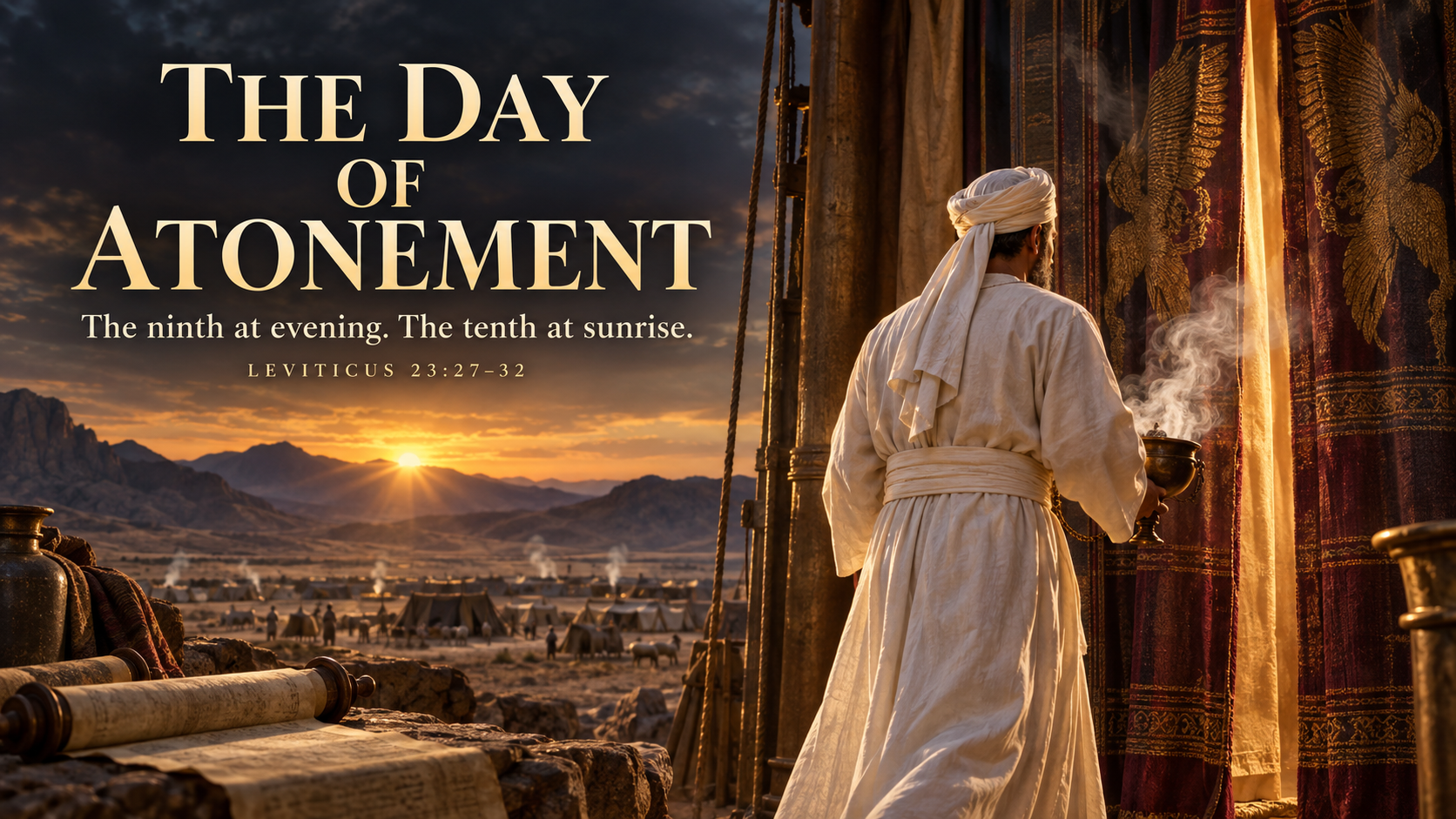
The instructions for the Day of Atonement contain an important distinction: Yahuwah appoints the tenth day for atonement, yet commands the observance to begin on the ninth day at evening.
These dates must be read together. The ninth cannot be treated as the tenth, and the evening belonging to one numbered day cannot simply be reassigned without explanation.
When the day is counted from sunrise, the sequence fits: the observance begins on the ninth at evening, continues through the night, enters the tenth at sunrise, and concludes that evening.
Consider the words of Scripture.
Leviticus 23:27 states:
“Also on the tenth day of this seventh month there shall be a day of atonement…”
The appointed day is the tenth.
Verse 32 then specifies:
“…in the ninth day of the month at even, from even unto even, shall ye celebrate your sabbath.”
The starting point is identified with the ninth, and the observance continues from evening to evening. Both instructions must be honoured. Leviticus 23:27–32, KJV.
We cannot focus on “from even unto even” while overlooking “in the ninth day.” The dates are essential to understanding the sequence.
With a sunrise beginning, the ninth starts in the morning. Its daylight hours pass, and evening arrives while it is still the ninth.
At that evening, the observance begins.
The night follows and remains part of the ninth. At the next sunrise, the tenth begins. The observance continues through the daylight of the tenth and ends that evening.
| Point in time | Numbered day | Observance |
|---|---|---|
| Sunrise | Ninth begins | Has not begun |
| Evening | Still the ninth | Begins |
| Following sunrise | Tenth begins | Continues |
| Following evening | Still the tenth | Ends |
The starting evening belongs to the ninth. The following daylight belongs to the tenth. The observance includes both, exactly as the two dates in the instruction require under this reading.
Now place the beginning of the numbered day at evening.
If the evening identified as the ninth begins the ninth, then the night that follows belongs to the ninth. The following daylight also belongs to the ninth.
At the next evening, the tenth begins—but the commanded evening-to-evening period has already reached its end.
| Point in time | Numbered day if evening begins it | Observance |
|---|---|---|
| Evening | Ninth begins | Begins |
| Following sunrise | Still the ninth | Continues |
| Following evening | Tenth begins | Ends |
The problem is clear: beginning the observance at the evening that starts the ninth places the entire observance on the ninth. The tenth has not been included.
The tenth cannot fulfil its appointed place in that sequence because the observance ends at the very moment the tenth arrives.

The sunrise sequence uses the same boundary throughout. The ninth begins at sunrise. The tenth begins at the following sunrise. Evening occurs within each numbered day.
There is also an essential distinction between the boundaries of a numbered day and the boundaries of a commanded observance.
The expression “from even unto even” tells us when this observance begins and ends. It does not itself say that every numbered day begins and ends at those same points.
Here, the observance begins during the ninth and continues into the tenth. Its evening-to-evening duration crosses the sunrise boundary between those dates.
This explains the instruction to begin on the ninth. The people are to enter the period of solemn rest and affliction that evening, before the daylight of the appointed tenth arrives.
The ninth is therefore not an incidental detail. It tells us where the observance begins in relation to the tenth.
Read the instruction as a complete sequence:
The ninth begins at sunrise.
On the ninth at evening, the observance begins.
The night passes.
At sunrise, the tenth begins.
The observance continues through the tenth’s daylight and concludes that evening.
The observance runs from evening to evening; the numbered days run from sunrise to sunrise.
This is the distinction illustrated by the Day of Atonement timeline. When the starting evening is placed within the ninth and the following morning begins the tenth, both dates retain their place, and the appointed tenth is included.
Quite simply, if you start your day at Even, then you cannot have the day of atonement as you will miss the entire 10th day.
Leave a Reply