

We live in a world where the calendar and clock feel unshakable. Monday follows Sunday, months have familiar names, and the year always starts on January 1. Our phones tell us the time down to the second, no matter where we are on Earth. It feels absolute, even scientific. But behind this seemingly stable system lies a web of human decisions — debates, decrees, and compromises — that shaped how the world measures time.
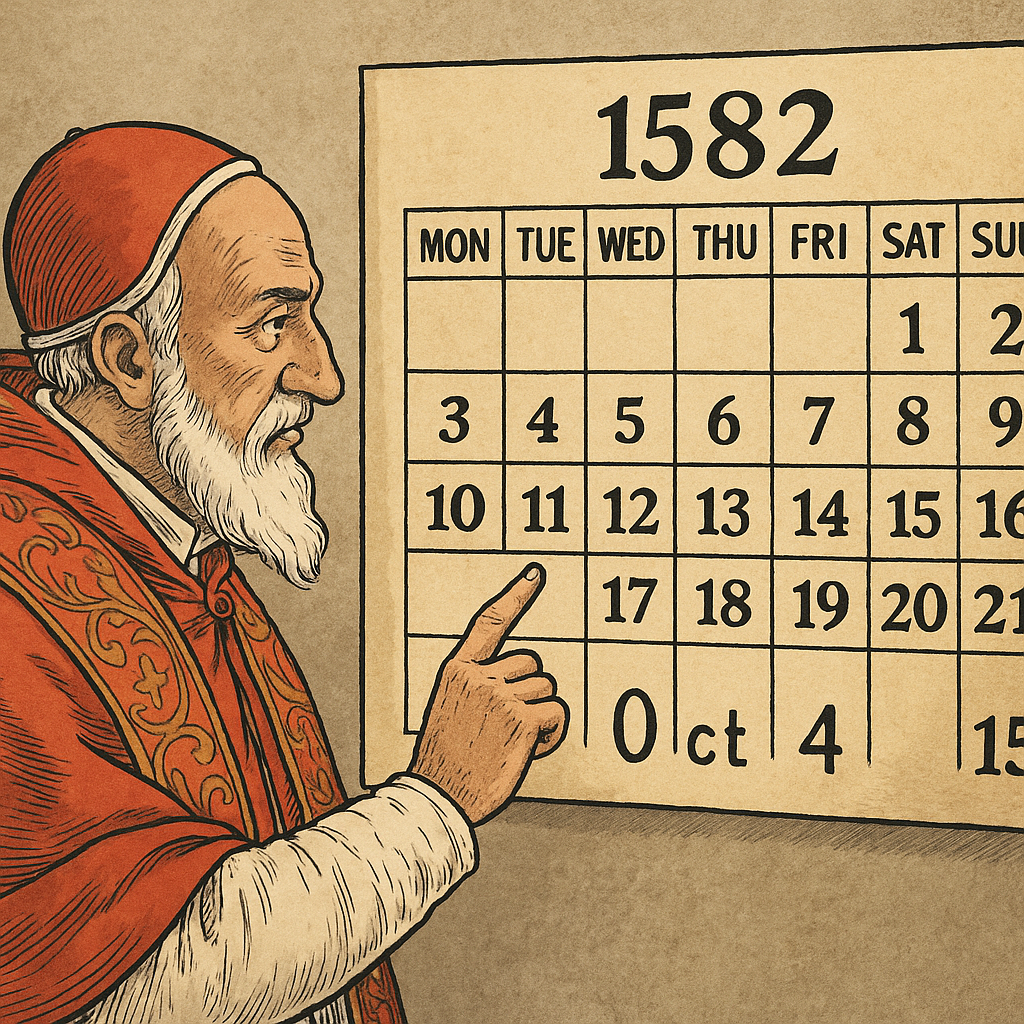
Today, nearly every nation uses the Gregorian calendar, a reform of the older Julian calendar introduced by Pope Gregory XIII in 1582. This calendar tracks the solar year — the time it takes Earth to orbit the sun — and keeps our seasons aligned with the same dates year after year. It is efficient, predictable, and perfectly suited to modern industry, agriculture, and international communication. But it is also entirely man-made.
The Bible, by contrast, describes a calendar woven into creation itself. In Genesis 1:14, Yahuwah declares:
“And Elohim said, ‘Let there be lights in the expanse of the heavens to separate the day from the night. And let them be for signs and seasons [moedim], and for days and years.’”
These “signs” — the sun, moon, and stars — were meant to govern time. Yet the Gregorian calendar relies solely on the sun and ignores the moon entirely. It begins days at midnight by convention, not by Yahuwah’s markers of sunset or dawn. It detaches months from the lunar cycle, erasing the “new moon day” that anchors time in Scripture. And it fixes global time zones and date boundaries along political lines — decisions made by men, not by heaven.
Before we explore these differences more deeply, we must understand how humanity arrived at this system — and why, despite its near-universal use, it is not truly universal at all.
The Rise and Dominance of the Gregorian Calendar
The calendar that now governs nearly every corner of the globe did not descend from heaven — it was built by men, layer upon layer, over centuries. Its story is one of political power, religious influence, and the growing demand for order in an increasingly connected world.
From Julius Caesar to Pope Gregory XIII
The calendar most of the ancient Roman world used was the Julian calendar, introduced by Julius Caesar in 46 BCE. It was a purely solar calendar, designed to align the civil year with the seasons by averaging the solar year to 365.25 days. While this was a remarkable improvement over older Roman systems, the extra quarter day accumulated over centuries, slowly shifting the calendar out of sync with the equinoxes.
By the 16th century, this drift was causing serious problems for the Church. The date of Easter, tied to the spring equinox and the first full moon thereafter, was slipping further from its intended season. To correct the error, Pope Gregory XIII decreed a reform in 1582, removing ten days from the calendar and revising the leap-year system. This Gregorian calendar more closely matched the solar year (365.2425 days) and fixed the date of Easter within the Church’s preferred range.
At first, Protestant and Orthodox regions resisted this “papal calendar,” but as global trade, science, and communication expanded, its practicality won out. By the 20th century, nearly the entire world — even non-Christian nations — had adopted the Gregorian system for civil use.
Why It Became Universal
The Gregorian calendar’s global dominance did not come about merely because it was accurate. It triumphed because it fit the needs of empire, commerce, and industry. European colonial powers imposed it across their territories. International treaties and scientific standards cemented it as the common language of time. And as mechanical clocks, steamships, and telegraphs shrank the world, a shared calendar became essential for coordination.
Another reason for its success is that it eliminates uncertainty. Months have fixed lengths (28–31 days), the year always begins on January 1, and weeks roll on continuously. Unlike a lunar calendar, which requires observation of the new moon and can vary in length, the Gregorian system is entirely predictable. It allows societies to plan work, school, taxation, and trade years in advance without relying on the skies.
Yet in this convenience lies its greatest departure from Yahuwah’s design. The biblical calendar depends on signs in the heavens — events like the new moon and the ripening of barley in the spring. These events cannot be known far in advance with absolute certainty. They require watchfulness and participation in creation. The Gregorian calendar, by contrast, divorces time from creation entirely (and at the same time – the creator) and turns it into a closed, mechanical cycle.
Isaiah 55:8–9 (KJV)
“For my thoughts are not your thoughts, neither are your ways my ways,” saith the LORD (Yahuwah).
For as the heavens are higher than the earth, so are my ways higher than your ways, and my thoughts than your thoughts.”
This shift is not merely practical — it is deeply spiritual. In replacing the calendar anchored to Yahuwah’s appointed signs with one that can run without Him, humanity has replaced divine timekeeping with human control. What was once a dynamic relationship with creation has become a fixed grid on a printed page.
As the scripture says, the heavens are higher than the earth and it was the heavens that provided his clock, not the earth and not ourselves.
Other Calendar Systems Still in Use Today
Although the Gregorian calendar dominates global business, politics, and daily life, it is not the only way humans mark time. Across the world, ancient systems still endure — some rooted in lunar cycles, others in lunisolar calculations, many preserving traditions that predate Rome by millennia. Their continued use is a powerful reminder that time is not universal — it is interpreted differently by different peoples.
The Islamic (Hijri) Calendar – Purely Lunar
The Islamic calendar, first established in the 7th century CE, is based entirely on the lunar cycle. Each month begins with the sighting of the new crescent moon, and a year consists of 12 lunar months — about 354 days. Because this is shorter than the solar year, Islamic months drift backward through the seasons over a 33-year cycle. This is why Ramadan and other Islamic observances occur in different seasons from year to year.
Crucially, the Islamic calendar requires observation — in many communities, religious authorities still wait for verified sightings of the crescent moon before declaring a new month. This preserves a direct link between sacred time and the heavens.
The Hebrew (Jewish) Calendar – Lunisolar Roots
The Hebrew calendar is a lunisolar system — it uses the moon to mark months and the sun to anchor the year to the seasons. Months begin with the new moon, and an extra month is added seven times every 19 years to keep the festivals aligned with the agricultural cycle.
In ancient Israel, this calendar was determined not by mathematical calculation but by eyewitness testimony. As Arthur Spier records in The Comprehensive Hebrew Calendar:
“The beginning of the months were determined by direct observation of the new moon. Then those beginnings of months (Rosh Hodesh) were sanctified and announced by the Sanhedrin, the Supreme Court in Jerusalem, after witnesses testified that they had seen the new crescent…” (Spier, p. 1)
Similarly, The Universal Jewish Encyclopedia confirms:
“The months of the year were lunar, and began with the new moon.” (UJE, “Calendar,” p. 631)
This observational process kept Israel’s time anchored directly to Yahuwah’s signs in the heavens. Today, however, the Hebrew calendar is determined by calculation rather than observation — a change made under Roman rule in the 4th century CE when public declaration was forbidden.
The Chinese Calendar – Ancient Lunisolar Precision
The Chinese calendar, used for traditional festivals and astrology, is another lunisolar system. Months begin with the new moon, and leap months are added to keep the year aligned with the solar cycle. This calendar has been in continuous use for over 2,000 years and remains central to cultural events such as the Lunar New Year.
Other Traditional Calendars
Many cultures still preserve their ancestral timekeeping systems. The Hindu calendar uses both lunar and solar cycles, while the Ethiopian calendar maintains a different year count and seven-year offset from the Gregorian system. Even the modern astronomical year numbering used by scientists differs subtly in its reckoning.
Each of these systems reveals the truth that there is no single “natural” way to measure time. What we accept as universal is, in reality, just one choice among many — and it is not the one Scripture describes.
Time Zones and the International Date Line: Man’s Lines in the Sand
If the Gregorian calendar is a man-made structure laid over the heavens, then modern time zones and the International Date Line are the fence posts that hold it in place. Both are inventions — created seen in nature or Scripture, but by human agreement.
The Invention of Time Zones
Before the 19th century, each city kept its own local time based on the position of the sun. Noon was simply the moment the sun reached its highest point in the sky. But as railways, telegraphs, and global communication networks spread, this patchwork of local times became impractical. Trains needed standardised schedules; businesses needed coordinated hours.
The solution was born at the International Meridian Conference held in Washington, D.C., in 1884, where representatives from 25 nations agreed to adopt Greenwich, England, as the Prime Meridian (0° longitude) and divide the world into 24 time zones, each roughly 15° of longitude apart. This decision laid the foundation for the system we still use today — one based entirely on human convention rather than any natural phenomenon.
Time zones solved practical problems but at a cost: they detached time from the natural rhythm of the heavens. Noon is no longer when the sun is overhead; it is simply when the clock says 12:00. Two places under the same sky can now be on different “days” entirely.
The International Date Line – A Man-Made Divider
Even more revealing is the International Date Line (IDL) — an imaginary line that runs mostly along the 180° meridian in the Pacific Ocean. Cross it from east to west, and you “gain” a day; cross west to east, and you “lose” one. Yet this line is not fixed by nature — it bends and curves around island nations for political and economic convenience.
A striking example occurred in 2011, when the nation of Samoa shifted the date line to align its calendar with Australia and New Zealand, skipping December 30 entirely. In a single night, a Friday became a Saturday — not because the heavens changed, but because a government decree said so. (“Samoa skips Friday and moves to the other side of the International Date Line,” BBC News, Dec. 29, 2011.)
This demonstrates a crucial truth: the modern structure of time is arbitrary and negotiable. It is a tool of human convenience, not a reflection of divine order.
The Biblical Contrast – Days, Months, and Years in Motion
In Scripture, time is never determined by imaginary lines or political decisions. It is determined by observable signs:
- A day is marked by “Light then evening and morning” (Genesis 1:3-5) — dawn to dawn, not midnight to midnight.
- A month begins with the new moon (Numbers 10:10, 1 Samuel 20:5).
- The year is anchored by the spring harvest and the ripening of barley (Exodus 12:2, Deuteronomy 16:1).
These events are not fixed to a man-made grid — they move across the earth. Where the new moon is first visible depends on location, weather, and celestial mechanics. This means the “start” of a biblical month is not a fixed global moment like midnight or 00:00 UTC. It shifts with the heavens themselves.
This dynamic nature is difficult for many to grasp because the Gregorian system is built on rigid, artificial boundaries. A day begins at midnight, the date line is fixed, and months are independent of the sky. But in Yahuwah’s design, time is alive — a rhythm written into creation that moves as the heavens move.
This is why, when overlaying the biblical new moon on the Gregorian calendar, a biblical day can stretch across two Gregorian days. The new month may begin at different times in different parts of the world, creating a dynamic flow of time rather than a fixed grid.

It’s also vital to understand that where the new moon is first visible depends on where you are on the earth. Because the moon’s visibility is influenced by both its orbit and Earth’s curvature, the thin crescent often becomes visible first in regions closer to the western edge of the inhabited world — such as the Middle East or Africa — and then progressively later as the earth rotates eastward.
This means that the start of the biblical month may not occur on the same Gregorian date worldwide. In some regions, the new moon might be seen on a Monday evening, while in others it may not appear until Tuesday evening. This is not an error — it’s a feature of Yahuwah’s design. His calendar is not bound to a single man-made date line or fixed global moment. Instead, it is woven into creation itself, unfolding naturally as the heavens reveal their signs across the face of the earth.mic flow of time rather than a fixed grid.
Why This Matters and How It Differs From Biblical Reckoning
It is tempting to view calendars and time zones as harmless tools — neutral systems created for convenience. But Scripture shows us that time is not just a human construct; it is one of the first things Yahuwah (God) sanctified and wove into the fabric of creation. It is also one of the primary ways He communicates His plan and His appointed times to humanity.
Time by Heaven’s Design
From the very beginning, Yahuwah set the sun, moon, and stars in the heavens as markers of sacred time:
“And Elohim said, ‘Let there be lights in the expanse of the heavens to separate the day from the night. And let them be for signs and for seasons [moedim — appointed times], and for days and years.’” – Genesis 1:14
This verse establishes the divine order:
- Days are measured by the turning of the earth, marked by sunrise and sunset.
- Months are tied to the cycle of the moon — the new moon begins a new month.
- Years are anchored to the sun’s path and the agricultural cycles it drives.
This system is observable, dynamic, and relational. It requires humanity to look upward and remain attentive to Yahuwah’s signs. It is a calendar that invites participation — a living dialogue between Creator and creation.
The ancient world understood this deeply. As The Universal Jewish Encyclopedia records:
“Each lunar month was divided into four parts, corresponding to the four phases of the moon. The first week of each month began with the new moon, so that, as the lunar month was one or two days more than four periods of seven days, these additional days were not reckoned at all.” (UJE, Vol. 10, p. 482, “Week”)
Likewise, the Encyclopedia Biblica observes:
“The four quarters of the Moon supply an obvious division of the month… it is most significant that in the older parts of the Hebrew scriptures the new moon and the sabbath are almost invariably mentioned together. The [lunar] month is beyond question an old sacred division of time common to all the Semites…” (Encyclopedia Biblica, 1899, pp. 4178–4179)
Even the philosopher Philo of Alexandria described the new moon as a sacred time, writing:
“The sacred festival of the new moon, which the people give notice of with the trumpets…” (Philo, Special Laws II, 141)
These historical records confirm that biblical timekeeping was rooted in the observable movements of the heavens, not in fixed mathematical grids.
This is why the appointed times — the moedim — cannot simply be mapped onto the Gregorian calendar without distortion. They are set by signs that do not align with man-made structures.
This living, observational system cannot be fully reconciled with the fixed, mechanical system that governs our clocks and calendars today. The two are built on different foundations: one divine and dynamic, the other human and static.
Conclusion: The Choice Between Man’s Time and Yahuwah’s Time
The way humanity keeps time today is a triumph of organisation — a global system that allows trains to run, businesses to coordinate, and nations to communicate. Yet for all its precision and usefulness, it is not the calendar of Scripture. It is a system built by men, maintained by governments, and enforced by international agreements. It serves commerce well, but it does not reflect the design Yahuwah established in creation.
The biblical reckoning of time is very different. It is not fixed to political boundaries or man-made lines. It does not begin days at midnight or months on arbitrary dates. Instead, it calls us to look up — to watch for the setting of the sun, then the first sliver of the new moon, and the turning of the seasons. It weaves us into creation’s rhythm and aligns us with the Creator’s appointed times.
This difference is not trivial. The moedim — Yahuwah’s appointed times — are central to His plan of redemption and the return of Yahshua (Jesus). They are rehearsals of events past and future, prophetic markers written into time itself. But to see them clearly, we must understand the calendar they are built upon. And that calendar is not the Gregorian system most of the world uses today.
Scripture warns us that “all the world wondered after the beast” (Revelation 13:3) — a sobering reminder that the world’s systems, even those that seem harmless or practical, can lead humanity away from the ways Yahuwah established. The prophet Daniel foresaw a power that would “speak great words against the Most High, and shall wear out the saints of the Most High, and think to change times and laws” (Daniel 7:25). These words are more than symbolic. The very fabric of time — days, months, and appointed seasons — has indeed been redefined by man-made authority.
Yet even as the world walks according to these altered times, Scripture reveals a small and faithful remnant who will not follow. In the final days, “here is the patience of the saints: here are they that keep the commandments of Elohim, and the faith of Yahshua” (Revelation 14:12). This 144,000 stand apart from the world’s systems, choosing instead to walk in Yahuwah’s rhythm, following His appointed times and commandments as they were set from the beginning.
Most of the world now follows a calendar and timekeeping system crafted by human hands, detached from the sun, moon, and stars Yahuwah placed in the heavens. Yet His appointed times remain unchanged, woven into creation itself and waiting to be rediscovered. To walk in step with His plan, we must first realign our understanding of time with the way He set it from the beginning.
In the next part of this series, we will step back into the ancient world and examine the calendar of Scripture itself — the luni-solar design revealed in the Torah and the Prophets, confirmed in the writings of the Apostles, and echoed throughout history. Only by returning to the way Yahuwah set time in motion can we begin to understand the significance of His appointed times and the mystery of the days leading to the return of Yahshua.
📚 References
Scripture References:
- Genesis 1:3 – “Then God said, “Let there be light”; and there was light.”
- Genesis 1:14 – “Let there be lights… for signs and seasons, and for days and years.”
- Exodus 12:2 – “This month shall be unto you the beginning of months…”
- Numbers 10:10 – “In the beginnings of your months you shall blow the trumpets…”
- 1 Samuel 20:5 – David speaks of the new moon as the start of a new month.
- Psalm 104:19 – “He made the moon to mark the seasons…”
- Daniel 7:25 – “…he shall think to change times and laws.”
- Revelation 13:3 – “And all the world wondered after the beast.”
- Revelation 14:12 – “Here is the patience of the saints: here are they that keep the commandments of God…”
Historical & Scholarly References:
- The Universal Jewish Encyclopedia (1943), “Calendar,” p. 631–632.
- The Universal Jewish Encyclopedia, “Week,” Vol. 10, p. 482.
- Encyclopedia Biblica (1899), pp. 4178–4179, 5290.
- Arthur Spier, The Comprehensive Hebrew Calendar, “Historical Remarks on the Jewish Calendar,” p. 1.
- George Foot Moore, Judaism, Vol. 2, p. 22.
- Hutton Webster, Rest Days, p. 243.
- Philo of Alexandria, Special Laws II, 141; Book 26, XXX, 159.
- Emil Schürer, The History of the Jewish People in the Age of Jesus Christ, p. 366.
- Theological Wordbook of the Old Testament, Vol. 1, p. 266.
- “The Jewish Calendar; Changing the Calendar,” Torah.org
- “Holidays,” Universal Jewish Encyclopedia, p. 410.
 The Calendar of Scripture