
Video of this article:
For those who prefer the presentation in video format, you can find it here:
Introduction – Humanity’s Search for Time
From the dawn of civilization, humanity has sought to measure time. The question has never been whether time exists, but how to reckon it: when does a day begin, when does a month start, how is a year counted? These questions shaped farming, worship, commerce, and empires.
Yet Scripture makes clear that the true measure of time comes from Yahuwah (יהוה):
“Then Elohim said, ‘Let there be lights in the expanse of the heavens to separate the day from the night, and let them be for signs and for appointed times (moedim), and for days and years.’”
— Genesis 1:14
From the very beginning, Yahuwah established the heavenly lights to govern sacred time. The sun, moon, and stars were not merely created to give light — they were appointed to mark days, months, years, and moedim (appointed times).
But as civilizations expanded and empires rose, humanity increasingly developed systems of its own. Some cultures followed the moon. Others followed the sun. Some attempted to combine both into increasingly sophisticated calendars. Over time, mankind moved further from direct observation of the heavens and toward systems governed by calculation, administration, and political control.
Today, nearly the entire world follows the Gregorian calendar — a fully solar system detached from the visible cycles of the moon. Yet this was not always the case. Ancient civilizations across Mesopotamia, Egypt, and the Mediterranean world once looked directly to the heavens in order to measure time.
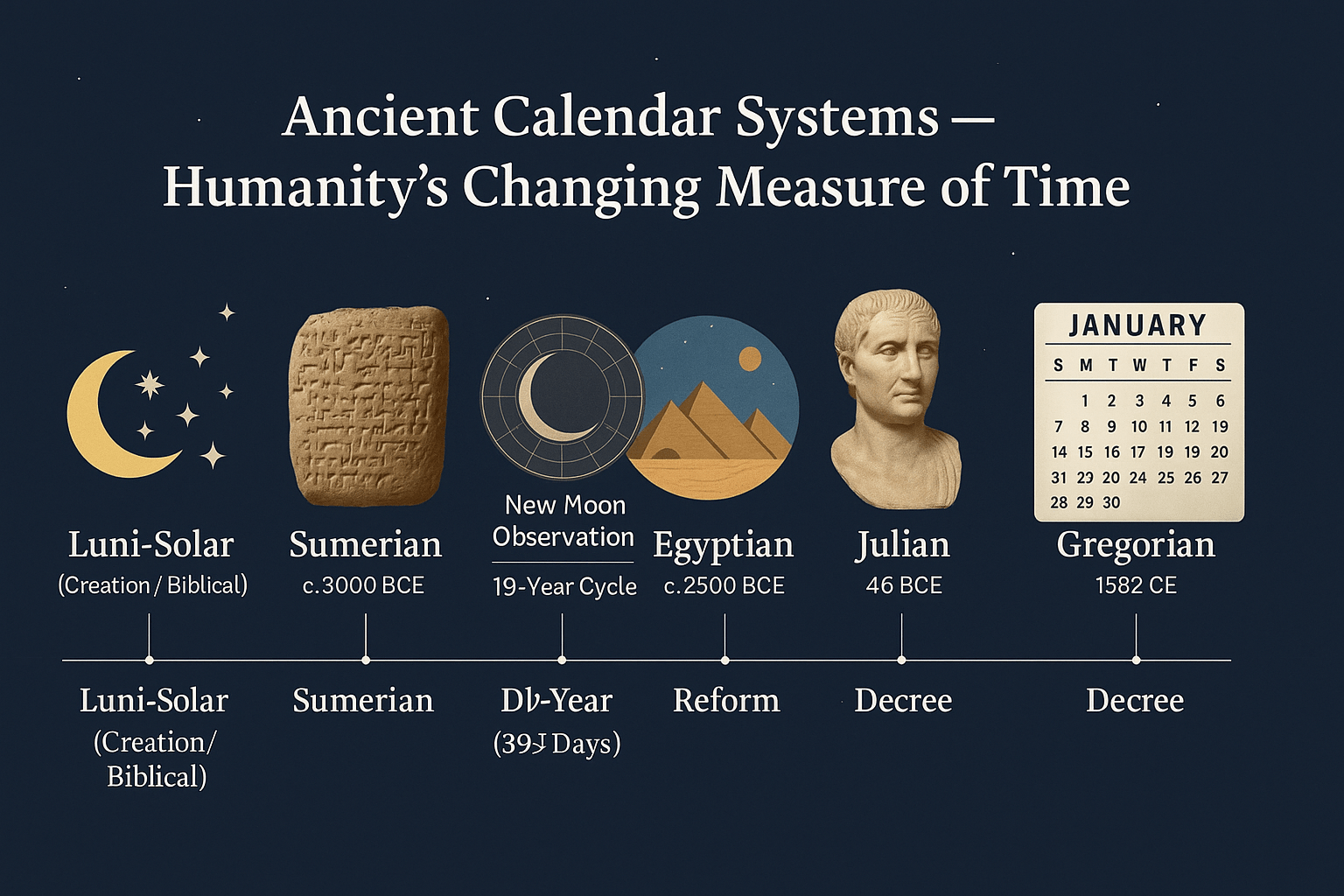
This article explores how humanity measured time before the Gregorian calendar — from the lunar reckoning of Sumer and Babylon to the solar systems of Egypt and Rome — before returning to the Biblical Calendar itself. Along the way, we will compare lunar, solar, and luni-solar systems and examine how Yahuwah’s design differs from the calendars mankind later established.
Most importantly, we will see that throughout all of history, despite changing kingdoms and shifting calendars, the heavens themselves have remained constant. The moon continues its cycles, the stars continue their appointed movements, and Yahuwah’s moedim remain woven into creation itself.
The Sumerian Calendar – Early Lunar Reckoning
Among the earliest civilizations known to history were the Sumerians of Mesopotamia, located in the region of modern-day Iraq between the Tigris and Euphrates rivers. Long before Rome, Greece, or modern astronomy, the Sumerians carefully observed the heavens in order to measure time.
Their calendar was primarily lunar. Each month began with the first visible crescent moon appearing after sunset. This thin crescent, barely visible at first, marked the beginning of a new cycle and became the foundation of their reckoning of months.
Cuneiform tablets dating back to the third millennium BCE reveal that the Sumerians organized their year around twelve lunar months, each consisting of either twenty-nine or thirty days depending on the moon’s cycle. But because a lunar year totals approximately 354 days — around eleven days shorter than the solar year — the Sumerians encountered a significant problem: seasonal drift.
Over time, their months gradually moved earlier against the agricultural seasons. Harvests no longer aligned properly with the calendar, creating difficulties for farming and civil administration. To correct this drift, the Sumerians occasionally inserted additional months into the calendar, a process later known as intercalation.
For its time, the system was remarkably sophisticated. Yet despite its complexity, it remained a human attempt to regulate time through observation and calculation.
Still, the Sumerian calendar preserved one important principle: the beginning of the month was tied directly to the visible new moon. Even among the earliest civilizations, humanity understood that time was connected to the heavens.
While the Sumerian system came long after the pattern Yahuwah established in creation, it nevertheless reflects an important historical witness: ancient mankind recognized the moon as a fundamental marker of time.
The Babylonian Calendar – Empire and the 19-Year Cycle
The Babylonians inherited much from the Sumerians, including their approach to measuring time. Over centuries, however, they refined the system into one of the most influential calendars of the ancient world.
By the sixth century BCE, Babylon had developed a structured luni-solar calendar. Like the Sumerians before them, the Babylonians began their months with the sighting of the new crescent moon. Observers carefully watched the western horizon after sunset, waiting for the moon’s first visible appearance. Once confirmed, a new month officially began.
But the Babylonians introduced a more advanced method of regulating the relationship between lunar months and the solar year. Rather than inserting extra months only occasionally, they gradually developed a standardized intercalation system based on a nineteen-year cycle. Within every nineteen years, seven additional leap months were inserted to keep the lunar months aligned with the agricultural seasons.
This system later became known among Greek astronomers as the “Metonic cycle,” though Babylonian records demonstrate that versions of the cycle were already in use centuries earlier.
The Babylonian calendar was not merely an agricultural tool. It became an instrument of imperial administration. Time regulated taxation, commerce, religious festivals, and governmental order across a vast empire. In many ways, the calendar functioned as a means of political and social unification.
Babylonian influence eventually spread throughout much of the ancient Near East. Even the Jewish people were affected during the Babylonian captivity. Month names such as Nisan, Tammuz, and Elul reflect this influence and later appear within biblical and rabbinic writings.
Yet despite Babylon’s sophistication, its system remained fundamentally different from the Biblical Calendar established by Yahuwah. The Babylonian calendar increasingly relied upon organized calculation and imperial administration rather than direct dependence upon the appointed signs established in creation.
Nevertheless, the Babylonians preserved one significant truth: even one of history’s greatest empires recognized that months were governed by the moon.
External Historical Support
The Universal Jewish Encyclopedia confirms that “the months of the year were lunar, and began with the new moon” (UJE, “Calendar,” p. 631).
Scholar Sacha Stern likewise notes that the Babylonian nineteen-year cycle became standardized across the Achaemenid Empire, reflecting the growing use of calendars for political and administrative control as well as religious observanc
The Egyptian Calendars – Lunar Worship and a Solar Year
While Mesopotamia refined the luni-solar model, ancient Egypt developed something different. The Egyptians eventually created one of the earliest major solar calendar systems in recorded history. Yet even Egypt did not completely abandon lunar reckoning. Instead, multiple systems operated side by side — one governing civil administration and another regulating religious observances.
The Egyptian civil calendar consisted of twelve months of thirty days each, followed by five additional epagomenal days, producing a total of 365 days. This structure allowed Egypt to organize agriculture, taxation, construction, and state administration with remarkable consistency.
For a civilization dependent upon the annual flooding of the Nile, predictable timekeeping was essential. Yet the Egyptian solar year was not perfectly aligned with the true solar cycle of approximately 365.2422 days. Over centuries, the calendar slowly drifted against the seasons.
To help recalibrate their reckoning of time, the Egyptians carefully observed the heliacal rising of Sirius (known to the Greeks as Sothis). This event occurred when Sirius first became visible in the eastern sky just before sunrise after a period of invisibility. Its appearance roughly coincided with the flooding of the Nile and became an important astronomical marker within Egyptian timekeeping.
Even within this solar-dominant system, however, lunar reckoning never fully disappeared. Religious festivals, temple rituals, and sacred observances often continued to follow the cycles of the moon. This demonstrates how deeply lunar observation remained woven into humanity’s understanding of sacred time.
The Egyptian system reveals an important transition in the history of calendars. Increasingly, civilizations sought stable and predictable systems capable of supporting centralized government and large-scale administration. Yet despite these developments, the heavens themselves continued to regulate the rhythms upon which life depended.
Historical Support
Egyptologist Richard A. Parker notes that the Egyptians “used three calendars simultaneously: two lunar systems for religious purposes and a civil solar calendar of 365 days,” while the Sothic cycle played a major role in maintaining long-term alignment with seasonal changes (The Calendars of Ancient Egypt).

The Roman Calendars – From Chaos to Order
While Mesopotamia and Egypt developed calendars connected to celestial observation, early Rome approached time very differently. The earliest Roman calendars were irregular, politically manipulated, and often disconnected from consistent astronomical reckoning.
Originally, the Roman year reportedly consisted of only ten months, beginning in March and ending in December, leaving part of winter effectively uncounted. Later, January and February were added, but the calendar remained unstable. Days and months were frequently adjusted by political authorities, who sometimes lengthened or shortened years to extend terms of office or gain administrative advantage.
Time itself became subject to political control.
By the first century BCE, the Roman calendar had become badly disorganized. This instability prompted Julius Caesar to commission a comprehensive reform. With the assistance of the Alexandrian astronomer Sosigenes, Caesar introduced the Julian calendar in 46 BCE.
The Julian system abandoned lunar reckoning almost entirely and established a purely solar calendar. The year was fixed at 365.25 days, achieved by adding a leap day every four years. For Rome, this reform brought much-needed administrative stability. Agriculture, trade, taxation, military planning, and imperial governance all benefited from a standardized system of timekeeping.
Yet the reform also marked a profound shift in humanity’s relationship with time.
The calendar was no longer tied to the visible new moon. Months became fixed mathematical units independent of direct heavenly observation. Time increasingly moved away from observational reality and toward centralized civil administration.
This transition proved highly influential. As Roman power expanded, the Julian calendar spread across much of the known world and laid the foundation for the modern systems still used today.
Historical Support
Encyclopaedia Britannica notes that Julius Caesar’s reform in 46 BCE “replaced the confused lunar calendar with a solar year of 365.25 days” (Julian Calendar, Encyclopaedia Britannica).
The Gregorian Reform – The Calendar of Empire
Even the Julian calendar was not perfectly accurate. Its calculation of the solar year — 365.25 days — was slightly too long. Though the error was small, it accumulated steadily over centuries, gradually causing the calendar to drift away from the true solar year and the seasonal equinoxes.
By the sixteenth century, this drift had become a major concern for the Roman Catholic Church, particularly regarding the dating of Easter, which was intended to remain connected to the spring equinox.
In response, Pope Gregory XIII introduced a new reform in 1582 CE through the papal bull Inter gravissimas. Ten days were removed from the calendar, and new leap-year rules were established. Under the revised system, century years would only be leap years if divisible by 400. This adjustment produced an average year length of 365.2425 days — far closer to the true solar cycle.
The Gregorian calendar was born.
While the reform improved solar accuracy, it also completed a process that had been unfolding for centuries: the complete removal of lunar observation from civil timekeeping.
Months no longer reflected the visible cycles of the moon. The beginning of months was no longer tied to observation of the heavens. Instead, time became fully standardized through mathematical calculation and administrative authority.
At first, many nations resisted the Gregorian reform. Catholic countries adopted it quickly, while many Protestant nations delayed acceptance for decades or even centuries. Over time, however, its usefulness for commerce, science, navigation, industry, and international coordination caused it to spread throughout nearly the entire world.
Today, the Gregorian calendar functions as the global civil standard.
Yet despite its dominance, it remains a fully man-made system. It is designed around administrative precision, political uniformity, and solar calculation — not around the appointed times established by Yahuwah in creation.
The visible new moon plays no role within the Gregorian system. Sacred time, as revealed in Scripture, has effectively become invisible within the framework by which most of humanity now measures life.
Historical Support
Encyclopaedia Britannica records that Inter gravissimas “dropped 10 days” from the calendar and revised leap-year rules to correct the drift inherited from the Julian system (Gregorian Calendar, Encyclopaedia Britannica).
Comparing Human Systems
By this point in history, a clear pattern begins to emerge. The earliest civilizations closely observed the heavens in order to measure time. The moon governed months, the stars marked seasonal changes, and the sun regulated agricultural years.
But over time, human systems became increasingly fixed, calculated, and centralized.
The Sumerians observed the moon directly. The Babylonians refined lunar reckoning through organized intercalation cycles. Egypt increasingly emphasized the solar year, while Rome ultimately severed civil timekeeping almost entirely from visible celestial observation.
By the time the Gregorian calendar emerged, time had become standardized, predictable, and administrative. Calendars no longer depended upon watching the heavens. Instead, they relied upon mathematical calculation, civil authority, and global synchronization.
Yet despite all of humanity’s changing systems, the heavens themselves never changed.
The moon continued its cycles. The stars continued their appointed movements. The seasons continued according to the order established at creation.
Human calendars repeatedly shifted according to political, agricultural, and religious priorities, but creation itself remained constant.
This distinction is what separates Yahuwah’s calendar from the systems mankind later developed. Human calendars evolved according to the needs of kingdoms and empires. But the Biblical Calendar remained rooted in the signs established in the heavens from the beginning.
Over time, mankind increasingly moved away from direct observation and toward systems designed for administration and control. The progression from observational calendars to globally standardized civil time reflects not only technological advancement, but a profound shift in humanity’s relationship with creation itself.
The Biblical Calendar – Yahuwah’s Design
While Sumerian, Babylonian, Egyptian, and Roman systems each shaped humanity’s understanding of time, none fully reflected the pattern Yahuwah established in the beginning. His calendar is distinct because it uses the heavenly lights together — sun, moon, and stars — to govern days, months, years, and moedim (appointed times).
Genesis 1:14 declares:
“Then Elohim said, ‘Let there be lights in the expanse of the heavens to separate the day from the night, and let them be for signs and for appointed times (moedim), and for days and years.’”
The Hebrew word translated “appointed times” is moedim (מועדים). These are Yahuwah’s sacred appointments — the times He established for worship, remembrance, and prophetic fulfillment. They include Passover, Unleavened Bread, First Fruits, Pentecost, Trumpets, Atonement, and Tabernacles.
These appointed times are not arbitrary religious traditions. Scripture presents them as part of the structure of sacred time itself.
Psalm 104:19 further confirms the moon’s role in this system:
“He appointed the moon for appointed times (moedim); the sun knoweth his going down.”
Again, the Hebrew word is moedim. The moon was specifically appointed to mark Yahuwah’s sacred times.
Throughout Scripture, the new moon (chodesh, חדש) repeatedly appears as the beginning of months. In fact, the Hebrew word for “month” is directly connected to the new moon itself.
Numbers 10:10 declares:
“Also in the day of your gladness, and in your solemn days, and in the beginnings of your months… ye shall blow with the trumpets…”
The beginning of the month was not treated as an ordinary event. It marked the renewal of Yahuwah’s appointed cycle and functioned as a sacred marker of time.
The new moon appears throughout the Scriptures:
- Numbers 10:10 — Trumpets blown at new moons and festivals.
- 1 Samuel 20:5, 18, 24 — David and Jonathan acknowledge the new moon as a sacred observance.
- Isaiah 66:23 — “From one new moon to another, and from one Sabbath to another…”
- Ezekiel 46:1–3 — Sanctuary gates opened specifically for Sabbaths and new moons.
The new moon was therefore not a minor detail within biblical worship. It formed part of the foundation of sacred timekeeping and Yahuwah’s covenant relationship with His people.
Unlike the Gregorian calendar — which functions independently of visible lunar cycles — the Biblical Calendar remains directly connected to the heavens established at creation.
Declaring the Month – Witness and Observation
How was the new month established in practice? Scripture repeatedly points to the new moon as the marker of months, but historical records provide deeper insight into how this process functioned within ancient Israel.
The beginning of the month was not originally determined by printed calendars, fixed mathematical tables, or long-term calculations. It depended upon direct observation of the heavens.
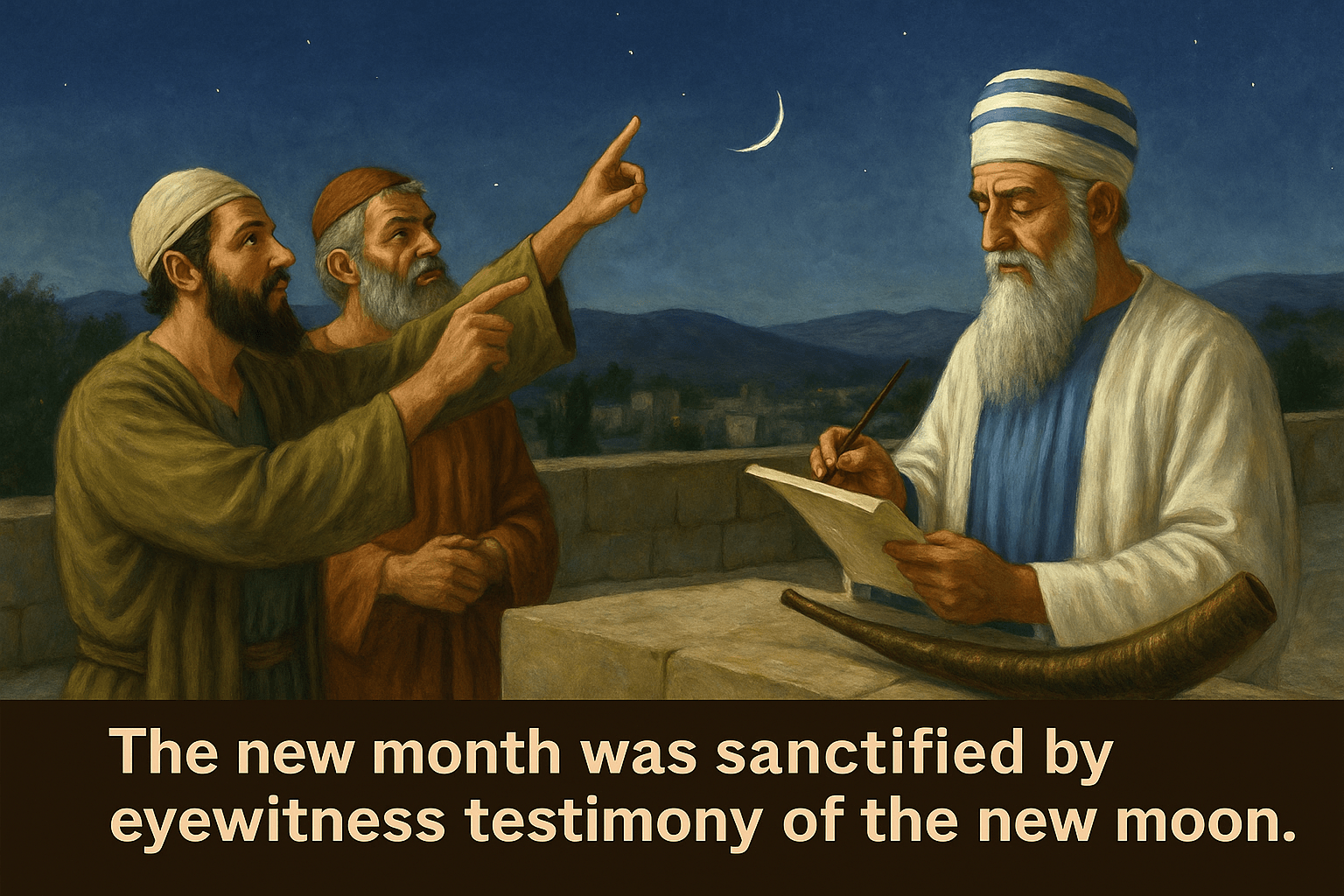
Witnesses watched for the appearance of the new crescent moon. Once the moon was seen, testimony was brought before the Sanhedrin in Jerusalem, where witnesses were carefully examined before the new month was officially declared.
Historical Jewish records describe this process in remarkable detail.
The Mishnah (Rosh Hashanah 2) records that witnesses testified regarding the appearance of the new moon and were carefully questioned concerning what they observed. If trustworthy testimony confirmed the sighting, the new month was sanctified and publicly proclaimed.
Arthur Spier summarizes the process:
“The beginning of the months were determined by direct observation of the new moon. Then those beginnings of months (Rosh Chodesh) were sanctified and announced by the Sanhedrin, the Supreme Court in Jerusalem, after witnesses testified that they had seen the new crescent and after their testimony had been thoroughly examined.”
— The Comprehensive Hebrew Calendar, p.1
The Universal Jewish Encyclopedia likewise explains:
“On the thirtieth day of the month a council would meet to receive the testimony of witnesses that they had seen the new moon. If two trustworthy witnesses had made deposition… the council proclaimed a new month to begin on that day.”
— Universal Jewish Encyclopedia, p.632
These records reveal something extremely important: during the time of Yahshua (ישוע), no fully fixed calculated calendar yet existed. Months still depended upon direct observation of the heavens.
Emil Schürer confirms this point:
“They did not in the time of Jesus Christ possess as yet any fixed calendar, but on the basis of a purely empirical observation, on each occasion they began a new month with the appearing of the new moon…”
— The History of the Jewish People in the Age of Jesus Christ, p.366
This meant that sacred time unfolded differently from the rigid global systems humanity follows today. Because the heavens are observed locally, the beginning of sacred time was experienced locally as well.
This distinction becomes increasingly important when considering how biblical time differs from modern globally synchronized systems. As we will explore later in this series, local observation of the heavens has profound implications for understanding biblical days, months, and appointed times across the earth.
The observational system required attentiveness, participation, and continual awareness of Yahuwah’s signs in the heavens. Unlike modern calendars — which can predict dates decades in advance — the biblical system remained dynamic and directly connected to creation itself.
The New Moon as a Sacred Festival
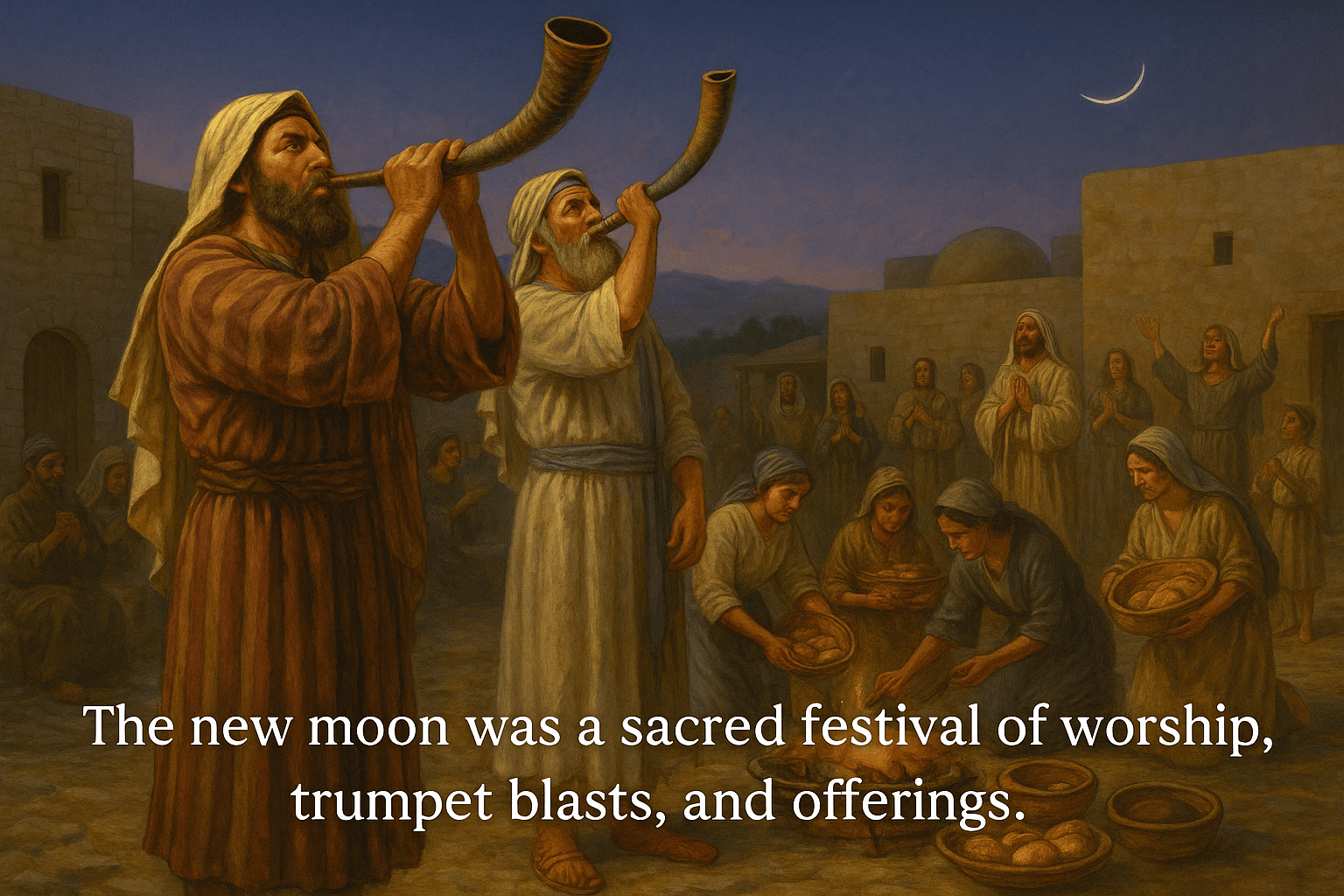
The new moon was not merely a method of counting time. In Scripture and in ancient Jewish practice, it was also treated as a sacred occasion — a time of worship, gathering, and renewal within Yahuwah’s appointed cycle.
Throughout the Scriptures, new moons are associated with trumpet blasts, offerings, assemblies, and worship.
Numbers 10:10 declares:
“Also in the day of your gladness, and in your solemn days, and in the beginnings of your months, ye shall blow with the trumpets over your burnt offerings…”
The beginning of the month therefore carried spiritual significance. It was not viewed as an ordinary civil marker, but as part of Yahuwah’s sacred order of time.
Historical sources from the Second Temple period confirm this understanding. Philo of Alexandria, a Jewish philosopher contemporary with Yahshua, described the new moon as a sacred festival and emphasized its connection to the visible illumination of the moon:
“At the time of the new moon, the sun begins to illuminate the moon with a light visible to the outward senses…”
— Philo, Special Laws II, 141
Elsewhere, Philo refers to:
“The sacred festival of the new moon, which the people give notice of with the trumpets…”
— Philo, Book 26, XXX, 159
These testimonies reveal that the new moon was not simply a technical calendar marker. It was celebrated as a visible renewal of Yahuwah’s appointed cycle.
Each month, the appearance of the new crescent announced a new beginning. The heavens themselves became the witness that another cycle of sacred time had commenced.
This stands in sharp contrast to the modern world. Today, months begin silently according to printed schedules, digital devices, and civil calculation. Most people rarely notice when a new month begins.
But within the Biblical Calendar, the beginning of the month invited people to look upward — to watch, observe, and participate in the rhythm established by Yahuwah in creation itself.
From Observation to Calculation – Hillel II’s Reform
For centuries, the Biblical Calendar continued to function through direct observation of the heavens. Witnesses watched for the appearance of the new crescent moon, testimony was examined by the Sanhedrin, and the beginning of months was publicly declared.
But eventually, this system encountered a major historical crisis.
During the fourth century CE, Roman persecution against the Jewish people intensified. Public religious authority became increasingly restricted, and the Sanhedrin could no longer function freely in the same manner as before. Under these conditions, maintaining the traditional observational system became extremely difficult.
It was during this period that Hillel II (c. 359 CE) introduced a calculated calendar system.
Rather than depending upon eyewitness observation of the new moon, months and festivals were now fixed mathematically in advance. Sacred time no longer depended upon direct observation of the heavens but upon predetermined calculation.
Historical sources explain why this transition occurred.
As torah.org summarizes:
“Declaring the new month by observation of the new moon… can only be done by the Sanhedrin. In the time of Hillel II, the Romans prohibited this practice. Hillel II was therefore forced to institute his fixed calendar…”
This reform preserved continuity during a time of persecution and dispersion. Yet it also marked a major turning point in the history of biblical timekeeping.
What had once depended upon visible signs in the heavens increasingly became detached from direct observation.
This shift reflects a broader historical pattern seen throughout humanity’s calendars. Again and again, societies moved toward systems that were predictable, stable, and administratively convenient.
But the original biblical pattern required continual attentiveness to the heavens Yahuwah established from the beginning. Sacred time was not merely calculated — it was observed.
The transition from observation to calculation therefore represents more than a technical adjustment. It reflects a profound shift in humanity’s relationship with time itself.
Week and Month Connections
Some historical sources show that in the ancient world, the week itself was once connected to the lunar cycle. Most people have no realization of this today.
Several ancient writings describe months being divided according to the phases of the moon. The Universal Jewish Encyclopedia states:
“Each lunar month was divided into four parts, corresponding to the four phases of the moon. The first week of each month began with the new moon.”
— Universal Jewish Encyclopedia, Vol. 10, p.482, “Week”
Other historical sources observe that in older Hebrew writings, the new moon and the Sabbath are frequently mentioned together, showing the early relationship between lunar reckoning and sacred weekly cycles.
The Encyclopedia Biblica notes:
“In the older Hebrew writings, the new moon and the Sabbath are almost invariably mentioned together.”
— Encyclopedia Biblica (1899), pp.4178–4179
Over time, however, these connections weakened. The weekly cycle gradually became separated from visible lunar phases, and moved to a solar only system which moved further away from direct heavenly observation.
In the ancient world, the heavens were not viewed merely as background decoration. The cycles of the moon, the movement of the stars, and the progression of the seasons formed part of the framework through which civilizations understood time, worship, and the ordering of life itself.
Why This Matters – Appointed Times and the Return of Yahshua
Understanding how humanity has measured time is more than an exercise in history. It directly affects how we understand Yahuwah’s appointed times (moedim) and shapes the way we read prophecy, worship, and the return of Yahshua.
Leviticus 23 repeatedly declares that Yahuwah’s appointed times are to be observed “throughout your generations”:
“These are the feasts of יהוה, even holy convocations, which ye shall proclaim in their seasons.”
— Leviticus 23:4
These moedim include:
- Passover (Pesach)
- Unleavened Bread
- First Fruits
- Pentecost (Shavuot)
- Trumpets (Yom Teruah)
- Atonement (Yom Kippur)
- Tabernacles (Sukkot)
Scripture presents these appointed times not merely as ancient religious traditions, but as prophetic markers woven into Yahuwah’s redemptive plan.
Yet within the Gregorian system — the calendar followed by nearly the entire modern world — these appointed times become largely hidden inside an entirely different framework of timekeeping.
The Gregorian calendar:
- begins its days at midnight rather than by observable heavenly signs,
- begins its months on fixed numbered dates rather than the new moon,
- and measures its years independently of Yahuwah’s appointed cycles.
It is therefore not simply a different calendar. It is a fundamentally different way of reckoning time.
This distinction carries profound spiritual implications.
Scripture repeatedly emphasizes the importance of watchfulness, readiness, and obedience in the last days. Revelation 14:12 describes a faithful remnant:
“Here is the patience of the saints: here are they that keep the commandments of Elohim, and the faith of Yahshua.”
At the same time, Revelation 7 describes a “great multitude, which no man could number” standing before the throne. Many students of prophecy understand this distinction as reflecting differing levels of preparedness and alignment with Yahuwah’s ways.
Whether or not one agrees with every interpretation, the central point remains: Yahuwah’s appointed times matter.
They shape how we understand worship, prophecy, covenant, and ultimately the return of Yahshua Himself.
As later articles in this series will explore, restoring the Biblical Calendar is not merely about recovering ancient customs. It is about returning to Yahuwah’s appointed rhythm of time — a rhythm that Scripture presents as continuing from creation into the coming Kingdom itself.
A Tale of Two Calendars
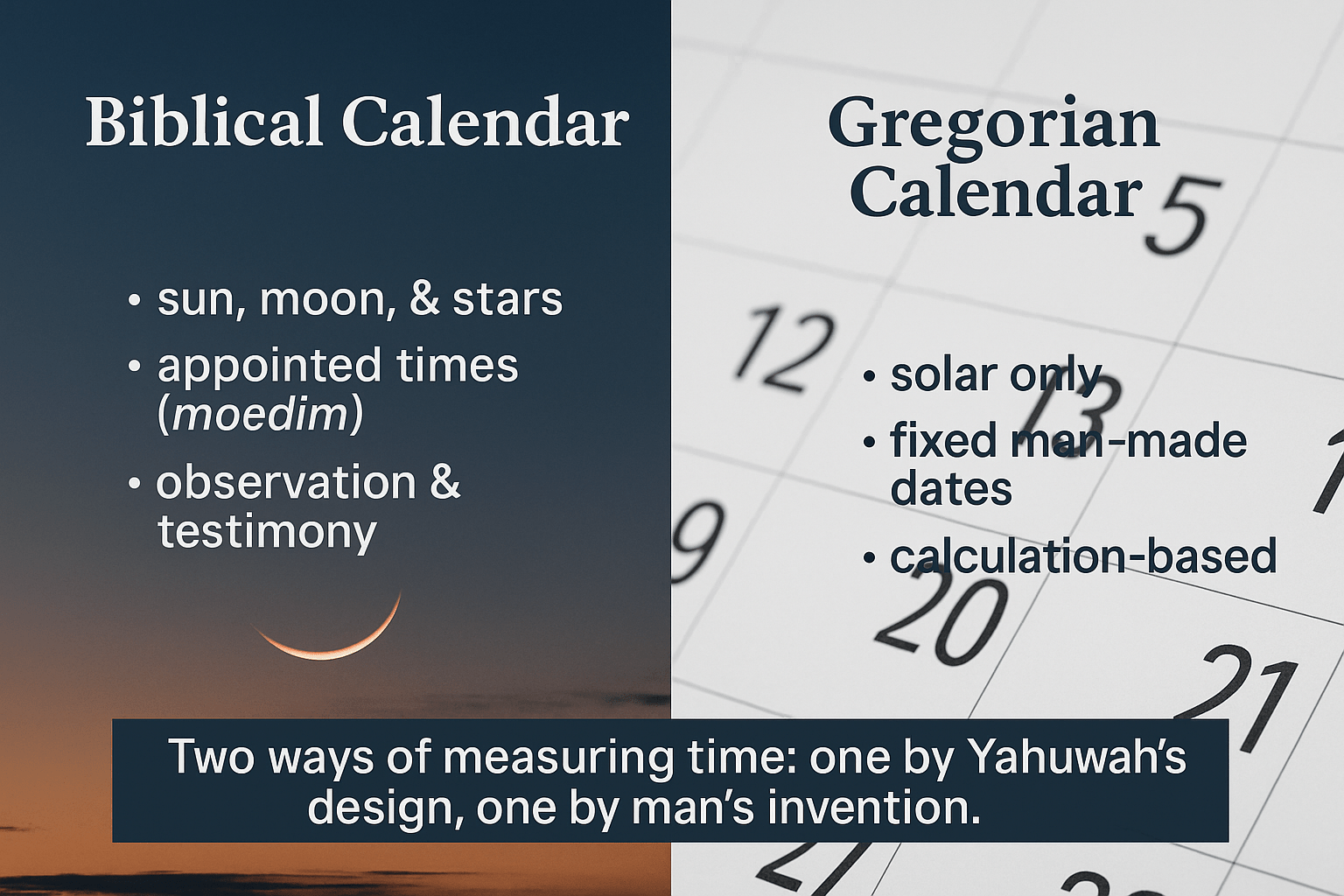
By this point, the contrast between the Biblical Calendar and the Gregorian calendar becomes unmistakable. Humanity now follows two fundamentally different approaches to timekeeping.
The Biblical Calendar is rooted in the observable signs established in creation. The Gregorian calendar is rooted in civil administration and mathematical standardization.
The differences are profound.
| Feature | Biblical Calendar | Gregorian Calendar |
|---|---|---|
| Basis of time | Sun, moon, and stars (Genesis 1:14) | Solar only |
| Start of month | First visible crescent (Numbers 10:10) | Fixed numbered dates |
| Start of day | Dawn or sunset (debated) | Midnight |
| Appointed times | Fixed by lunar-solar signs | Cannot be accurately plotted |
| Foundation | Divine appointment | Human reform and administration |
In the Biblical Calendar, sacred time unfolds through direct observation of Yahuwah’s appointed signs in the heavens. Months begin with the new moon, and appointed times are anchored to observable cycles established at creation.
The Gregorian calendar functions very differently. Its months begin according to fixed numerical dates entirely independent of the moon. Its structure depends upon mathematical calculation and global civil synchronization rather than direct observation of the heavens.
One system requires attentiveness to creation.
The other requires only calculation and administration.
This distinction becomes especially important when considering Yahuwah’s moedim. These appointed times cannot simply be transferred onto the Gregorian system without losing the framework in which they were originally established.
The Biblical Calendar was not designed around political empires, global commerce, or administrative convenience. It was established through Yahuwah’s ordering of creation itself.
And despite centuries of human reform, the heavens continue to testify to that original order. The moon still marks its cycles, the seasons still unfold, and Yahuwah’s appointed times remain embedded within the structure of creation.
The Path Forward – Returning to the Ancient Ways
After examining humanity’s changing systems of timekeeping, an important question remains: if mankind has gradually moved away from Yahuwah’s appointed order, can we return?
Scripture answers with a call that echoes across generations:
“Thus says יהוה: ‘Stand in the ways and see, and ask for the old paths, where the good way is, and walk in it; then you will find rest for your souls.’”
— Jeremiah 6:16
The “old paths” are not merely ancient customs preserved for historical interest. They are Yahuwah’s appointed ways — His Sabbath, His moedim, and His rhythm of worship established from the beginning.
Rediscovering the Biblical Calendar is therefore not about rejecting every modern system used in daily life. Civil calendars serve practical purposes within society. Rather, the issue is recognizing that Yahuwah’s appointed times operate according to a different framework — one rooted in creation itself.
Human calendars have repeatedly changed throughout history. Kingdoms rose and fell. Emperors reformed timekeeping. Religious authorities altered systems for administrative and political purposes. Yet Yahuwah’s appointed order remains unchanged.
The heavens still testify to His design.
When believers align themselves with Yahuwah’s appointed times, they step back into a rhythm established from the foundation of creation — a rhythm Scripture presents not as temporary, but enduring.
Isaiah 66:23 points beyond the present age and into the coming Kingdom:
“And it shall come to pass, that from one new moon to another, and from one sabbath to another, shall all flesh come to worship before me, saith יהוה.”
This passage reveals something remarkable: the rhythm of Yahuwah’s calendar does not belong merely to the past. Scripture presents it as continuing into the future Kingdom itself.
The Biblical Calendar is therefore not simply an ancient Hebrew system replaced by modern civilization. It is part of Yahuwah’s ongoing order of sacred time — an order that continues to call His people back to the appointed ways established in the beginning.
Conclusion – Time and the Kingdom
From the moon-watchers of Sumer to the astronomers of Babylon, from Egypt’s solar priests to Caesar’s reformers, humanity has spent thousands of years attempting to regulate time.
Every civilization sought order, stability, and control. Over time, calendars became increasingly standardized, calculated, and administrative. The Gregorian calendar — now used by nearly the entire world — represents the culmination of that historical progression.
Yet throughout all of mankind’s reforms, Yahuwah’s appointed order has remained unchanged.
The cycles of the heavens continue. The moon still marks its phases. The seasons still unfold according to the order established at creation. And Yahuwah’s moedim remain embedded within that order.
As the return of Yahshua draws nearer, understanding these appointed times becomes more than an exercise in historical study. Scripture presents them as part of Yahuwah’s covenant relationship with His people and as prophetic markers connected to His plan of redemption.
The Biblical Calendar is therefore not merely about counting days. It is about worship, covenant, obedience, and readiness.
History clearly demonstrates that humanity has repeatedly altered its systems of timekeeping. The deeper question is whether believers are willing to return to Yahuwah’s appointed rhythm of time — to once again look to the signs He established in the heavens and walk according to the order set in motion from the very beginning.
The issue is no longer whether mankind changed time.
The issue is whether we are willing to rediscover Yahuwah’s measure of it.
WHAT’S NEXT
In the next article, we will move from the ancient world into the modern one and examine how humanity measures time today.
We will explore:
- the Gregorian calendar,
- time zones,
- the International Date Line,
- global synchronization,
- and the assumptions modern civilization makes about the beginning of days and months.
Most importantly, we will compare these systems to the calendar revealed in creation by Yahuwah and examine how modern timekeeping differs from the observational framework found in Scripture.
As we will discover, the deeper we examine mankind’s systems of time, the clearer it becomes that Yahuwah’s design was never intended to be separated from the heavens.
View the next article here:
References
Scripture
Genesis 1:14 — The sun, moon, and stars appointed for signs, moedim, days, and years.
Psalm 104:19 — The moon appointed for moedim.
Numbers 10:10 — Trumpets blown at the beginnings of months and appointed feasts.
Leviticus 23 — Yahuwah’s appointed times (moedim).
1 Samuel 20:5, 18, 24 — New moon observance acknowledged by David and Jonathan.
Isaiah 66:23 — Worship from new moon to new moon and Sabbath to Sabbath.
Ezekiel 46:1–3 — Sanctuary gates opened for Sabbaths and new moons.
Jeremiah 6:16 — “Ask for the old paths…”
Revelation 7:9 — The great multitude.
Revelation 14:12 — Those who keep the commandments of Elohim and the faith of Yahshua.
Primary & Historical Sources
Parker, Richard A. The Calendars of Ancient Egypt.
Richards, E. G. Mapping Time: The Calendar and Its History. Oxford University Press, 1998. Blackburn, B. & Holford-Strevens, L. The Oxford Companion to the Year. Oxford University Press, 1999.
Stern, Sacha. Calendar and Community: A History of the Jewish Calendar, Second Century BCE–Tenth Century CE. Oxford University Press, 2001.
Hannah, Robert. Greek and Roman Calendars: Constructions of Time in the Classical World. Duckworth, 2005.
Spier, Arthur. The Comprehensive Hebrew Calendar.
Schürer, Emil. The History of the Jewish People in the Age of Jesus Christ.
Universal Jewish Encyclopedia, Vol. 10. Encyclopedia Biblica (1899). Encyclopaedia Britannica — “Julian Calendar” and “Gregorian Calendar.”
Inter gravissimas — Papal Bull of Pope Gregory XIII (1582 CE).
torah.org — Historical overview of Hillel II and the fixed calculated calendar.
Leave a Reply