
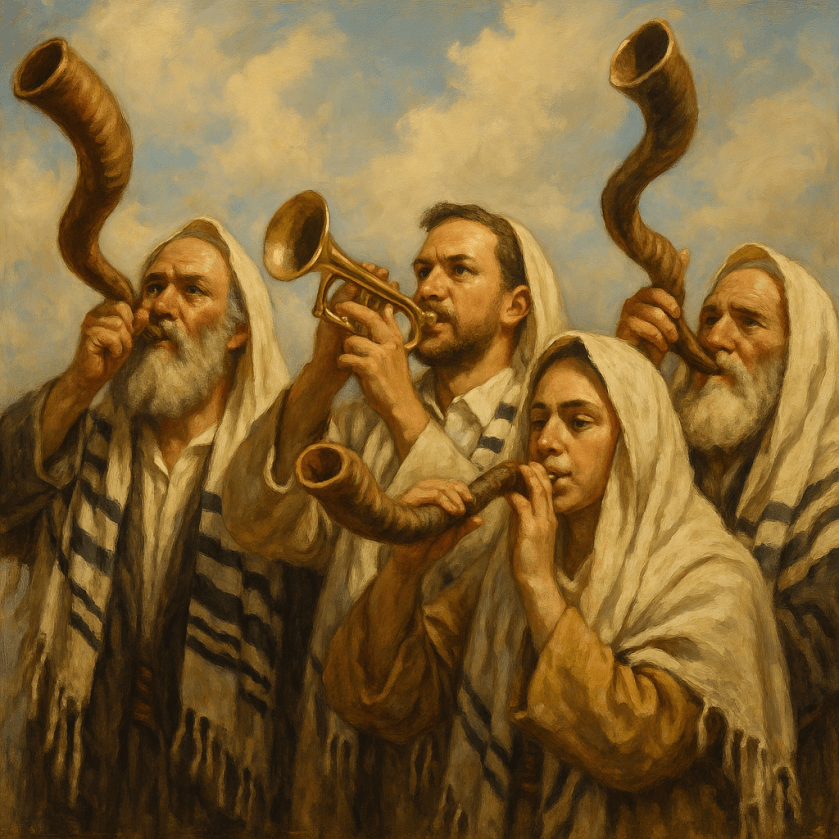
I. The Alarm of Heaven – The Meaning of Yom Teruah
Of all Yahuwah’s appointed times, Yom Teruah — the Day of Trumpets — is perhaps the most misunderstood and most overlooked. Yet it is among the most prophetically urgent. It is the moed (appointed time) that shakes sleepers awake and signals that the King is drawing near. It is not the harvest itself, nor the day of judgment — but the trumpet blast that warns both are coming.
Yahuwah commanded Israel:
“Speak unto the children of Israel, saying, In the seventh month, in the first day of the month, shall ye have a sabbath, a memorial of blowing of trumpets, an holy convocation.”
— Leviticus 23:24–25
Unlike the other moedim (Appointed times) that have immovable calendar dates, Yom Teruah is uniquely linked to the new moon — a moment that must be observed, not calculated. It cannot be predicted precisely in advance. It appears suddenly, requiring watchfulness and readiness. This is no accident. The entire feast is built on the principle of watching for the sign in the heavens — a physical rehearsal of a deeply spiritual truth.
The word “teruah” (תְּרוּעָה) does not merely mean “blowing.” It refers to a shout, blast, alarm, or war cry. It is the same word used in Joshua 6 when the shofar blast brought down Jericho’s walls, and in Joel 2:1 when the prophet cries:
“Blow ye the trumpet in Zion, and sound an alarm in my holy mountain: let all the inhabitants of the land tremble: for the day of Yahuwah cometh, for it is nigh at hand.”
The trumpet was never ornamental in Scripture. It gathered the people (Numbers 10:1–3), signalled battle (Jeremiah 4:19), announced kings (1 Kings 1:34), and warned of impending judgment (Amos 3:6). Yom Teruah, the appointed time of Trumpets, is all of these things at once — a sacred alarm that announces the coming of the King, summons His people to readiness, and warns the world that judgment approaches.
And yet there is more than just one trumpet in his list of appointed times. The other appointed times also have trumpets blasts. For example the appointed time of harvest which we see as Pentecost or Shavuot. It is no coincidence that Paul ties the wheat harvest itself to a trumpet blast:
“For the trumpet shall sound, and the dead shall be raised incorruptible, and we shall be changed.”
— 1 Corinthians 15:52
Yet the appointed time of trumpets does not cause the harvest — it prepares the field. Just as the shofar warned Israel to purify themselves before Yahuwah descended on Sinai (Exodus 19:16–19), so too Yom Teruah, the appointed time of trumpets, warns the world to repent, awaken, and align themselves with Yahuwah’s calendar before the events of Atonement and Tabernacles and Shavuot unfold.
This is why the prophets consistently tie the trumpet blast to repentance. The alarm is not merely a sound — it is a call to return:
“Shall a trumpet be blown in the city, and the people not be afraid? shall there be evil in a city, and Yahuwah hath not done it?”
— Amos 3:6
Trumpets do not soothe — they shake. They do not lull — they awaken. They break the silence before the storm. And in a world lulled by the false peace of man-made religion and counterfeit calendars, Yom Teruah, the appointed time of trumpets, is the Creator’s piercing reminder that His appointed times still govern the unfolding of history.
II. A Warning Before Judgment – The Prophetic Role of Trumpets
Yom Teruah is not the day of judgment itself — but it announces that judgment is coming. It is the thunderclap before the storm, the herald that shakes the earth awake before the King rises from His throne. The trumpet blast is mercy — but it is mercy with urgency.
Throughout Scripture, the sounding of the trumpet is always connected to warning, warfare, and divine intervention. It is Yahuwah’s way of calling people to repentance before the sword falls. This scripture found in Joel pictures the appointed time of Trumpets perfectly.
“Blow the trumpet in Zion, and sound an alarm in My holy mountain! Let all the inhabitants of the land tremble; for the day of Yahuwah is coming, for it is near.”
— Joel 2:1
This is not gentle language — it is the language of a watchman crying out as destruction approaches. The trumpet is blown to warn the city before the invader arrives. And so it is with Yom Teruah: it warns humanity that the books are about to be opened, and the Judge is preparing to rise. It warns that the harvest is near.
Ezekiel was given this same watchman’s commission:
“If the watchman sees the sword coming and does not blow the trumpet, and the people are not warned, and the sword comes and takes any person from among them… his blood I will require at the watchman’s hand.”
— Ezekiel 33:6
Yahuwah uses the trumpet to strip away excuses. No one will be able to say they were not warned.
The Trumpets of Revelation – Echoes of Yom Teruah
The book of Revelation builds on this prophetic pattern. Seven trumpets sound in succession (Revelation 8–11), each releasing judgments that intensify until the final blast announces that “the kingdoms of this world have become the kingdoms of our Master and of His Messiah” (Revelation 11:15).
These trumpet blasts mirror Yom Teruah in both purpose and timing — each one is a divine warning, each one a call to repentance before the final judgment comes. But just as Israel had to be watching for the first sliver of the new moon to know when Yom Teruah began, so too must Yahuwah’s people be watching for the signs that signal His approaching judgment.
The Call to Repentance Before the Storm
The trumpet is not sounded for those already awake. It is sounded for the sleepers — for the complacent, the distracted, and the deceived. Yom Teruah is the call that pierces through the noise of Babylon’s calendar and says:
“Return. Realign. The King is coming.”
And yet, just as in ancient times, many will ignore the blast. They will continue on their way, content in man-made religion, untroubled by the alarm, feeling they are already saved — until the day the door shuts and it is too late.
Yahshua warned of this very thing:
“Not everyone who says to Me, ‘Lord, Lord,’ shall enter the kingdom of heaven, but he who does the will of My Father in heaven.
Many will say to Me in that day, ‘Lord, Lord, have we not prophesied in Your name, cast out demons in Your name, and done many wonders in Your name?’
And then I will declare to them, ‘I never knew you; depart from Me, you who practice lawlessness!’”
— Matthew 7:21–23
and again
“For as in the days before the flood, they were eating and drinking, marrying and giving in marriage, until the day that Noah entered the ark, and they did not know until the flood came and took them all away, so also will the coming of the Son of Man be.”
— Matthew 24:38–39
The trumpet blast is the final cry of mercy before judgment falls. It does not force repentance — but it removes ignorance. Those who hear and turn will be prepared when the harvest begins. Those who harden their hearts will find themselves caught unaware, like those outside the ark when the rain began to fall.
III. Preparing a People Before the King Comes
What Is the Oil? More Than Sentiment—A Life Aligned
In the parable, all ten have lamps (the profess to know him), all expect the Bridegroom, and all doze (human frailty). But only five carry extra oil. That oil is not vague “spirituality.” Scripture names its content:
Scripture uses oil symbolically in many places, and when we examine these passages together, we see that oil consistently represents the Spirit of Yahuwah, obedience, and set-apartness (holiness) — the qualities that enable His people to remain ready when the Bridegroom comes.
Here are key examples and how they connect:
1. Oil as the Spirit of Yahuwah
Oil is frequently associated with anointing — the setting apart and empowering of someone by the Ruach haQodesh (Holy Spirit).
- 1 Samuel 16:13 – “Then Samuel took the horn of oil and anointed him in the midst of his brothers; and the Spirit of Yahuwah came upon David from that day forward.”
→ The pouring of oil symbolizes the Spirit coming upon and empowering someone for service. - Zechariah 4:2–6 – The prophet sees a lampstand supplied by two olive trees. When he asks what it means, the angel replies: “Not by might nor by power, but by My Spirit,” says Yahuwah of hosts.
→ The flowing oil from the olive trees represents the continual supply of the Spirit that fuels the light — just as the Spirit fuels the believer’s life and witness.
This symbolism carries directly into Matthew 25:1–13, where the wise virgins carry oil in their lamps. Their lamps continue to burn because they remain filled with the Spirit — whereas the foolish virgins do not.
2. Oil as Obedience and Righteousness
While oil clearly represents the Spirit, the Spirit is given to those who obey:
- Acts 5:32 – “The Holy Spirit, whom God has given to those who obey Him.”
→ The Spirit and obedience are inseparable. The wise virgins’ oil isn’t just emotional zeal or belief — it is the fruit of a life aligned with Yahuwah’s will. - Psalm 119:105 – “Your word is a lamp to my feet and a light to my path.”
→ A lamp without oil is useless — and likewise, the Word without obedience is dead. The oil gives the lamp light, just as the Spirit-empowered obedience gives the Word life in a believer’s walk.
3. Oil and Set-Apartness
Oil was also used to sanctify — to mark something or someone as set apart for Yahuwah’s purposes.
- Exodus 30:25–30 – The anointing oil consecrated the priests and the holy objects, setting them apart for Yahuwah.
→ This connects to the wise virgins being prepared and set apart for the Bridegroom. They are not merely believers in name — they are consecrated vessels, walking in obedience and filled with His Spirit.
4. Oil and Endurance
The wise virgins’ oil also represents ongoing preparation. They brought extra oil, implying they lived in continual readiness — not one-time belief but sustained obedience and faithfulness. It means they had prepared more than what the others had. They understood his word and kept it ready for the appointed times.
- Revelation 14:12 – “Here is the patience of the saints: here are those who keep the commandments of Yahuwah and the faith of Yahushua.”\
→ It is this combination — enduring obedience and steadfast faith — that keeps their lamps burning until the Bridegroom arrives.
Putting It All Together:
Oil is not a vague metaphor for “faith.” It is the Spirit-fueled obedience and set-apart walk that sustains Yahuwah’s people in readiness. Oil is found the word. Without this oil — without aligning ourselves with His commandments, His Spirit, and His appointed times — the lamp goes out, and the Bride is unprepared.
This is why the foolish virgins are turned away despite calling Him “Lord.” They lacked the oil of obedience and the Spirit’s sanctifying work. They were practicing another’s law and not the Law of Yahuwah.
Oil, then, is lived alignment—the practiced habit of ordering life by Yahuwah’s commandments and His time. The wise don’t scramble to “buy truth” at midnight; they have stored a history of obedience. The foolish have lamps but no reserve—profession without practiced submission. Hence their panic: “Give us your oil.”
Learning His appointed times is not something that can be transferred at a moments notice. It requires study and reading his word to understand. One cannot just transfer that oil immediately. It requires one to sit down and study. You cannot transfer a life of obedience at the last minute (Matt 25:8–9).
Why Much of the Church Sleeps
Mainstream Christianity loudly confesses the Bridegroom yet lives by another rhythm—a Romanized calendar and man-made holy days—while Yahuwah’s Sabbaths, New Moons, and feasts are sidelined or spiritualized. Yahushua already judged this posture: “In vain do they worship Me, teaching as doctrines the commandments of men.” (Matt 15:9)
Ezekiel charged the priests who blur holy and common and hide their eyes from His Sabbaths
26 Her priests have violated My law and profaned My holy things; they have not distinguished between the holy and unholy, nor have they made known the difference between the unclean and the clean; and they have hidden their eyes from My Sabbaths, so that I am profaned among them.
– Ezekiel 22:26
That is sleep. It sounds reverent, looks busy, but moves off-beat from the King’s time.
Yom Teruah shatters that slumber. The shofar says: Wake up. Trim the wick. Check your oil. Not your rhetoric—your rhythm.
References
Passover (Pesach) – Deliverance through the Lamb
- Exodus 12:1–14 – Original institution of Passover in Egypt
- Leviticus 23:5 – Command for annual observance
- Numbers 9:1–5 – Passover kept in the wilderness
- Deuteronomy 16:1–8 – Observance in the land
- John 1:29 – “Behold, the Lamb of God…”
- Matthew 26:17–29 – The Last Supper at Passover
- 1 Corinthians 5:7 – “Messiah our Passover is sacrificed for us”
- Revelation 5:6–9 – The Lamb slain and exalted
Unleavened Bread (Chag HaMatzot) – The removal of sin
- Exodus 12:15–20 – Command to remove leaven
- Leviticus 23:6–8 – Feast of Unleavened Bread instituted
- Deuteronomy 16:3–4 – “Bread of affliction” reminder
- 1 Corinthians 5:6–8 – “Purge out the old leaven”
- 2 Corinthians 5:21 – Messiah who “knew no sin”
- John 19:31–42 – Yahshua’s body laid in the tomb during this feast
First Fruits (Yom HaBikkurim) – Resurrection and new life
- Leviticus 23:9–14 – Offering the first sheaf of barley
- Exodus 23:19 – “First of the firstfruits” offered to Yahuwah
- 1 Corinthians 15:20–23 – Messiah the “firstfruits” of the resurrection
- Matthew 28:1–6 – Resurrection on First Fruits
- John 20:1–18 – The risen Messiah appears
- Romans 8:23 – Believers as “firstfruits” awaiting redemption
- James 1:18 – “A kind of firstfruits of His creatures”
Shavuot (Pentecost) – The wheat harvest and the Spirit
- Leviticus 23:15–22 – Count fifty days and offer new grain
- Deuteronomy 16:9–12 – Count from putting the sickle to the grain
- Exodus 19:1–8 – Torah given at Sinai (also in the third month)
- Acts 2:1–4 – Spirit poured out at Pentecost
- Daniel 12:11–13 – 1,335 days and the end-time harvest
- Jubilees 1:1; 15:1; 16:13 – Covenant and harvest timing
- Matthew 13:39 – “The harvest is the end of the age”
- Joel 3:13 – “Put in the sickle, for the harvest is ripe”
- Revelation 14:15–16 – “The harvest of the earth was reaped”
Trumpets (Yom Teruah) – The alarm and awakening
- Leviticus 23:23–25 – Command for the day of blowing trumpets
- Numbers 29:1–6 – Sacrifices for the day
- Psalm 81:3 – Blow the trumpet at the new moon
- Joel 2:1 – “Blow the trumpet in Zion”
- Amos 3:6 – Trumpet as warning of Yahuwah’s actions
- Matthew 25:1–13 – Parable of the ten virgins (awakening call)
- Revelation 8–11 – Seven trumpets preceding judgment
- 1 Thessalonians 4:16 – “The trumpet of Elohim”
- 1 Corinthians 15:52 – “At the last trumpet… we shall be changed”
Atonement (Yom Kippur) – Judgment and separation
- Leviticus 16 – Two goats, atonement ritual
- Leviticus 23:26–32 – Day of afflicting the soul
- Numbers 29:7–11 – Sacrifices for Yom Kippur
- Hebrews 9:11–28 – Messiah as High Priest entering once for all
- Revelation 20:11–15 – Great white throne judgment
- Revelation 7:3–4 – Sealing of Yahuwah’s servants
- Ezekiel 9:4–6 – Mark on the foreheads of the faithful
- Matthew 25:31–46 – Sheep and goats separated
- Revelation 14:12 – “Those who keep the commandments of Yahuwah”
Tabernacles (Sukkot) – Dwelling with His people
- Leviticus 23:33–43 – Command to dwell in booths
- Deuteronomy 16:13–17 – Rejoicing at the Feast of Booths
- Nehemiah 8:14–18 – Restoration of Sukkot observance
- Zechariah 14:16–19 – Nations required to keep Sukkot in the Kingdom
- John 7:2, 14, 37 – Yahshua teaches during Sukkot
- Revelation 21:3–4 – “The tabernacle of Elohim is with men”
- Isaiah 4:5–6 – Yahuwah’s shelter over His people
 The Calendar of Scripture