
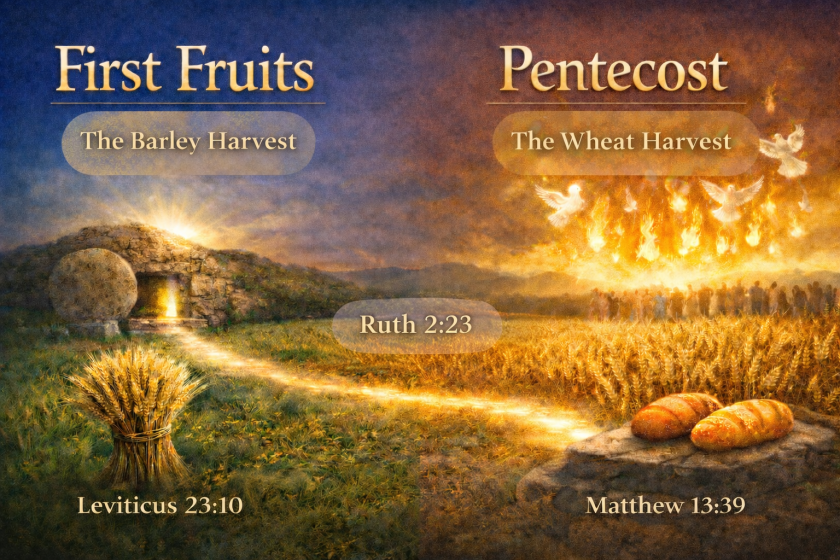
Today, according to the Scriptural calendar, we observe the Day of First Fruits—an appointed time established by Yahuwah from the beginning, rich in both agricultural and prophetic meaning.
This is not a tradition of men, but a day defined in Scripture, fulfilled in Yahushua, and still declaring truth today.
What Are First Fruits?
The command is given in Deuteronomy:
“You shall take some of the first of all the produce of the ground…
…and now, behold, I have brought the first fruits of the land which You, O Yahuwah, have given me.”
First Fruits was the offering of the very first yield of the land. This was not just any harvest—it was the barley harvest, the earliest crop to ripen.
This offering acknowledged that Yahuwah is the provider, that the land belongs to Him, and that the first portion is set apart and holy.
It was an act of trust. Before the full harvest came in, the first was given.
When Is First Fruits?
Leviticus tells us that the sheaf of First Fruits is to be waved:
“On the day after the Sabbath.”
This places it immediately after the Sabbath that follows Passover.
We are not left to guess when this occurred. Scripture records the exact timing when Israel entered the land:
Joshua 5:10–12
“Now the children of Israel camped in Gilgal, and kept the Passover on the fourteenth day of the month at twilight on the plains of Jericho.
And they ate of the produce of the land on the day after the Passover, unleavened bread and parched grain, on the very same day.
Then the manna ceased on the day after they had eaten the produce of the land; and the children of Israel no longer had manna, but they ate the food of the land of Canaan that year.”
This passage gives us the full sequence:
- The 14th day – Passover
- The 15th day – the Sabbath (the first day of Unleavened Bread)
- The 16th day – the day after the Sabbath, when they first ate the produce of the land
This 16th day marks the beginning of the barley harvest, and it aligns perfectly with the instruction given in Leviticus for the Day of First Fruits.
The Barley Harvest – A Prophetic Beginning
Barley is the first of the harvests.
It is not the full harvest, but the beginning of them—the first sign that the season of gathering has arrived.
This is why First Fruits is so significant. It points forward. It declares that more is coming.
Yahushua – The First Fruits
Paul writes:
“But now is Yahushua risen from the dead, and become the first fruits of them that slept.”
Yahushua rose on this very day—the Day of First Fruits.
Just as the first sheaf of barley was lifted before Yahuwah, Yahushua was raised as the first of the resurrection, guaranteeing that others will follow.
The Timing of His Resurrection
The timeline given in Scripture is precise:
- Yahushua was crucified on Passover (14th)
- He rested in the tomb on the Sabbath (15th)
- He rose on the Day of First Fruits (16th)
Luke records:
“On the Sabbath they rested according to the commandment.”
And the Gospels tell us:
“As the first day of the week began to dawn…”
“Very early in the morning… when the sun had risen…”
He rose at dawn, at the beginning of the day.
This aligns perfectly with the time the First Fruits offering would be presented.
The Third Day
Scripture consistently states that He would rise on the third day.
Counting:
- 14th → first day
- 15th → second day
- 16th → third day
The Day of First Fruits is therefore the day of resurrection and new life.
The First Fruits and the Resurrection of Many
Yahushua was not alone in resurrection at that time.
“And the graves were opened; and many bodies of the saints which slept arose… and appeared unto many.”
This is a powerful witness.
The First Fruits offering was never about a single grain—it represented the beginning of a harvest. In the same way, Yahushua rose first, and others were raised and seen in Jerusalem, confirming that the harvest had begun.
The Order of the Resurrection
Scripture tells us:
“Messiah the first fruits; afterward they that are Messiah’s at His coming.”
There is an order.
Yahushua is first. Others follow. The full harvest comes later at His coming. This tells us when the second coming is and is refelected in many scriptures speaking of the wheat harvest which we know as Pentecost.
This reflects the pattern established in the harvest itself.
Counting to Pentecost – The Continuation of the Harvest
The Day of First Fruits is not the end—it is the beginning of a count.
Leviticus 23 commands:
“15 Count, so it happens, from the day after the Sabbaths of the wave sheath (unleavened bread), seven Sabbaths complete.
16 Count fifty days, to the day which is after the seventh Sabbath. Then you shall offer a new grain offering to Yahuwah.”
This instruction establishes a defined starting point. The count begins from the day after the last Sabbath of Unleavened Bread, at the time of the wave sheaf offering. From this point, a measured count is made until the next appointed time.
When this is understood correctly, something remarkable is seen.
If we count fifty working days from that starting point—the day after the last Sabbath of Unleavened Bread—we arrive at a very specific time: the 16th day of the third new moon.
This is not arbitrary. It shows that the count is precise, structured, and anchored within Yahuwah’s calendar.
What strengthens this further is that we are given a second witness to the same pattern in the book of Daniel:
“Blessed is he who waits, and comes to the thousand three hundred and thirty-five days.”
— Daniel 12:12
When the 1335 days are counted from the Day of Trumpets, they also lead to the 16th day of the third new moon.
This agreement between Leviticus and Daniel is not coincidence.
Both passages:
- Begin from an appointed starting point
- Require a measured count
- Lead to the same appointed day
- Declare blessing upon those who arrive at that time
This reveals a consistent pattern in Yahuwah’s calendar. He establishes times, sets counts, and brings His people to appointed days with precision.
In this light, the resurrection of Yahushua on First Fruits becomes even more significant. It is not only the beginning of the barley harvest, but also the starting point of a count that leads forward into a greater harvest.
The same pattern seen in the barley and wheat harvests is reflected in the counting of days. What begins with First Fruits continues, unfolds, and leads to a greater ingathering—exactly as Yahuwah has appointed.
The Wheat Harvest – Pentecost
Following the count from First Fruits, we arrive at Pentecost—the appointed time that completes the counting process.
This day is not separate from what came before. It is the fulfillment of the count that began from the day after the last Sabbath of Unleavened Bread. Having completed the full measure, we arrive at the time appointed by Yahuwah for the next stage of the harvest.
Pentecost is associated with the wheat harvest, a greater and fuller ingathering than the barley that came before. Where First Fruits marked the beginning, Pentecost represents increase.
In the Torah, this is marked by the offering of two loaves before Yahuwah, signifying a more complete gathering.
In the Renewed Covenant, we see this fulfilled:
“When the day of Pentecost had fully come… they were all filled with the Holy Spirit…”
This moment is not random—it occurs precisely at the end of the counted days.
On that day, the Spirit was poured out, the message went forth, and many were added. What began with one—the First Fruits—now expands into a greater harvest.
The pattern remains consistent. The barley comes first, then the wheat. The beginning is followed by increase. What was first established in Yahushua continues in those who follow Him.
The Full Pattern of the Harvest
Scripture reveals a consistent pattern:
The barley harvest comes first. Then the wheat.
Yahushua rises first. Then many are gathered.
First Fruits marks the beginning. Pentecost continues the work. The final harvest is still to come.
Why This Matters
First Fruits is not just history.
It shows us that:
- Resurrection has already begun
- Yahushua is the guarantee
- The harvest is still unfolding
A Call to Return
These are the appointed times of Yahuwah.
“This day shall be to you a memorial… you shall keep it as an appointed time.”
They were given for remembrance, for understanding, and for truth.
Conclusion
Today we remember the beginning of the harvest.
The barley has been offered.
The First Fruits has been raised.
The third day has been fulfilled.
The saints have been seen.
The count has begun.
And the wheat harvest is still to come.
He is risen.
He is the First Fruits.
 The Calendar of Scripture