
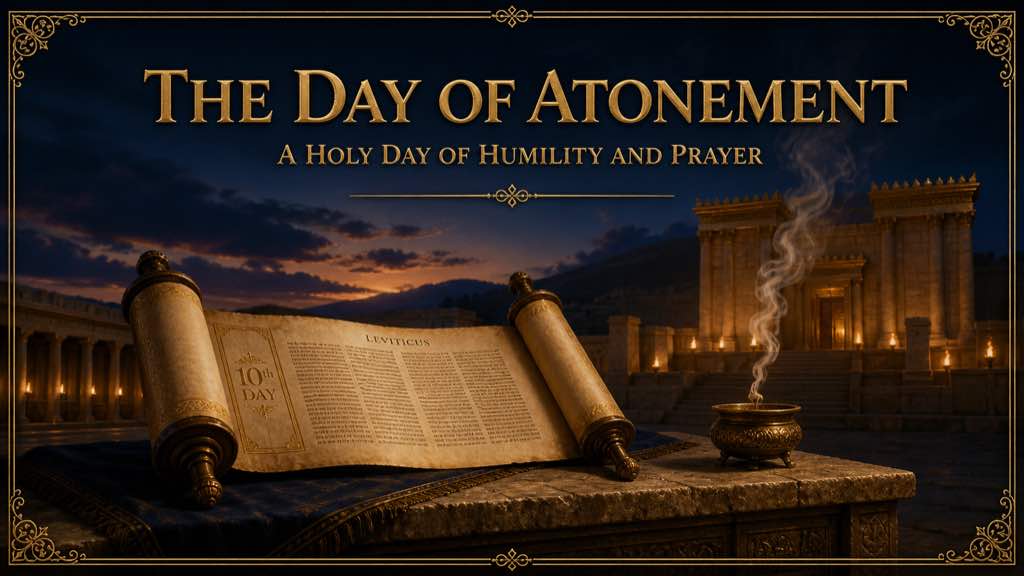
The Day of Atonement is an appointed time of complete rest, humility, repentance and cleansing. It occurs on the tenth day of the seventh month and is observed from evening to evening.
Leviticus 23 establishes the day and explains the responsibility of the people. Leviticus 16 then reveals the atonement service performed on their behalf. Together, these passages show both our need to humble ourselves and Yahuwah’s provision for cleansing and reconciliation.
Leviticus 23
26 And Yahuwah spoke to Moses, saying,
27 “Also the tenth day of this seventh month is the Day of Atonement; it shall be a holy convocation for you, and you shall humble yourselves and present an offering by fire to Yahuwah.
28 You shall not do any work on this same day, for it is the Day of Atonement, to make atonement on your behalf before Yahuwah thy Elohim.
29 If there is any person who will not humble himself on this same day, he shall be cut off from his people.
30 If there is any person who does any work on this same day, I will destroy that person from among the people.
31 You shall do no work at all [on that day]. It is a permanent statute throughout your generations wherever you may be.
32 It is to be to you a Sabbath of complete rest, and you shall humble yourselves. On the ninth day of the month at evening, from evening to evening you shall keep your Sabbath.”
Leviticus 23 shows the seriousness of this appointment. Those who refused to humble themselves or continued their ordinary work were rejecting an appointed time that Yahuwah had set apart.
Observing this appointment requires us to identify the seventh month and its tenth day according to the heavenly signs Yahuwah appointed for times and seasons. That calendar question is examined separately in the studies linked throughout this website.
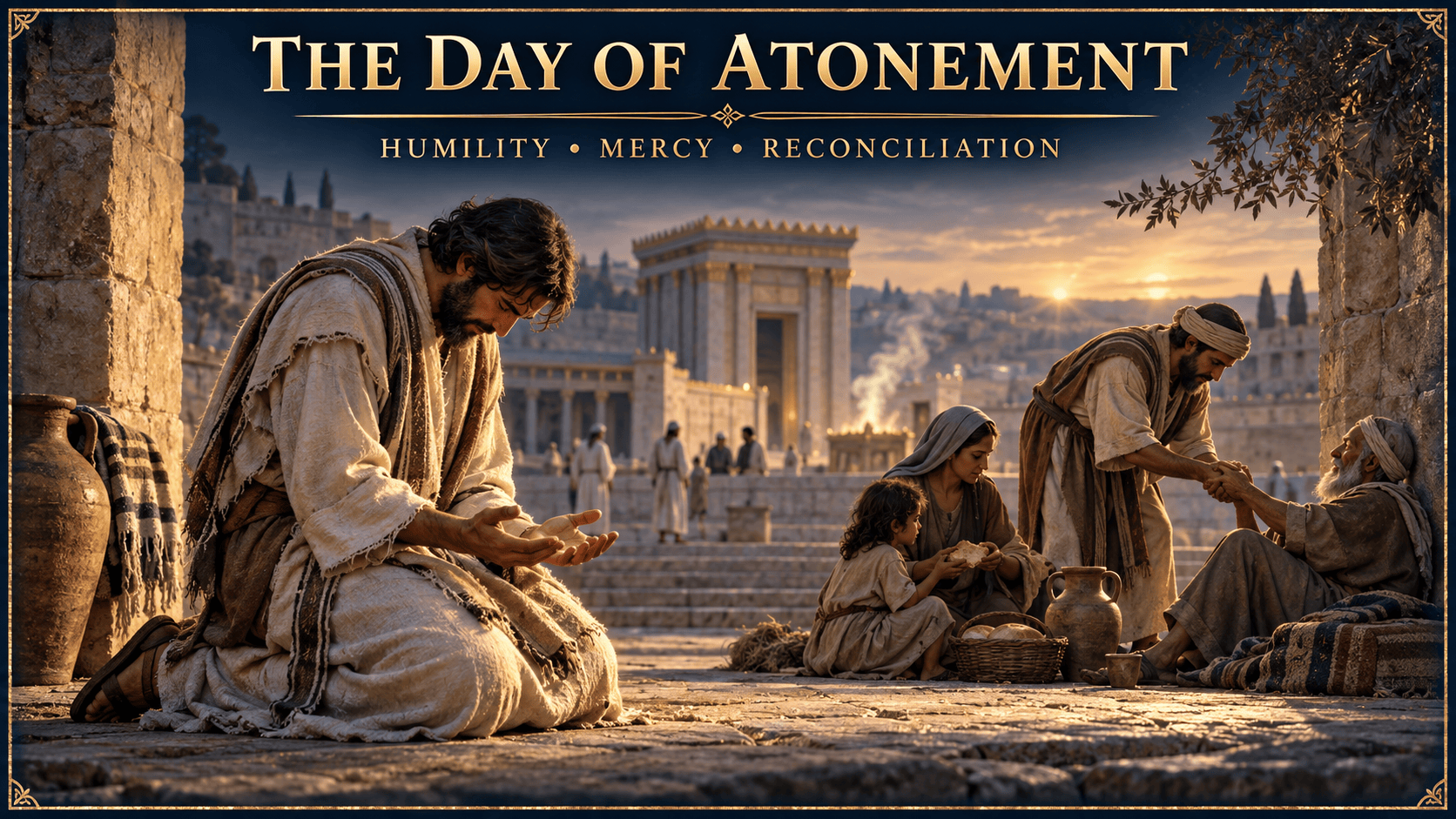
Leviticus 23 commands the people to humble themselves, but what does genuine humility look like? Isaiah 58 warns that outward fasting is meaningless when people continue to quarrel, practise injustice and oppress others. Yahuwah desires humility that produces repentance, mercy and righteous conduct.
Isaiah 58 does not simply contrast fasting with eating. It contrasts empty religious observance with a changed life—releasing burdens, helping the oppressed, feeding the hungry and caring for those in need.
Isaiah 58:2-7
2 Yet they seek Me daily,
And delight to know My ways,
As a nation that did righteousness,
And did not forsake the ordinance of their Elohim.
They ask of Me the ordinances of justice;
They take delight in approaching Elohim.
3 ‘Why have we fasted,’ they say, ‘and You have not seen?
Why have we afflicted our souls, and You take no notice?’“In the day of your fast you find pleasure,
And instead exploit all your labourers.
4 You fast for strife and debate,
And strike with the fist of wickedness.
You will not fast as you do this day,
To make your voice heard on high.5 But was this the fast that I have chosen?
A day for a man to afflict his soul (by not eating)?
Is it to bow down his head like a bulrush,
And to spread out sackcloth and ashes?
Is this what you would call this a fast?
And an acceptable day to the Lord?6 “Is this not the fast that I have asked for?
To loose the bonds of wickedness.
To undo the heavy burdens.
To let the oppressed go free.
To break every yoke.
7 Is it not to share your bread with the hungry?
And that you bring to your house the poor who are cast out?
When you see the naked, that you cover him?
And not hide yourself from your own flesh?
Atonement and cleansing
Leviticus 16 describes the service performed by the high priest on the Day of Atonement. He washed, clothed himself in the holy linen garments and made atonement for himself and his household before acting on behalf of Israel.
Two goats were presented. One was offered as a sin offering, and its blood was used in cleansing the sanctuary from the uncleanness and transgressions of the people. Over the other goat, the high priest confessed the sins of Israel before it was sent into the wilderness, symbolically carrying those sins away.
The high priest also carried burning coals and finely beaten incense inside the veil. The resulting cloud covered the mercy seat. In Revelation, incense is explicitly associated with the prayers of Yahuwah’s people. This provides a meaningful connection between atonement, prayer and approaching Yahuwah’s throne.
Leviticus 16:12-16
12 Then he shall take a censer full of burning coals of fire from the altar before Yahuwah, with his hands full of sweet incense beaten fine, and bring it inside the veil.13 And he shall put the incense on the fire before Yahuwah, that the cloud of incense may cover the mercy seat that is on the Testimony, lest he die.
Yahushua and the greater atonement
Hebrews 9 explains that the earthly sanctuary and its services pointed towards a greater reality. The high priest entered the Most Holy Place repeatedly with the blood of animals, but Yahushua entered the greater and more perfect tabernacle with His own blood.
The Day of Atonement therefore teaches us about cleansing, mediation and reconciliation. It reminds us that we cannot remove our own sin. We depend upon the mercy of Yahuwah and the work of Yahushua, through whom we may approach with a cleansed conscience.
Revelation 8 contains imagery that I understand as being associated with atonement, prayer and judgment.
The prayers of the saints rise before Yahuwah with the incense. Fire is then taken from the altar and cast upon the earth, and the angels prepare to sound their trumpets. This presents a sobering progression from prayer before the throne to judgment upon the earth.
Revelation 8:1-6
1 When He opened the seventh seal, there was silence in heaven for about half an hour.
2 And I saw the seven angels who stand before Yahuwah, and to them were given seven trumpets.
3 Then another angel, having a golden censer, came and stood at the altar. He was given much incense, that he should offer it with the prayers of all the saints upon the golden altar which was before the throne.
4 And the smoke of the incense, with the prayers of the saints, ascended before Yahuwah from the angel’s hand. 5 Then the angel took the censer, filled it with fire from the altar, and threw it to the earth. And there were noises, thunderings, lightnings, and an earthquake.
6 So the seven angels who had the seven trumpets prepared themselves to sound.
7 The first angel sounded: And hail and fire followed, mingled with blood, and they were thrown to the earth. And a third of the trees were burned up, and all green grass was burned up.
What does this appointment ask of us?
The Day of Atonement calls us to stop our ordinary work and humble ourselves before Yahuwah. It is a time for prayer, self-examination, repentance and reconciliation.
Isaiah 58 also teaches us to examine how we treat others. Are we relieving burdens or creating them? Are we caring for those in need? Are we willing to forgive, seek forgiveness and correct what is wrong?
Outward observance must be accompanied by an inward change of heart. The Day of Atonement reminds us of the seriousness of sin, the mercy of Yahuwah and our complete dependence upon the atoning work of Yahushua.
Will we humble ourselves, receive His correction and walk according to His appointed ways?
May Yahuwah your Elohim baruch you.

Leave a Reply