

The Scriptures are clear: before the return of Messiah, humanity will be divided into two camps — those who bear the mark of Yahuwah and those who bear the mark of the beast. This is not a vague metaphor. It is a prophetic reality rooted deeply in Scripture, and it revolves around one central question: Whose authority do you obey — Yahuwah’s or man’s?
The Lie that Deceives the whole world
The apostle Paul revealed this stark divide in 2 Thessalonians 2:7–12, warning that “the mystery of lawlessness is already at work” — a secret rebellion against Yahuwah’s law that began in the early days of the ekklesia and has continued ever since. He writes that those who perish “did not receive the love of the truth that they might be saved… for this reason Elohim will send them strong delusion, that they should believe the lie.”
“For the mystery of lawlessness is already at work… and then the lawless one will be revealed… whose coming is after the working of Satan with all power and signs and lying wonders, and with all unrighteous deception among those who perish, because they did not receive the love of the truth, that they might be saved. And for this reason Yahuwah will send them strong delusion, that they should believe the lie, that they all may be condemned who did not believe the truth but had pleasure in unrighteousness.”
— 2 Thessalonians 2:7–12
What is “the lie”? It is the age-old deception first whispered in Eden: that man can decide for himself what is good and what is evil — that we can define truth, time, and worship apart from Yahuwah. This lie is not merely philosophical; it is institutional. It is embedded in man-made religion, counterfeit calendars, and traditions that replace the commandments of Elohim.
The “mystery of lawlessness” is the spirit that rejects Yahuwah’s Torah and substitutes human authority in its place. It is the spirit that says, “We will worship on our day, keep our feast on our schedule, and follow our traditions,” even when they contradict Scripture. This is how the beast system gains its power — not by open rebellion alone, but by persuading believers to obey man rather than Yahuwah.
Yahushua Himself condemned this substitution of divine instruction with man-made religion:
“These people draw near to Me with their mouth,
And honour Me with their lips,
But their heart is far from Me.
And in vain they worship Me,
Teaching as doctrines the commandments of men.”
— Matthew 15:8–9
The Sabbath – The Commandment Man Thinks He Can Change
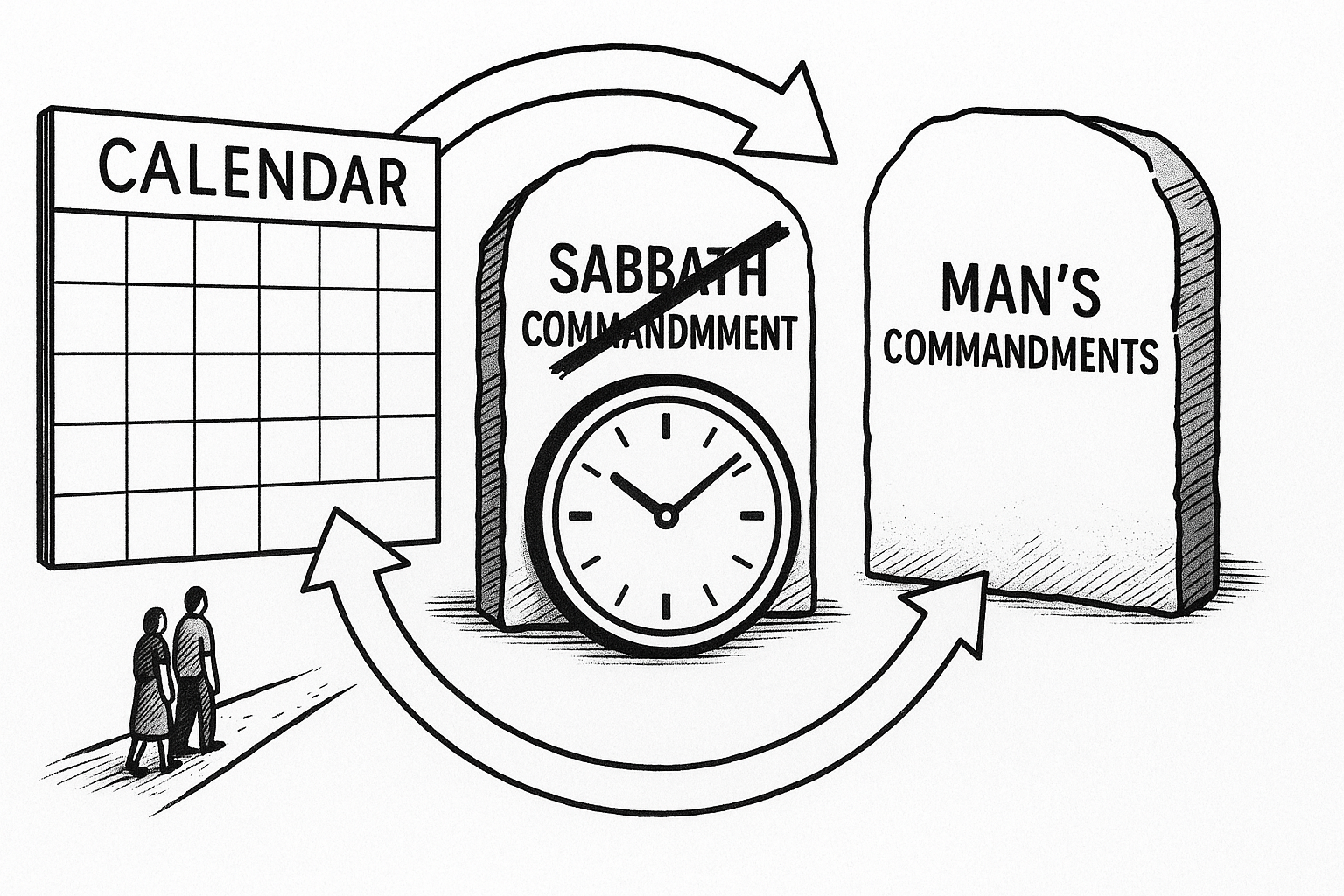
This is more than empty words. The Sabbath commandment — unlike any other — is governed by time, and time is determined by the calendar. Change the calendar, and you change the Sabbath. Change the Sabbath and you are no longer following His commandments, but mans.
James 2:10–11
“For whoever keeps the whole law and yet stumbles at just one point is guilty of breaking all of it.
For He who said, ‘Do not commit adultery,’ also said, ‘Do not murder.’ If you do not commit adultery but do commit murder, you have become a lawbreaker.”
This is why Daniel prophesied that the final beast power would “think to change times and law” (Daniel 7:25). And Revelation reveals that the world would follow this system (Revelation 13:3), even as a faithful remnant refuses:
“Here is the patience of the saints; here are those who keep the commandments of Yahuwah and the faith of Yahshua.”
— Revelation 14:12
This is precisely how the beast system operates: by moving worship from Yahuwah’s appointed times to man’s appointed times. And billions follow without question, thinking they are obeying Elohim when in fact they are keeping a counterfeit sabbath on a counterfeit calendar. This is why Yahushua says their worship is “in vain” — because they are honouring Him according to man’s traditions, not His Word.
Paul calls this deception a “mystery” — a hidden rebellion. And indeed, the true calendar, the true Sabbath, and the true moedim have been hidden from the world for centuries.
Colossians 1:26 declares:
Colossians 1:26
26 the mystery which has been hidden from ages and from generations, but now has been revealed to His saints.
Those who love the truth, search the Scriptures, and turn from the traditions of men will have this mystery unveiled. They will see the appointed times written in the heavens from the beginning. They will understand that Yahuwah’s mark is found in obedience — (Revelation 14:12).
Two Marks – One On The Forehead And One On The Hand.
And this is where the great separation occurs. The 144,000 stand with the Lamb on Mount Zion, sealed with the Father’s Name on their foreheads (Revelation 14:1). They are not marked by the beast. They have not accepted the counterfeit. They walk in obedience to Yahuwah’s law and timing. They have returned to His ways while the world clings to man’s ways.
The rest follow a different path. They “did not repent of the works of their hands” (Revelation 9:20–21) and are judged for their stubborn rebellion. Like those in Ezekiel 9, they are struck down because they refused to “sigh and cry” over the abominations done in Israel. Only those marked by Yahuwah — those who grieve over lawlessness and align with His ways — are spared.
The Two Camps – The Obdeient and the Multitude
Even the prophets saw this division. Isaiah 66:23–24 speaks of a future time when “from one New Moon to another and from one Sabbath to another, all flesh shall come to worship before Me.” But the transgressors — those who rejected His Sabbaths and moedim — become “an abhorrence to all flesh.”
Isaiah 66:23–24
“And it shall come to pass that from one new moon to another, and from one Sabbath to another, all flesh shall come to worship before Me,” says Yahuwah.
24 “And they shall go forth and look upon the corpses of the men who have transgressed against Me. For their worm does not die, and their fire is not quenched. They shall be an abhorrence to all flesh.”
This is the line that will divide the 144,000 from the great multitude. Both are redeemed, but the 144,000 stand apart as a sealed, obedient remnant — a firstfruits people who refuse the mark of compromise. The rest of the world follows the beast into false worship because they believe the lie.
The Scriptures are clear: obedience and timing are not optional extras — they are the mark that identifies Yahuwah’s people in the final conflict.
The Seal and the Mark: Two Signs, One Choice
From Genesis to Revelation, Scripture presents a clear and consistent truth: humanity is divided into two camps — those sealed by Yahuwah and those marked by the beast. This division is not about outward labels or religious affiliations; it is about obedience and allegiance — who we serve and whose authority we submit to.
Revelation paints this divide with unflinching clarity:
“If anyone worships the beast and his image, and receives his mark on his forehead or on his hand, he himself shall also drink of the wine of the wrath of Yahuwah…”
— Revelation 14:9–10
Immediately after this warning, the text identifies the other group — those who stand apart from this judgment:
“Here is the patience of the saints; here are those who keep the commandments of Yahuwah and the faith of Yahushua.”
— Revelation 14:12
These two verses are not separate thoughts. They are two sides of the same reality: those who reject Yahuwah’s commandments and walk according to man’s traditions bear the mark of the beast, while those who keep His commandments and hold fast to Yahushua bear His seal.
This truth echoes throughout Scripture. In Exodus, Yahuwah declares that His law — specifically, His ordinances kept at their appointed time — is to be a sign on the hand and between the eyes:
“It shall be as a sign to you on your hand and as a memorial between your eyes, that Yahuwah’s law may be in your mouth; for with a strong hand Yahuwah has brought you out of Egypt.
You shall therefore keep this ordinance at its appointed time from year to year.”
— Exodus 13:9–10
And again:
“It shall be as a sign on your hand and as frontlets between your eyes…”
— Exodus 13:16
Moses repeats this charge:
“These words which I command you today shall be in your heart… You shall bind them as a sign on your hand, and they shall be as frontlets between your eyes.”
— Deuteronomy 6:6–8
“Therefore you shall lay up these words of Mine in your heart and in your soul, and bind them as a sign on your hand, and they shall be as frontlets between your eyes.”
— Deuteronomy 11:18
This is the language Revelation later mirrors. The mark of the beast and the seal of Yahuwah appear in the same places — the hand and the forehead — because both are about actions (hand) and beliefs (forehead). What we do and what we believe reveal who we serve.
“I gave them My Sabbaths to be a sign between Me and them, that they might know that I am Yahuwah who sanctifies them.”
— Ezekiel 20:12
The prophet Ezekiel saw a vision that reinforces this truth. In it, a mark was placed upon those who “sigh and cry over all the abominations” — those grieved by lawlessness and faithful to Yahuwah:
“Go through the midst of the city… and put a mark on the foreheads of the men who sigh and cry over all the abominations that are done within it.”
— Ezekiel 9:4
Those marked were spared. The rest — those who refused to turn from lawlessness — were not.
The apostles understood this same divide. John wrote:
“Now by this we know that we know Him, if we keep His commandments. He who says, ‘I know Him,’ and does not keep His commandments, is a liar, and the truth is not in him.”
— 1 John 2:3–4
And Peter warned:
“For the time has come for judgment to begin at the house of Yahuwah; and if it begins with us first, what will be the end of those who do not obey the gospel of Yahuwah?”
— 1 Peter 4:17
At the heart of this conflict is what Paul calls “the mystery of lawlessness.”
“For the mystery of lawlessness is already at work… The coming of the lawless one is according to the working of Satan, with all power, signs, and lying wonders, and with all unrighteous deception among those who perish, because they did not receive the love of the truth… And for this reason Yahuwah will send them strong delusion, that they should believe the lie.”
— 2 Thessalonians 2:7–11
The “lie” is not merely atheism or idolatry. It is the deception that one can claim to worship Yahuwah while rejecting His commandments — that one can walk in disobedience and still be counted among the faithful. This is why Yahushua rebuked the religious leaders of His day:
“These people draw near to Me with their mouth, and honor Me with their lips, but their heart is far from Me. And in vain they worship Me, teaching as doctrines the commandments of men.”
— Matthew 15:8–9
This verse exposes the heart of the issue: man-made commandments replace Yahuwah’s, and people follow them thinking they are serving Him. The Sabbath illustrates this most clearly.
Unlike commandments such as murder or theft, the Sabbath’s observance is tied directly to time — and time can be redefined. Look at how many calendars have been made. If men tell you the Sabbath is on another day, or according to another calendar, and you follow them rather than searching the Scriptures, then you are no longer keeping Yahuwah’s command — you are keeping the commandments of men.
It is here that the two camps diverge. One group clings to tradition and follows the majority, accepting whatever “day” and “season” is sanctioned by earthly powers. The other searches the Word, learns the Creator’s appointed times, and refuses to bow to man’s calendar. One bears the mark of rebellion. The other bears the seal of obedience.
And Yahuwah’s Word does not soften the outcome. Those who reject His ways and follow the beast’s system — even while calling it “worship” — face judgment. Those who keep His commandments and hold fast to Yahushua stand sealed and protected.
“Blessed are those who do His commandments, that they may have the right to the tree of life, and may enter through the gates into the city.”
— Revelation 22:14
This is why the 144,000 are described as those who have not been defiled and who follow the Lamb wherever He goes (Revelation 14:4). They are not swayed by the traditions of the majority. They do not accept the commandments of men. They are sealed with Yahuwah’s name on their foreheads because His law is written on their hearts (Jeremiah 31:33).
The rest of humanity — even many who call themselves believers — are swept into the other camp. They worship, but in vain (Matthew 15:9). They walk in religion, but without obedience. They receive a mark — not on their skin, but in their thoughts and actions (Revelation 13:16) — showing their allegiance to a counterfeit system. They are lawless because they “did not receive the love of the truth” (2 Thessalonians 2:10).
This division is seen again in Ezekiel’s vision:
“Go through the midst of the city, through the midst of Jerusalem, and put a mark on the foreheads of the men who sigh and cry over all the abominations that are done within it.”
— Ezekiel 9:4
Only those grieved by lawlessness — those who refuse to join in it — are marked for preservation. The rest are swept away in judgment. Revelation echoes this same reality: the sealed are protected (Revelation 7:3), while those who bear the beast’s mark face wrath (Revelation 14:9–11).
The 144,000 are that preserved remnant — sealed, protected, and delivered. They are not special because of race or bloodline. As Paul wrote:
“For they are not all Israel who are of Israel… it is not the children of the flesh who are children of Yahuwah, but the children of the promise are counted as the seed.”
— Romans 9:6–8
True Israel is defined not by ancestry but by faith and obedience. The 144,000 are those who have circumcised hearts (Romans 2:28–29), who belong to Messiah (Galatians 3:29), and who keep the commandments of Yahuwah (Revelation 14:12).
The great multitude — though saved — does not share in this distinction. They “come out of the great tribulation” (Revelation 7:14), purified through suffering rather than preserved through sealing. They will stand before the throne in white robes — but they did not stand on Mount Zion with the Lamb. They were not sealed as firstfruits. They did not walk in full obedience.
This is the sobering reality Scripture sets before us: two camps, two destinies. One marked by compromise and tradition, the other by obedience and truth. One walks according to the commandments of men. The other keeps the commandments of Yahuwah and follows the Lamb.
The question every believer must face is simple — but it cuts to the heart:
Which camp will you belong to?
The Mark of the Beast – A Sign of Rebellion
The mark of the beast mirrors this principle. It too appears on the hand and forehead, but instead of representing obedience to Yahuwah, it represents allegiance to a counterfeit system:
“If anyone worships the beast and his image, and receives his mark on his forehead or on his hand, he… shall also drink of the wine of the wrath of Yahuwah…”
— Revelation 14:9–10
This mark is not merely about forced microchips or physical branding. It is about a global system that forces worship at man-made appointed times — times that deny Yahuwah’s calendar and enthrone human authority in its place. The beast’s mark is about replacing Yahuwah’s Word with human tradition.
And nowhere is this rebellion more evident than in the calendar itself. The Creator’s calendar is governed by the sun, moon, and stars — “for signs and for appointed times” (Genesis 1:14). But Rome imposed a solar calendar and fixed weekly cycle, severing worship from the heavens. It is no coincidence that the only commandment that can be governed by men is the Sabbath. If man changes the calendar, he changes the day. And if the day changes, most people — without question — will follow the crowd rather than the Word.
The difference is stark:
- The Mark of Yahuwah: His Torah and appointed times written on the heart and mind. A sign of those sanctified, who walk according to His ways using His Luni-solar times.
- The Mark of the Beast: The rejection of His law and calendar, replaced by man-made traditions, counterfeit worship, and false times using man made solar times.
Even Satan’s ambition reveals the nature of this battle:
“I will ascend into heaven… I will sit on the mount of the appointed times… I will be like the Most High.”
— Isaiah 14:13–14
Satan seeks to sit on the mount of Yahuwah’s appointed times, to replace them with his own. And through the calendars and festivals of men, he has largely succeeded. The whole world follows this beastly system, often believing they serve God while walking in rebellion:
“So the great dragon was cast out… who deceives the whole world.”
— Revelation 12:9
Yet Yahuwah still calls:
“Come out of her, My people, lest you share in her sins, and lest you receive of her plagues.”
— Revelation 18:4
The call is not merely to leave false religion — it is to leave false time, false worship, and false authority.
The Truth
All Ten Commandments are unchangeable truths. But only one — the Sabbath — depends on time. If the time is shifted, the day is shifted. If the calendar is replaced, the commandment is broken without anyone thinking they’ve broken it. It is the perfect deception. Man changes the appointed day, claims it is still “the Sabbath,” and the world follows without question. And yet Yahuwah declared:
“From one New Moon to another, and from one Sabbath to another, all flesh shall come to worship before Me.”
— Isaiah 66:23
The appointed times — Sabbaths and moedim — are woven into the rhythm of the heavens (Genesis 1:14), not into man-made constructs like the Gregorian calendar or the International Date Line. This is why the Sabbath is the focal point of the battle over worship. It is the visible test of whether we follow Yahuwah’s authority or man’s.
Using the Gregorian calendar – a calendar instituted and made by man, and ignoring the calendar of scripture, which starts every new moon day, is walking with another.
The Great Multitude – Mercy in the Midst of Judgment
While the 144,000 stand apart as the sealed firstfruits — those who keep the commandments of Yahuwah and hold fast to the faith of Yahshua — Scripture reveals there is another company standing before the throne: a great multitude that no man can number.
Revelation 7:9–10
“After this I looked, and behold, a great multitude that no one could number, from every nation, from all tribes and peoples and languages, standing before the throne and before the Lamb, clothed in white robes, with palm branches in their hands, and crying out with a loud voice, ‘Salvation belongs to our Elohim who sits on the throne, and to the Lamb!’”
This multitude is not the same as the 144,000 — and yet they too are redeemed. They are not sealed before the tribulation begins, but they come out of the tribulation:
Revelation 7:13–14
“Then one of the elders answered, saying to me, ‘Who are these arrayed in white robes, and where did they come from?’ And I said to him, ‘Sir, you know.’ So he said to me, ‘These are the ones who come out of the great tribulation, and washed their robes and made them white in the blood of the Lamb.’”
Here lies a crucial prophetic distinction: the 144,000 are prepared before the storm, sealed for protection as the judgments of Yahuwah are unleashed. The great multitude, however, wakes up during or after the storm — purified through suffering and repentance. They are saved not because they walked in obedience from the beginning, but because in the fire of tribulation they turned and clung to the Lamb.
This separation reflects Yahuwah’s justice and mercy working in tandem. It is the same principle echoed throughout Scripture: a faithful remnant is preserved, while others are brought to repentance through judgment. As Isaiah declares:
Isaiah 26:9
“For when Your judgments are in the earth, the inhabitants of the world will learn righteousness.”
The Great Multitude represents those who were once part of the deceived majority — those who were swayed by the mystery of lawlessness (2 Thessalonians 2:7–12), who “loved not the truth” and followed the commandments of men. But in the crucible of tribulation, their eyes are opened. Like the prodigal son, they return, washed clean by the blood of the Lamb.
The great multitude is proof that Yahuwah’s mercy endures even in the darkest hour. But their story is also a sobering warning: delay is dangerous. Many who ignored Yahuwah’s commandments and calendar when the call first went out will only awaken when the plagues fall and the shaking begins.
The prophet Zechariah speaks of this refining process:
Zechariah 13:8–9
“And it shall come to pass in all the land,” says Yahuwah,
“That two-thirds in it shall be cut off and die,
But one-third shall be left in it:
I will bring the one-third through the fire,
Will refine them as silver is refined,
And test them as gold is tested.
They will call on My name,
And I will answer them.
I will say, ‘This is My people’;
And each one will say, ‘Yahuwah is my Elohim.’”
This is the path of the Great Multitude — refined through tribulation, awakened by judgment, and ultimately redeemed. They will stand before the throne in victory, but their road is steep and marked with suffering. The difference between them and the 144,000 is not salvation — for both are saved — but timing and obedience.
One group chooses to obey before the storm; the other learns obedience through the storm. One is sealed ahead of time and protected through the judgments; the other washes their robes in blood after the judgments fall. One walks in the light of His calendar and commandments now; the other sees the truth too late to escape the full weight of tribulation.
The great multitude is that final harvest — the ingathering of nations who, even at the last hour, turn from Babylon’s lies and cling to the Lamb.
Two Goats, Two Groups – The Prophetic Pattern Hidden in Leviticus 16
Long before John saw visions of beasts, seals, and harvests, Yahuwah revealed the entire end-time drama through a simple yet profound ceremony: the Day of Atonement ritual in Leviticus 16. Hidden within this ancient moed (appointed time) is a pattern that unlocks the mystery of the two groups described in Revelation — the 144,000 and the great multitude, the sealed and the condemned, the redeemed firstfruits and the castaway tares.
Once a year, on the most solemn day of Yahuwah’s calendar, the high priest entered the Most Set-Apart Place to make atonement for Israel. Central to this ritual were two goats, chosen by lot:
“And Aaron shall cast lots upon the two goats; one lot for Yahuwah, and the other lot for Azazel.”
— Leviticus 16:8
One goat was slain, its blood sprinkled on the mercy seat to atone for the sins of the people:
“Then he shall kill the goat of the sin offering, which is for the people, bring its blood inside the veil, do with that blood as he did with the blood of the bull, and sprinkle it upon the mercy seat…”
— Leviticus 16:15
The second goat — the live goat — was not slain. Instead, the high priest laid his hands upon it, confessed over it the sins of Israel, and sent it away into the wilderness:
“And Aaron shall lay both his hands on the head of the live goat, and confess over it all the iniquities of the children of Israel… and shall send it away by the hand of a man into the wilderness.”
— Leviticus 16:21–22
Two goats. One sacrifice. One exile. One enters into the Most Set-Apart presence. The other is cast away, bearing iniquity far from the camp.
This is not just ritual — it is prophecy.
Two Goats, Two Destinies – A Pattern of the End
These two goats are prophetic types of two groups at the end of the age. Both are “goats of the congregation.” Both stand before Yahuwah. But their destinies diverge completely.
- The goat “for Yahuwah” points directly to Yahshua the Messiah, the Lamb slain for the sins of the world. Through His blood, atonement is made, and access to the Most Set-Apart Place — the presence of Yahuwah — is restored (Hebrews 9:11–14). These are in the temple.
- The live goat (Azazel – the goat that goes away) represents the removal of sin and those who remain in their iniquity. It is not sacrificed but driven into the wilderness, away from the camp — a powerful picture of separation and judgment.
This dual pattern reappears throughout Scripture. It is Cain and Abel. Jacob and Esau. Wheat and tares. Sheep and goats. Wise virgins and foolish virgins. In every case, both appear similar — both are “religious,” both offer sacrifices, both await the Bridegroom — but only one is accepted.
Yahshua Himself declared this final division:
“When the Son of Man comes in His glory… He will separate them one from another, as a shepherd divides his sheep from the goats.”
— Matthew 25:31–32
The two goats of Leviticus 16 are the prophetic root of that separation.
The 144,000 and the Great Multitude – The Fulfillment of the Two Goats
Revelation shows us the same pattern in its climactic scenes. The 144,000 stand with the Lamb on Mount Zion, sealed with the Father’s Name on their foreheads (Revelation 14:1). They are called “firstfruits” (Revelation 14:4), echoing the sacrificial goat — wholly dedicated, purified, and accepted before Yahuwah.
The great multitude, meanwhile, emerges “out of great tribulation” (Revelation 7:14). They have “washed their robes” but did not stand sealed before the judgments began. Many will come through fire — saved, yes, but only after judgment falls.
And then there are those who refuse repentance altogether:
“But the rest of mankind, who were not killed by these plagues, did not repent… and they did not repent of their murders or their sorceries or their sexual immorality or their thefts.”
— Revelation 9:20–21
They are also a part of the goats driven into the wilderness — separated from the camp, cut off from the presence of Yahuwah.
Ezekiel foresaw this same moment:
“Go through the midst of the city… and put a mark on the foreheads of the men who sigh and cry over all the abominations… But to the others He said… slay utterly… but do not come near anyone on whom is the mark.”
— Ezekiel 9:4–6
The mark distinguishes the two goats — the sealed and the unsealed, the spared and the judged.
Why the Sabbath Is Central
Of all the commandments, the Sabbath is unique. It alone is governed by time, and thus it alone can be shifted by human manipulation. Murder, theft, idolatry — these cannot be legislated into righteousness. But time can be redefined. A calendar can be rewritten. And when it is, worship itself is redirected.
This is the heart of the matter. If the Sabbath is placed on a man-made calendar — detached from the new moons and appointed times Yahuwah ordained — then even well-meaning worship becomes vain. It is possible to believe you are obeying, and yet be walking in rebellion because the foundation (time) has been corrupted.
This is why the Sabbath is the dividing line. It is the one commandment Satan can counterfeit by altering the measure of time itself. And once time is changed, the moedim — the appointed times of Yahuwah — vanish from view. Without knowing His Sabbaths and His calendar, true obedience becomes impossible. The rest of the commandments cannot be properly kept without first aligning to His time.
The Wheat Harvest – The Firstfruits Without Blemish and the Rest of the Ingathering
The language of harvest saturates Scripture — not as a poetic metaphor but as a prophetic reality. Yahuwah revealed His plan of redemption through the agricultural cycle of Israel, and the wheat harvest holds a special place in that revelation. The Wheat harvest occurs at the time we read as Pentecost or Shavuot.
It represents the great ingathering of souls at the end of the age — but also a separation within that harvest itself.
The Firstfruits: Set Apart and Without Blemish
In Torah, the first portion of every harvest belonged wholly to Yahuwah:
“The first of the firstfruits of thy land thou shalt bring into the house of Yahuwah thy Elohim.”
— Exodus 23:19
This was not merely an offering — it was a declaration. The first of the wheat, carefully gathered and without blemish, was consecrated to Him before the rest of the harvest was even touched. It was His possession, His portion, and His delight. Only after the firstfruits were offered could the rest of the harvest be brought in.
This principle holds profound prophetic weight. Among the final generation of believers there will likewise be a first portion — those who are refined, purified, and wholly devoted. They will not have “bowed the knee to Baal” (1 Kings 19:18), nor compromised with the traditions of men. They are undefiled by the systems of this world because they have refused to walk by man’s calendar, man’s appointed times, or man’s ways. Their obedience is not partial or seasonal — it is total.
These are the “without blemish” ones — not because they are sinless in their own strength, but because they have been cleansed, sanctified, and aligned with Yahuwah’s order. They follow His instructions not merely in word but in time — keeping His Sabbaths and moedim according to His calendar, not Rome’s. They are those of whom it can be said:
“Blessed are the undefiled in the way, who walk in the law of Yahuwah.”
— Psalm 119:1
Just as the first of the wheat was lifted up before Yahuwah as holy, so too this set-apart company is offered first — a pledge and a promise of the greater harvest still to come.
The Rest of the Harvest: Still His, Yet Not Without Blemish
After the firstfruits were presented, the remainder of the wheat harvest was gathered in. This too belonged to Yahuwah — but it was not offered as the first portion. It was not without blemish. It included stalks that had weathered storms, some that bore scars, and some that required threshing to separate chaff from grain.
So it will be at the end of the age. The great multitude — vast, diverse, redeemed from every nation — will indeed belong to Him. They will stand before the throne, clothed in white, washed in the blood of the Lamb (Revelation 7:9-14). But they will not all share the same testimony. Many will come out of great tribulation; many will awaken late; many will be refined through fire rather than prepared in obedience.
Yet Yahuwah, in His mercy, gathers them still. The wheat harvest is not rejected — but it is ordered. First, the holy portion is offered. Then the rest is brought in. And that order is not arbitrary — it reveals the heart of Elohim and the weight He places on wholehearted obedience.
A Prophetic Picture of the End
The wheat harvest, then, is more than a shadow of Shavuot (Pentecost) — it is a map of the final redemption. First, the firstfruits: the consecrated portion, set apart and undefiled, gathered ahead of the rest. Then, the great harvest: the multitude, refined and redeemed, gathered from the ends of the earth.
And just as the firstfruits sanctify the whole harvest (Romans 11:16), so too this first portion — the pure offering — sanctifies what follows. Their obedience paves the way for the rest. Their steadfastness is the standard by which the remainder is gathered.
This is no small matter. It is the difference between those who are prepared when the Bridegroom comes and those who scramble for oil at the last moment (Matthew 25:1-13). It is the difference between those marked on their foreheads with Yahuwah’s sign and those who receive the mark of the beast. It is the difference between the first offered and the last gathered.
The harvest is one — but within it, order, distinction, and purpose remain. The first is Yahuwah’s most treasured portion. The rest, though still His, follow after.
The Final Call: “Come Out of Her, My People”
At the end of all things, Scripture gives a cry that echoes like a trumpet blast across the nations — a call that divides humanity into two camps and demands a decision that cannot be delayed:
“Come out of her, My people, lest you share in her sins, and lest you receive of her plagues.”
— Revelation 18:4
This is not a polite invitation. It is a command from heaven — a warning issued just before judgment falls. “Her” is Babylon — the global system of deception, rebellion, false worship, and counterfeit time that has ensnared the whole world. And the reason Yahuwah calls His people out is simple: you cannot carry Babylon’s ways into His Kingdom.
The Choice Before Us
As the harvest ripens and the angels prepare to thrust in the sickle, every soul on earth will stand on one of two sides. Those sealed with Yahuwah’s mark — obedient to His commandments, walking in His moedim, aligned with His calendar — will stand as the 144,000 firstfruits and the great multitude clothed in white. Those who cling to Babylon’s times, her traditions, and her calendar will receive the mark of the beast and share in her plagues.
Revelation 22:14–15 declares the dividing line with final clarity:
“Blessed are those who do His commandments, that they may have the right to the tree of life, and may enter through the gates into the city. But outside are dogs and sorcerers and sexually immoral and murderers and idolaters, and whoever loves and practices a lie.”
The lie is the great counterfeit — that man can change what Yahuwah has ordained and still be accepted. It is the lie that obedience without timing is enough. It is the lie that grace cancels covenant. And it is the lie that blinds multitudes from hearing the cry: “Come out of her, My people.”
A Final Trumpet Blast
The harvest is almost ready. The line is being drawn. Babylon’s days are numbered, and Yahuwah’s moedim are counting down the final events of history. The trumpet is about to sound, the Day of Atonement is near, and the tabernacle of Elohim is soon to be with men.
The question is not whether the sickle will swing — it will. The question is whether you will be found among the firstfruits, sealed and blameless, or among those who must be purified through tribulation.
The voice from heaven still calls:
“Come out of her, My people.”
Leave behind the counterfeit calendars, the man-made traditions, and the worship of convenience. Return to the Creator’s appointed times. Keep His commandments. Walk in His ways.
For the Bridegroom is coming — and only those on His timetable will be ready to meet Him.
 The Calendar of Scripture
YOU are already marked with the beast because you fa
LikeLike
Interestingly, WordPress deleted half your text before I even got it this time, and it only based on inappropriate keywords.Guessing your message was not what anyone who loves Yahshua would desire.
LikeLike
If you love him then the very least you could do is get his name right YAHUSHUA is the only name for YOUR SALVATION!Kind Regards Kev
LikeLike
Hello Nivek?
Could you show me where exactly the Father or the Son ever wrote their names in English? How did they spell them? Which scripture is it found in?
Because as far as I understand, the divine name was only ever written in Hebrew, not English. The four sacred letters — Yod, Hey, Vav, Hey (יהוה) — are what we transliterate as YHWH, but even that is not the original name, only an attempt to represent the Hebrew using our alphabet.
Whether someone writes “Yahuah,” “Yahwah,” or something else, all of these are simply approximations of the same original Name. None of them can claim to be “correct,” because none of them are the original Hebrew.
The truth is, English cannot perfectly reproduce Hebrew sounds. Each Hebrew letter carries meaning well beyond mere phonetics. English has no such equivelent. Once we try to express those sounds in English, we are already several steps removed from the original. That makes arguments over whether a “U” or a “W” is correct meaningless — they are just attempts to represent a sound that English letters were never designed to capture.
You indicate that V and W make different sounds in English, thus your issue. That might be true where you live, but it is certainly not true everywhere. Across languages and history, U, V, and W often interchange, merge, or shift. This shows that spelling choices are about representation, not correctness.
Here are examples:
German – W pronounced as V
Wasser (water) → pronounced Vasser
Wein (wine) → pronounced Vine
Vater (father) → pronounced Fah-ter
Dutch – W and V blur together
Wit (white) → sounds like Vit
Wonen (to live) → sounds close to Vonen
Dutch speakers often pronounce English “window” as “vindow,” showing how flexible these sounds are.
Hindi – No distinction between V and W
Vine and Wine → both pronounced close to ʋine
Van and Wan → often sound identical
Here, speakers use a single sound ʋ that sits between “v” and “w.”
Latin – V pronounced as W
Virgil → pronounced Wirgil
Victoria → pronounced Wictoria
The letter W didn’t exist in Latin. The V was pronounced as “W,” and the modern letter W came from writing UU (double U).
Old English – W originally written as “UU”
“Water” → uuater
“William” → Uuilliam
This shows U and W were interchangeable even in English.
Polish – Ł pronounced like W
Łódź → pronounced Woodge
Łukasz → pronounced Woo-kash
Here, a completely different letter represents the same sound as English “W.”
Finnish / Estonian – V and W interchangeable
Wesi (old spelling of “water”) → Vesi
Wanha (old) → Vanha
These letters were interchangeable until spelling was standardised.
All of this shows that U, V, and W are not fixed sounds. They vary by place and time. So to claim that one spelling of the Name is right and another is wrong is simply inaccurate. They are all attempts to represent the sound of the Hebrew Vav (ו), which itself can carry a “u,” “v,” or “w” sound depending on context.
Even Scripture itself shows that language has changed and will one day be restored. Originally, the world spoke one language:
Genesis 11:1 – “Now the whole earth had one language and one speech.”
But at Babel, languages were confused and scattered. Yet YHWH promises this will not always be the case:
Zephaniah 3:9 – “For then I will restore to the peoples a pure language, that they all may call on the name of YHWH, to serve Him with one accord.”
This means our current languages — and the way we spell the Name in them — are temporary and imperfect.
Even our English Bibles still preserve traces of the divine Name in many personal names, showing the “Yah” element. Clearly these names are not written in English with YAH in them but other letters to approximate the sound.
Isaiah – Yesha’yahu (“Yah is salvation”)
Jeremiah – Yirmeyahu (“Yah will exalt”)
Zephaniah – Tsephanyah (“Yah has hidden”)
Obadiah – Ovadyah (“Servant of Yah”)
Hezekiah – Chizqiyahu (“Yah strengthens”)
Nehemiah – Nechemyah (“Comfort of Yah”)
All these names contain the Yah element, yet none of their English spellings capture the original Hebrew perfectly. This alone proves that English spellings are approximations — not sacred, fixed representations.
So the question is not whether we should write “Yahuah” or “Yahwah.” The real issue is that both are human attempts to express a sacred Name written in a language far older and deeper than English. What matters most is not the choice of letter, but the reverence, understanding, and intent behind using that Name.
So is it really worth while sitting here pushing that one is not saved because of the way they spelt His name in English? No, its not. Because the name with which we are save by is יהושׁוע which means Yah is Salvation.
Robert-Aaron
LikeLike
Shalom Wh
LikeLike
It seems your reply was cut off?
LikeLike
Thank you for this it is very enlightening. One question I have. How do you reconcile “from one sabbath to another etc all flesh will worship before me” (Isa 66:23) with 1 Co 15:50 “flesh and blood cannot inherit the kingdom of God; neither doth corruption inherit incorruption”. How will flesh worship before Him if there is no flesh?
LikeLike
Hello Erica,
That’s a great question — and the key to understanding it is to realise Isaiah 66:23 and 1 Corinthians 15:50 are not contradicting each other. They’re simply two perspectives of the same truth, much like looking at a cylinder.
From the front, a cylinder appears as a circle. From the side, it looks like a rectangle. Two people might argue over which shape is correct, but when you step back, you see they were both right — they were just describing the same object from different angles.
Isaiah’s “circle view” says:
“From one new moon to another and from one Sabbath to another, all flesh shall come to worship before Me…” (Isa. 66:23)
Here, “all flesh” (kol basar) simply means all living beings. It’s not discussing mortality or corruption — it’s stating that all who live will worship YHWH. This includes mortal people who survive into Messiah’s Kingdom (Zech. 14:16) and those resurrected and glorified.
Paul’s “rectangle view” says:
“Flesh and blood cannot inherit the kingdom of God…” (1 Cor. 15:50)
Here, “flesh and blood” refers to our present mortal, corruptible state. As we are now — subject to sin, decay, and death — we cannot inherit the eternal Kingdom.
The Whole Cylinder View – Stepping Back
When we step back and see the entire cylinder, the two views come together and make perfect sense. Paul immediately explains the solution to the problem of corruptible flesh:
“We shall all be changed… this corruptible must put on incorruption, and this mortal must put on immortality.” (1 Cor. 15:51–53)
This is the key. It’s not that physical existence ceases — it’s that our current state will be transformed into something incorruptible and immortal. Even Yahushua’s resurrected body was physical but glorified (Luke 24:39).
Now we can see how both passages fit together:
Our present corruptible nature cannot inherit the Kingdom.
Yet all living beings — both mortal people who continue into Messiah’s reign and glorified saints who have been transformed — will worship before YHWH in the age to come.
So both views are true — they’re just different perspectives of the same reality, just like the circle and the rectangle are two views of one cylinder.
LikeLike
Thank you for this. One more question (Sorry, I have many questions). If we are waiting for a return to a 360 day calendar with 12 months x 30 as we think in the Days of Noah, what do you make of the 364 day calendar in Enoch and Jubilees? The Jewish Calendar in Jubilees: A 364 Day Solar Year – TheTorah.com https://www.thetorah.com/article/jewish-calendar-in-jubilees-a-solar-year What Is the Bible’s Calendar? – TheTorah.com https://www.thetorah.com/article/what-is-the-bibles-calendar
>
LikeLike
Hi Erica,
That’s a really good question, and one that many people wrestle with. But I think the answer becomes much clearer when we let Scripture itself be the final authority and follow the principle it gives us: “By the mouth of two or three witnesses a matter shall be established” (Deut. 19:15). There are many views out there. Many ways to go. But only one is correct. “There is a way that seems right to a man, but its end is the way of death.” (Proverbs 14:12)
We have three very clear witnesses in Scripture that are books, that point to a 360-day year as God’s appointed time — in the beginning, in prophecy, and at the end.
Genesis – During the flood, from the 17th day of the 2nd month to the 17th day of the 7th month is recorded as 150 days (Gen. 7:11; 8:3-4). That’s exactly five months of 30 days, giving a 360-day year.
Daniel – Prophetic time is defined as “a time, times, and half a time” (Dan. 7:25; 12:7), which equals 3½ years or 30 days a month.
Revelation – The same period is called 42 months (Rev. 11:2; 13:5) or 1,260 days (Rev. 11:3; 12:6). All of these are mathematically consistent with 12 months × 30 days = 360 days.
Those three witnesses — from the Torah, the prophets, and the New Testament — agree perfectly. And when God gives us three consistent testimonies spanning thousands of years, that establishes the matter.
Now, as for the 364-day calendar in Enoch and Jubilees: It is possible that such a system may have been used after the original order was disrupted — likely following the changes that came with the flood, when Earth’s orbit shifted from its original design. That 364-day calendar fits nicely into a weekly cycle (52 weeks × 7 days), which would make it practical for worship schedules, but that doesn’t mean it reflects God’s original creation order. It’s also telling that neither the Torah, nor the prophets, nor the apostolic writings ever describe a 364-day year as God’s appointed time.
Even outside those three main witnesses, we see the same 360-day pattern assumed elsewhere. Esther 1:4-5 refers to a feast divided into two halves of 180 days, reflecting a 360-day year, and 1 Kings 8:2 shows months consistently understood as 30 days. Even the earliest calendars in surrounding cultures originally followed a 360-day cycle before later adjustments were added.
So while the 364-day calendar may have been a human attempt to adapt to a changed creation, it is not the same as the divine standard clearly witnessed in Scripture. That 360-day structure was present in the Days of Noah, is used in prophetic time, and appears again in the end-time timeline — and I believe it will be restored in the age to come.
From one new moon to another and from one Sabbath to another, all flesh shall come to worship before me saith Yahuwah.
Robert-Aaron
LikeLike
This article is incomplete without a mention of Universal Graded (or Differentiated) Salvation as there are essentially three different glories (spoken of by Paul in 1 Corinthians 15:41-42), two chronologicalresurrections and three qualitative types of resurrection.
https://nccg.org/universal_salvation.htm
LikeLike
Hi John,
I have been reading the article on Universal Salvation and appreciate the effort to present your theological view. However, I would like to better understand how this teaching aligns with what Scripture clearly says. I am reaching out not to argue, but to seek clarity based on the Bible itself.
There are several points I would like you to help clarify from Scripture:
1. You teach that all people will eventually be saved.
Scripture, however, says that salvation is for those who repent and believe, such as in John 3:16 and Acts 4:12. How do you reconcile this difference? Are there verses that explicitly teach that unbelievers will eventually be saved?
2. You teach that punishment is temporary and will end in reconciliation.
Yet Matthew 25:46 and Revelation 20:15 speak of eternal punishment for the wicked. The same word “eternal” is used for both life and punishment. On what scriptural basis do you interpret punishment as temporary rather than eternal?
3. You teach that the three levels of glory include unbelievers.
1 Corinthians 3:12-15, however, speaks of different rewards among believers, not unbelievers. Is there any verse that shows the wicked receiving any kind of glory?
4. You teach that all people will eventually worship God.
Philippians 2:10 says every knee will bow, but bowing does not always mean salvation. Even demons bowed before Jesus (Mark 1:24). What verses demonstrate that this future bowing equals reconciliation and salvation for all?
My only aim in writing is to understand how your teachings are grounded in Scripture. If the doctrine is true, I believe it should be clearly supported by the Bible itself.
Thank you for taking the time to provide scriptural explanations for these points. I look forward to your response.
Kind regards
LikeLike
Hi Rob,
I recommend you reread it a few times. It really does contain sufficient biblical and historic references and hyperlinks to support itself. Salvation is not an ‘In or Out’ issue. It’s a ‘In but When and Where’ issue. Salvation is for all but it is graded.
I liken our future eternal / immortal world to the earthly temple of old, compartmentalised into ‘the Most Holy place, the Holy place and the Outer Court’. Where one ends up is dependent on the choices we make while we walk this earth.
We were created free will beings for a reason. The glory of our eternity is dependent on how we exercise that free will in the here and now. As stated above, it is more than an ‘In or Out’ issue.
I offered the link in the full knowledge that most would find it anathema but some will say ‘Ahhhh Haaaa’.
Regards
John
LikeLike
Hi John,
Thanks for sharing your thoughts.
I’m not sure where you saw me say it was a salvation issue. Could you point that out for me? In the article I wrote, I specifically stated that it wasn’t a salvation issue.
That said, I completely agree with you regarding our choices and where we end up. I’ve actually written about that in the article as well—it’s the reason there are two goats.
Please let me know if I’ve misunderstood your point—I’m always open to discussion.
Kind regards,|
Robert-Aaron
LikeLike
In response to both nivek4970975 and robrichmond regarding the name of God.
A friend asked me a month or so ago by what name he should call God. I told him not to worry himself about the true name of God as he would spend the rest of his life trying to figure it out and gave him some names to use. Simply speaking he could call upon God by calling Him Father, or Fore-Father, or Elohim Almighty, or God of Abraham, Isaac and Jacob by which he would be invoking a one to one relationship with God. 1-2-1 John 1:1-4.
LikeLike
Our walk with God is different for each person. What I see is not for me to force upon others, and so I would simply encourage you and your friend to study the matter out. He will reveal it.
LikeLike