
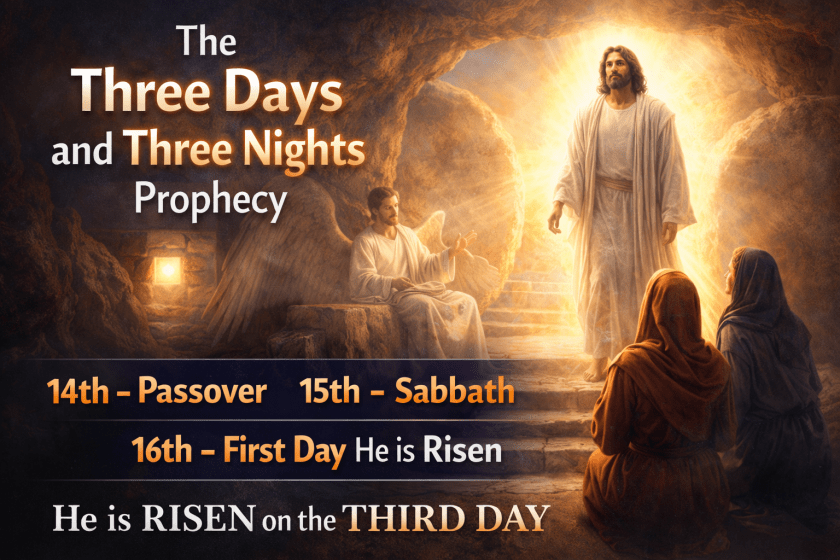
Much discussion surrounds the question of when Yahushua rose from the grave. Some insist that He must have been in the tomb for a literal three days and three nights. Others point to the many scriptures that plainly state He would rise on the third day. The real question, however, is not what tradition says, nor what men have repeated for generations, but what the scriptures themselves actually testify.
If all the witnesses are allowed to speak, the picture becomes very clear. The gospel accounts consistently show that Yahushua died on the 14th day of the month, rested in the tomb on the 15th, and rose on the 16th, the first day of the week. Yet many still appeal to Matthew 12:40 and claim that this one passage must mean Yahushua spent three full days and three full nights in the grave.
But is that really what the passage says?
To answer this properly, we must begin where every sound study should begin: with the plain statements of scripture. Then we must hear the witnesses of Matthew, Mark, Luke, and John concerning what truly happened. After that, we can return to the prophecy of “three days and three nights” and examine it carefully, in context, and in harmony with the rest of the word of Yahuwah.
There is wisdom in closely investigating every doctrine:
“There is no excuse for anyone in taking the position that there is no more truth to be revealed, and that all our expositions of Scripture are without an error. The fact that certain doctrines have been held as truth for many years by our people, is not a proof that our ideas are infallible. Age will not make error into truth, and truth can afford to be fair. No true doctrine will lose anything by close investigation.”
Truth never fears examination. If a teaching is true, it will stand when all the witnesses are heard.
What Yahushua Himself Said
Before looking at the events themselves, we should first establish what Yahushua said concerning His resurrection. The overwhelming testimony of scripture is that He would rise on the third day.
John 2:18-21
18 So the Jews said to him, “What sign do you show us for doing these things?”
19 Yahushua answered them, “Destroy this temple, and in three days I will raise it up.”
20 The Jews then said, “It has taken forty-six years to build this temple, and will you raise it up in three days?”
21 But he was speaking about the temple of his body.Matthew 16:21
From that time Yahushua began to show to His disciples that He must go to Jerusalem, and suffer many things from the elders and chief priests and scribes, and be killed, and be raised upon the third day.Matthew 17:22-23
22 As they were gathering in Galilee, Yahushua said to them, “The Son of Man is about to be delivered into the hands of men,
23 and they will kill him, and he will be raised on the third day.” And they were greatly distressed.Matthew 20:18-19
18 “See, we are going up to Jerusalem. And the Son of Man will be delivered over to the chief priests and scribes, and they will condemn him to death
19 and deliver him over to the Gentiles to be mocked and flogged and crucified, and he will be raised on the third day.”Mark 9:31
For He was teaching His taught ones and said to them, “The Son of Aḏam is being delivered into the hands of men, and they shall kill Him. And having been killed, He shall rise the third day.”Mark 10:34
34 And they shall mock him, and shall scourge him, and shall spit upon him, and shall kill him: and the third day he shall rise again.Luke 9:21-22
21 And he strictly charged and commanded them to tell this to no one,
22 saying, “The Son of Man must suffer many things and be rejected by the elders and chief priests and scribes, and be killed, and on the third day be raised.”Luke 24:7
The Son of Man must be delivered into the hands of sinful men and be crucified and on the third day rise.Luke 24:45-46
45 Then he opened their minds to understand the Scriptures,
46 and said to them, “Thus it is written, that the Son of Yahuwah should suffer and on the third day rise from the dead.”Matthew 27:62-64
62 The next day, that is, after the day of Preparation, the chief priests and the Pharisees gathered before Pilate
63 and said, “Sir, we remember how that impostor said, while he was still alive, ‘After three days I will rise.’
64 Therefore order the tomb to be made secure until the third day, lest his disciples go and steal him away and tell the people, ‘He has risen from the dead,’ and the last fraud will be worse than the first.”
These passages are not uncertain. They do not point in different directions. They repeatedly testify to the same thing: Yahushua would rise on the third day.
With that established, we can now turn to the witnesses of what actually took place.
The Witness of Matthew
Matthew records that Yahushua died on the 14th day of the month.
Matthew 27:50
50 And Yahushua cried out again with a loud voice, and gave up His spirit.
Later that same day, before the Sabbath began, He was buried.
Matthew 27:57-61
57 And when evening came, there came a rich man from Ramathayim, named Yosĕph, who himself had also become a taught one of Yahushua.
58 He went to Pilate and asked for the body of Yahushua. Then Pilate commanded the body to be given.
59 And having taken the body, Yosĕph wrapped it in clean linen,
60 and laid it in his new tomb which he had hewn out of the rock. And he rolled a large stone against the door of the tomb, and went away.
61 And Miryam from Magdala was there, and the other Miryam, sitting opposite the tomb.
This was still the 14th day, the Preparation day, the Passover day.
Matthew then continues:
Matthew 27:62
62 On the next day, which was after the preparation, the chief priests and Pharisees gathered together to Pilate.
The next day after the 14th is the 15th.
Matthew 27:63-66
63 saying, “Master, we remember, while He was still alive, how that deceiver said, ‘After three days I am raised.’
64 Command, then, that the tomb be safeguarded until the third day, lest His taught ones come by night and steal Him away, and should say to the people, ‘He was raised from the dead.’ And the last deception shall be worse than the first.”
65 So Pilate said to them, “You have a watch, go, safeguard it as you know how.”
66 And they went and safeguarded the tomb, sealing the stone and setting the watch.
Then after the Sabbath:
Matthew 28:1
1 Now after the Sabbath, toward dawn on the first day of the week, Miryam from Magdala and the other Miryam came to see the tomb.
This is the 16th day of the month, the first day of the week.
So Matthew’s sequence is plain:
14th – Yahushua dies and is buried
15th – Sabbath
16th – First day of the week, He is risen
Matthew only speaks of three days.
The Witness of Mark
Mark 15:37-42
37 And Yahushua cried out with a loud voice, and breathed His last.
38 And the veil of the Temple was torn in two from top to bottom.
39 And when the captain, who was standing opposite Him, saw that He cried out like this and breathed His last, he said, “Truly this Man was the Son of Elohim!”
40 And there were also women watching from a distance, among whom was also Miryam from Maḡdala, and Miryam the mother of Yaʽaqoḇ the Less and of Yosĕph, and Shelomah,
41 who also followed Him and attended Him when He was in Galil, and many other women who came up with Him to Yerushalayim.
42 And when evening had come, because it was the Preparation Day, that is, the day before the Sabbath.
Mark identifies the day of Yahushua’s death as the Preparation day, the day before the Sabbath.
He then records the burial:
Mark 15:43-47
43 Yosĕph of Ramathayim, a prominent council member, who was himself waiting for the reign of Elohim, came, boldly went in to Pilate and asked for the body of Yahushua.
44 But Pilate wondered whether He was already dead, so summoning the captain, he asked him if He was already dead.
45 And when he learned this from the captain, he gave the body to Yosĕph.
46 And he, having bought fine linen, took Him down, and wrapped Him in the linen. And he laid Him in a tomb which had been hewn out of the rock, and rolled a stone against the entrance of the tomb.
47 And Miryam from Magdala, and Miryam the mother of Yosĕph, saw where He was laid.
Then Mark says:
Mark 16:1-6
1 And when the Sabbath was past, Miryam from Magdala, and Miryam the mother of Yaʽaqoḇ, and Shelomah bought spices, to go and anoint Him.
2 And very early on the first day of the week, they came to the tomb when the sun had risen.
3 And they said among themselves, “Who shall roll away the stone from the entrance of the tomb for us?”
4 And looking up, they saw that the stone had been rolled away, for it was extremely large.
5 And having entered into the tomb, they saw a young man sitting on the right, wearing a white robe, and they were greatly astonished.
6 And he said to them, “Do not be much astonished. You seek Yahushua of Natsareth, who was impaled. He was raised – He is not here! See the place where they laid Him.
Again, the order is unmistakable:
14th – Preparation day
15th – Sabbath
16th – First day of the week
Mark only speaks of three days.
The Witness of Luke
Luke records the same sequence and adds a very important statement.
Luke 23:46-56
46 And crying out with a loud voice, Yahushua said, “Father, into Your hands I commit My spirit.” And having said this, He breathed His last.
47 And the captain, seeing what took place, praised Elohim, saying, “Truly, this Man was righteous!”
48 And when all the crowds who had gathered to that sight saw what took place, they beat their breasts and went away.
49 And all those who knew Him, and the women who followed Him from Galil, stood at a distance, watching this.
50 And see, a man named Yosĕph, a council member, a good and righteous man –
51 he was not agreeing with their counsel and deed – from Ramathayim, a city of the Yehuḏim, who himself was also waiting for the reign of Elohim,
52 he, going to Pilate, asked for the body of Yahushua.
53 And taking it down, he wrapped it in linen, and laid it in a tomb hewn out of the rock, where no one was yet laid.
54 And it was Preparation Day, and the Sabbath was approaching.
55 And the women who had come with Him from Galil followed after, and saw the tomb and how His body was laid.
56 And having returned, they prepared spices and perfumes. And they rested on the Sabbath according to the command.
Luke plainly identifies the day of Yahushua’s death as Preparation day, with the Sabbath immediately approaching. The women prepared spices before the Sabbath and then rested on the Sabbath according to the command.
Then Luke says:
Luke 24:1-3
1 And on the first day of the week, at early dawn, they came to the tomb, bringing the spices which they had prepared,
2 and they found the stone rolled away from the tomb.
3 And having entered, they did not find the body of the Master Yahushua.
So once again the sequence is:
14th – Preparation day
15th – Sabbath
16th – First day of the week
But Luke gives even more. On that same first day of the week, the disciples on the road to Emmaus said:
Luke 24:13-21
13 Now behold, two of them were traveling that same day to a village called Emmaus, which was seven miles from Jerusalem.
14 And they talked together of all these things which had happened.
15 So it was, while they conversed and reasoned, that Yahushua Himself drew near and went with them.
16 But their eyes were restrained, so that they did not know Him.
17 And He said to them, “What kind of conversation is this that you have with one another as you walk and are sad?”
18 Then the one whose name was Cleopas answered and said to Him, “Are You the only stranger in Jerusalem, and have You not known the things which happened there in these days?”
19 And He said to them, “What things?”
So they said to Him, “The things concerning Yahshua of Nazareth, who was a Prophet mighty in deed and word before Elohim and all the people,
20 and how the chief priests and our rulers delivered Him to be condemned to death, and crucified Him.
21 But we were hoping that it was He who was going to redeem Israel. Indeed, besides all this, today is the third day since these things happened.”
That statement is like a rock that cannot be moved. On the first day of the week, the day the tomb was found empty, they said, “Today is the third day.”
Luke only speaks of three days.
The Witness of John
John’s witness is just as plain.
John 18:39-40
39 “But you have a custom that I should release someone to you at the Passover. Do you therefore want me to release to you the King of the Jews?”
40 Then they all cried again, saying, “Not this Man, but Barabbas!” Now Barabbas was a robber.
The day Yahushua was crucified was the Passover.
John 19:30-31
30 So when Yahushua took the sour wine He said, “It has been accomplished!” And bowing His head, He gave up His spirit.
31 Therefore, since it was the Preparation Day, that the bodies should not remain on the stake on the Sabbath…
John identifies the day of His death as the Preparation day.
John 19:31-42
31 Since it was the day of Preparation, in order to prevent the bodies from hanging on the cross on the Sabbath (for that Sabbath was a high holy day) the Jews asked Pilate to have their legs broken and the bodies taken away.
32 Therefore the soldiers came and broke the legs of the first, and of the other who was impaled with Him,
33 but when they came to Yahushua and saw that He was already dead, they did not break His legs.
34 But one of the soldiers pierced His side with a spear, and instantly blood and water came out.
35 And he who has seen has witnessed, and his witness is true. And he knows that he is speaking the truth, in order that you might believe.
36 For this took place in order for the Scripture to be filled: “Not one of His bones shall be broken.”
37 And again another Scripture says, “They shall look on Him whom they pierced.”
38 And after this, Yosĕph of Ramathayim, being a taught one of Yahushua, but secretly, for fear of the Yehuḏim, asked Pilate that he might take the body of Yahushua, and Pilate gave permission. Therefore he came and took the body of Yahushua.
39 And Naḵdimon, who at first came to Yahushua by night, also came, bringing a mixture of myrrh and aloes, about a hundred pounds.
40 Then they took the body of Yahushua, and bound it in linen wrappings with the spices, as was the habit of the Yehuḏim for burial.
41 And at the place where He was impaled there was a garden, and in the garden a fresh tomb in which no one had yet been laid.
42 There, then, because of the Preparation of the Yehuḏim, they laid Yahushua, because the tomb was near.
Then John records the resurrection morning:
John 20:1
1 And on the first day of the week Miryam from Magdala came early to the tomb, while it was still dark, and saw that the stone had been removed from the tomb.
Again, the sequence is the same:
14th – Preparation day
15th – Sabbath
16th – First day of the week
John only speaks of three days.
The United Testimony of the Four Witnesses
Matthew, Mark, Luke, and John all testify together.
14th – Yahushua is impaled and buried
15th – Yahushua rests in the grave on the Sabbath
16th – Yahushua rises on the first day of the week
This agrees perfectly with what Yahushua Himself said:
Mark 9:31
“For He was teaching His taught ones and said to them, ‘The Son of Aḏam is being delivered into the hands of men, and they shall kill Him. And having been killed, He shall rise the third day.’”The four gospel accounts do not place Yahushua in the grave for three full days and three full nights. They place Him in the grave across the 14th, 15th, and 16th, with His resurrection occurring on the third day.
An Extra Witness: The Book of Nicodemus
There is also an additional witness found in the Book of Nicodemus.
The Book of Nicodemus is an ancient apocryphal writing, often linked with the Acts of Pilate. It is not part of the canon of scripture and should not be treated as equal to the inspired writings. However, it is of interest because it preserves an early traditional witness concerning the burial and resurrection narrative, and in this matter its sequence agrees with the gospel accounts.
Nicodemus 9:5-8
5 In like manner Joseph, when he came to the Jews, said to them Why are ye angry with me for desiring the body of Jesus of Pilate? Behold, I have put him in my tomb, and wrapped him up in clean linen, and put a stone at the door of the sepulchre:
6 I have acted rightly towards him; but ye have acted unjustly against that just person, in crucifying him, giving him vinegar to drink, crowning him with thorns, tearing his body with whips, and prayed down the guilt of his blood upon you.
7 The Jews at the hearing of this were disquieted, and troubled; and they seized Joseph, and commanded him to be put in custody before the sabbath, and kept there till the sabbath was over.
8 And they said to him, Make confession; for at this time it is not lawful to do thee any harm, till the first day of the week come.Nicodemus 9:12-14
12 The elders of the Jews hearing these words, were exceedingly enraged; and seizing Joseph, they put him into a chamber where there was no window; they fastened the door, and put a seal upon the lock;
13 And Annas and Caiaphas placed a guard upon it, and took counsel with the priests and Levites, that they should all meet after the sabbath, and they contrived to what death they should put Joseph.
14 When they had done this, the rulers, Annas and Caiaphas, ordered Joseph to be brought forth.Nicodemus 10:2-6
2 Then Annas and Caiaphas went forth, and while they were all admiring at Joseph’s being gone, behold one of the soldiers, who kept the sepulchre of Yahushua, spake in the assembly.
3 That while they were guarding the sepulchre of Yahushua, there was an earthquake; and we saw an angel of God roll away the stone of the sepulchre and sit upon it;
4 And his countenance was like lightning and his garment like snow; and we became through fear like persons dead.
5 And we heard an angel saying to the women at the sepulchre of Yahushua, Do not fear; I know that you seek Yahushua who was crucified; he is risen as he foretold.
6 Come and see the place where he was laid; and go presently, and tell his disciples that he is risen from the dead, and he will go before you into Galilee; there ye shall see him as he told you.
Even this extra witness follows the same order:
14th – Impalement
15th – In the grave
16th – Risen on the first day of the week
Returning to the Prophecy of Three Days and Three Nights
Now that the witnesses have spoken, we must return to the verse so often used to argue against them.
Matthew 12:40
40 For as Jonas was three days and three nights in the whale’s belly; so shall the Son of man be three days and three nights in the heart of the earth.
At first glance, some assume that this must refer to the time Yahushua spent dead in the tomb. Yet that interpretation immediately creates a conflict with the many other scriptures that plainly state He would rise on the third day.
The scriptures do not contradict themselves. If the plain testimony of many passages says He rose on the third day, then Matthew 12:40 must be understood in a way that harmonizes with them, not in a way that overturns them.
To understand it properly, we must begin with the context.
Matthew 12:38-41
38 Then certain of the scribes and of the Pharisees answered, saying, Master, we would see a sign from thee.
39 But he answered and said unto them, An evil and adulterous generation seeketh after a sign; and there shall no sign be given to it, but the sign of the prophet Jonas:
40 For as Jonas was three days and three nights in the whale’s belly; so shall the Son of man be three days and three nights in the heart of the earth.
41 The men of Nineveh shall rise in judgment with this generation, and shall condemn it: because they repented at the preaching of Jonas; and, behold, a greater than Jonas is here.
Verse 39 is often left out when this passage is quoted, yet it is critical. The sign was given to an evil and adulterous generation. It was directed at the wicked who would reject Him, accuse Him, examine Him, and condemn Him.
Just as important, the verse does not mention the tomb. It does not say grave. It does not say sepulchre. It says the Son of Man would be three days and three nights in the heart of the earth.
That raises the real question: what is meant by the heart of the earth?
What Is the Heart of the Earth?
Scripture identifies Jerusalem as being in the midst, or center, of the earth.
Ezekiel 5:5
Thus saith the Yahuwah Elohim; This is Jerusalem which I have set it in the midst of the nations and countries that are round about her.Psalms 74:12
For Elohim is my Sovereign from old, working deliverance from the midst of the earth.Ezekiel 38:12
to take plunder and to take booty, to stretch out your hand against the waste places that are again inhabited, and against a people gathered from the nations, acquiring livestock and goods, who dwell in the midst of the earth.Exodus 8:22
And I will sever in that day the land of Goshen, in which my people dwell, that no swarms of flies shall be there; to the end thou mayest know that I am Yahuwah in the midst of the earth.Genesis 48:15-16
15 Then Jacob blessed Joseph, and said,
“The Elohim before whom my fathers Abraham and Isaac walked,
The Elohim who has been my Shepherd all my life to this day,
16 The Angel who has redeemed me from all evil,
Bless the boys;
And may my name live on in them,
And the names of my fathers Abraham and Isaac;
And may they grow into a great multitude in the midst of the earth.”
The “heart of the earth,” then, is best understood as Jerusalem, the midst of the land, where Yahushua was delivered into the hands of sinful men and persecuted by the wicked.
This means Matthew 12:40 is not speaking of the time He lay dead in the tomb. It is speaking of the period in which He was in the heart of the earth, under examination, accusation, mocking, and persecution. And that very scripture says who would do it. It was a prophecy against those who would persecute him.
The Three Days and Three Nights: From the 11th to the 13th
Scripture begins this sequence before Passover.
John 12:1-2
1 Accordingly Yahushua, six days before the Passover came to Bethany where Lazarus was, who had died, who He raised from the dead.
2 So they made Him a supper there, and Martha served while Lazarus was one who sat at the table with Him.
The next day was the 10th day of the month.
John 12:12-13
12 On the next day a great crowd who had come to the Festival, when they heard that Yahushua was coming to Jerusalem,
13 took the branches of palm trees and went outside to meet Him and were crying out “Hosanna! Blessed is He who is coming in the name of YHWH, the sovereign of Israel!”
The 10th day was the day the lamb was selected.
Exodus 12:3
3 Speak to all the congregation of Israel, saying: “On the tenth of this month every man shall take for himself a lamb, according to the house of his father, a lamb for a household.”Exodus 12:6
6 Now you shall keep it until the fourteenth day of the same month.
Yahushua, the true Lamb, entered Jerusalem on the 10th and was then under examination until the 14th.
After His supper with the disciples, He went out to Gethsemane.
Matthew 26:30 and 36
30 And having sung a song, they went out onto the Mount of Olives.
36 Then Yahushua came with them to a place called Gethsemane and said to the disciples, “Sit here while I go over there and pray.”
Sometime between midnight and dawn He was arrested and taken to Caiaphas. The lamb was selected and the prophecy of the wicked was about to be fulfilled.
Matthew 26:57, 59-61
57 And those who had seized Yahushua led Him away to Caiaphas the High Priest, where the scribes and the elders were gathered together.
59 And the Chief Priests, and the elders, and all the council were seeking false witness against Yahushua to put Him to death,
60 but found none. Although many false witnesses came forward, they found none. But at last two false witnesses came forward
61 and said, “This one said, I am able to destroy the Temple of Elohim and build it in three days.”
This begins the 11th day. Yahushua is now in the heart of the earth, in Jerusalem, in the hands of wicked men. Here begins the first day and night of the sign of Jonah.
The next day comes in Matthew 27:1.
Matthew 27:1-2
1 And morning having come, all the Chief Priests and elders of the people took counsel against Yahushua, so as to put Him to death.
2 And having bound Him, they led Him to Pontius Pilate the governor.
Pilate then sent Him to Herod.
Luke 23:6-11
6 And when Pilate heard of Galilee, he asked the Man if He were a Galilean.
7 And when he learned that He was under the authority of Herod, he sent Him to Herod who was also in Jerusalem in those days.
8 And seeing Yahushua, Herod rejoiced greatly, for a long time he had wanted to see Him, because he had heard much about Him, and was anticipating to see some miracles done by Him,
9 and was questioning Him with many words, but He gave no answer.
10 And the Chief Priests and the scribes stood accusing Him intensely.
11 And Herod with his soldiers mocked Him, dressing Him in bright robes, and sent Him back to Pilate.
These events fill out the second and third days of the prophecy. Yahushua remains in the heart of the earth, being examined, accused, rejected, and mocked by the wicked generation to whom that sign was given.
Then comes the 14th, when the Lamb is slain.
Luke 23:13-17
13 And Pilate, having called together the chief priests and the rulers of the people,
14 said to them, “You brought this Man to me, as one who turns away the people. And look. I have examined Him in your presence and have found no guilt in this Man regarding the charges which you have made against Him.
15 and neither did Herod, for I sent you back to Him. And look. He has done nothing deserving of death.
16 Having disciplined Him, then, I shall release Him.”
17 for he had one to release to them at the festival.Luke 23:23-24
23 But with loud voices they insisted asking for Him to be impaled. And the voices of these men and other Chief Priests were prevailing.
24 And Pilate pronounced sentence that what they had asked should be done.Luke 23:44-46
44 And now it was about the sixth hour and darkness came over all the land until the ninth hour.
45 And the sun was darkened and the veil of the temple was torn in two.
46 And crying out with a loud voice Yahushua said, “Father, into Your hands I commit My spirit.” And having said this, He breathed His last.
So the full sequence is:
10th – The Lamb is selected
11th – First day and night in the heart of the earth
12th – Second day and night
13th – Third day and night
14th – Passover, the Lamb is slain
15th – Sabbath, He rests in the grave
16th – Firstfruits, He rises on the third day – The first day of the week.
Yahushua Our Firstfruits
The feast pattern itself confirms this order.
Exodus 12:6
6 And ye shall keep it up until the fourteenth day of the same month: and the whole assembly of the congregation of Israel shall kill it in the evening.Numbers 28:16
16 On the fourteenth day of the first month is the Passover of Yahuwah.Leviticus 23:5
5 On the fourteenth day of the first month at twilight is Yahuwah’s Passover.
Then comes Firstfruits:
Leviticus 23:10-11
10 “Speak to the children of Israel, and say to them: ‘When you come into the land which I give to you, and reap its harvest, then you shall bring a sheaf of the first fruits of your harvest to the priest.
11 He shall wave the sheaf before Yahuwah, to be accepted on your behalf; on the day after the Sabbath the priest shall wave it.’”
Joshua shows the same pattern:
Joshua 5:10-12
10 Now the children of Israel camped in Gilgal, and kept the Passover on the fourteenth day of the month at twilight on the plains of Jericho.
11 And they ate of the produce of the land on the day after the Passover, unleavened bread and parched grain, on the very same day.
12 Then the manna ceased on the day after they had eaten the produce of the land; and the children of Israel no longer had manna, but they ate the fruit of the land of Canaan that year.
The order is plain:
14th – Passover
15th – Sabbath
16th – Day after the Sabbath, Firstfruits
Now compare this with Yahushua
1 Corinthians 15:12-23
12 Now if Yahushua be preached that he rose from the dead, how say some among you that there is no resurrection of the dead?
13 But if there be no resurrection of the dead, then is Yahushua not risen:
14 And if Yahushua be not risen, then is our preaching vain, and your faith is also vain.
15 Yea, and we are found false witnesses of YHWH; because we have testified of YHWH that he raised up Yahushua: whom he raised not up, if so be that the dead rise not.
16 For if the dead rise not, then is not Yahushua raised:
17 And if Yahushua be not raised, your faith is vain; ye are yet in your sins.
18 Then they also which are fallen asleep in Yahushua are perished.
19 If in this life only we have hope in Yahushua, we are of all men most miserable.
20 But now is Yahushua risen from the dead, and become the firstfruits of them that slept.
21 For since by man came death, by man came also the resurrection of the dead.
22 For as in Adam all die, even so in Yahushua shall all be made alive.
23 But every man in his own order: Yahushua the first fruits; afterward they that are Yahushua’s at his coming.
Yahushua rose on the day of Firstfruits, the 16th day of the month, the day after the Sabbath.
John 19:31
Therefore, because it was the Preparation Day, that the bodies should not remain on the cross on the Sabbath…Mark 15:42
Now when evening had come, because it was the Preparation Day, that is, the day before the Sabbath…Luke 23:56
Then they went back and prepared spices and ointments and sweet-smelling herbs. And on the Sabbath they rested in accordance with the commandment.Matthew 28:1
Now after the Sabbath, as the first day of the week began to dawn, Mary Magdalene and the other Mary came to see the tomb.Mark 16:2
Very early in the morning, on the first day of the week, they came to the tomb when the sun had risen.Mark 16:9
Now when He rose early on the first day of the week, He appeared first to Mary Magdalene, out of whom He had cast seven demons.
Yahushua fulfilled the pattern perfectly:
14th – Passover Lamb slain
15th – Rest in the grave on the Sabbath
16th – Firstfruits, risen before Yahuwah
The Biblical Calendar and the Gregorian Calendar Are Not the Same
This matter also brings into focus another important truth: the Biblical calendar and the modern Gregorian calendar are not the same system.
The Biblical month begins with the new moon. The day numbers in scripture are reckoned from that point, not from the international date line and not from the continuous weekly cycle assumed in the Julian and Gregorian calendars. The reckoning of the month belongs to the Biblical calendar structure itself.
New Moon day was not counted as an ordinary work day. After that came the six working days and then the Sabbath, repeated through the month until the next new moon was sought again. This means that the day numbers seen in scripture must be understood from the sighting of the new moon, not from the civil calendar in use today.
This is why the 14th, 15th, and 16th days matter so much. Scripture shows Passover, Unleavened Bread, and Firstfruits as fixed by the Biblical month. The Messiah, as the great antitypical Lamb, fulfilled all of these types exactly as laid out in Leviticus 23.
He was crucified on the 14th of the month. He rested in the tomb over the Sabbath on the 15th. He rose on the 16th, the day of Firstfruits, the first day of the week.
This is of great importance because it shows that the Biblical calendar week does not align with the uninterrupted succession of modern Gregorian weeks as many assume. It answers the question of when the Messiah died and rose, and it shows that the events must be understood according to the Biblical calendar, not the modern civil one.
Conclusion
When all the witnesses are heard, the matter becomes plain.
Yahushua repeatedly said He would rise on the third day.
Matthew testifies to three days.
Mark testifies to three days.
Luke testifies to three days.
John testifies to three days.
The feast pattern testifies to three days.
Firstfruits confirms the third day.
The “three days and three nights” prophecy of Matthew 12:40 is therefore not a contradiction to the resurrection accounts. It is a prophecy concerning the Son of Man being in the heart of the earth, in Jerusalem, in the hands of a wicked and adulterous generation, from the 11th through the 13th, before He was slain on Passover.
The full scriptural order is this:
10th – The Lamb selected
11th – First day and night in the heart of the earth
12th – Second day and night
13th – Third day and night
14th – Passover, Yahushua slain
15th – Sabbath, resting in the grave
16th – Firstfruits, risen on the third day
This understanding preserves all the witnesses of scripture. It does not force one verse to overthrow many others. It harmonizes the prophecy with the plain testimony of the gospels, with the feast pattern of Leviticus 23, and with the witness that Yahushua is indeed the Firstfruits of those who sleep.
If we are willing to let scripture interpret scripture, then the matter is established.
The Messiah died on the 14th.
He rested on the 15th.
He rose on the 16th.
And He rose, exactly as the scriptures said, on the third day.
Yahuwah bless.
 The Calendar of Scripture
And God called the light Day and the darkness he called Night. Thus three days and three nights are not three 24 hour periods. They are six alternating periods of light and dark. If he died
LikeLike
Genesis 1:3-5
3 Elohim said, “Let there be light”; and there was light.
4 Elohim saw that the light was good and He affirmed and sustained it;
Elohim separated the light from the darkness.
5 Elohim called the light day, and the darkness He called night.
Then there was evening and then there was morning.
Day one.
Light, Evening, Night, Morning. -> And that is a day.
The portion we call Day is governed by the Light and that is correct. However Light travels around the world continuously and when it returns the next day begins and the old one has finished.
LikeLike
Obviously you have reconciled it differently but I am not sure you can ignore the Day and Night on the 14th.
LikeLike
The darkness was not night that fell. It was the absence of God. God is Light for we read On 1 John 1:5
1 John 1:5
“This then is the message which we have heard of him, and declare unto you, that God is light, and in him is no darkness at all.”
And the scriptures testify that it was before the evening that he was laid to rest:
Mark 15:42–46
“It was Preparation Day (that is, the day before the Sabbath). So as evening approached… Joseph of Arimathea… took down the body… wrapped it… and placed it in a tomb.”
Matthew 27:57–60
“As evening approached, there came a rich man from Arimathea… Joseph… placed it in his own new tomb.”
LikeLike