
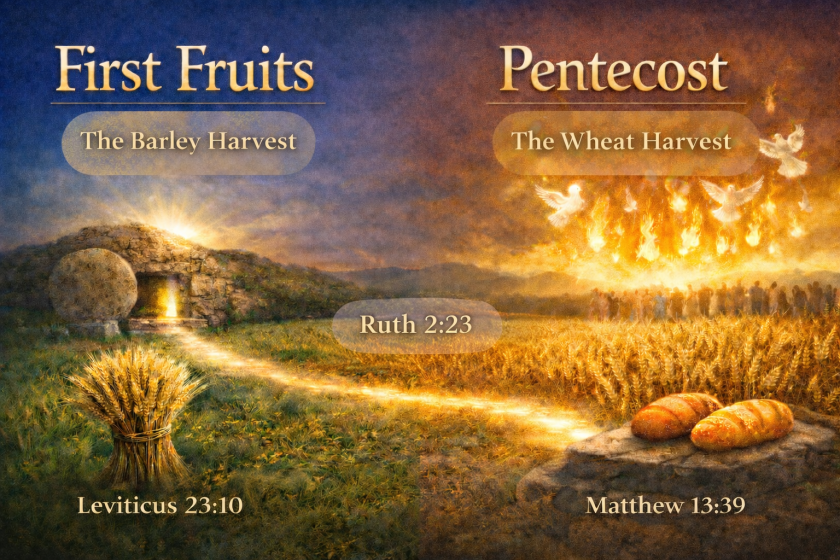
Today, according to the Scriptural calendar, we observe the Day of First Fruits—an appointed time established by Yahuwah from the beginning, rich in both agricultural and prophetic meaning.
This is not a tradition of men, but a day defined in Scripture, fulfilled in Yahushua, and still declaring truth today.
What Are First Fruits?
The command is given in Deuteronomy:
“You shall take some of the first of all the produce of the ground…
…and now, behold, I have brought the first fruits of the land which You, O Yahuwah, have given me.”
First Fruits was the offering of the very first yield of the land. This was not just any harvest—it was the barley harvest, the earliest crop to ripen.
This offering acknowledged that Yahuwah is the provider, that the land belongs to Him, and that the first portion is set apart and holy.
It was an act of trust. Before the full harvest came in, the first was given.
When Is First Fruits?
Leviticus tells us that the sheaf of First Fruits is to be waved:
“On the day after the Sabbath.”
This places it immediately after the Sabbath that follows Passover.
We are not left to guess when this occurred. Scripture records the exact timing when Israel entered the land:
Joshua 5:10–12
“Now the children of Israel camped in Gilgal, and kept the Passover on the fourteenth day of the month at twilight on the plains of Jericho.
And they ate of the produce of the land on the day after the Passover, unleavened bread and parched grain, on the very same day.
Then the manna ceased on the day after they had eaten the produce of the land; and the children of Israel no longer had manna, but they ate the food of the land of Canaan that year.”
This passage gives us the full sequence:
- The 14th day – Passover
- The 15th day – the Sabbath (the first day of Unleavened Bread)
- The 16th day – the day after the Sabbath, when they first ate the produce of the land
This 16th day marks the beginning of the barley harvest, and it aligns perfectly with the instruction given in Leviticus for the Day of First Fruits.
The Barley Harvest – A Prophetic Beginning
Barley is the first of the harvests.
It is not the full harvest, but the beginning of them—the first sign that the season of gathering has arrived.
This is why First Fruits is so significant. It points forward. It declares that more is coming.
Yahushua – The First Fruits
Paul writes:
“But now is Yahushua risen from the dead, and become the first fruits of them that slept.”
Yahushua rose on this very day—the Day of First Fruits.
Just as the first sheaf of barley was lifted before Yahuwah, Yahushua was raised as the first of the resurrection, guaranteeing that others will follow.
The Timing of His Resurrection
The timeline given in Scripture is precise:
- Yahushua was crucified on Passover (14th)
- He rested in the tomb on the Sabbath (15th)
- He rose on the Day of First Fruits (16th)
Luke records:
“On the Sabbath they rested according to the commandment.”
And the Gospels tell us:
“As the first day of the week began to dawn…”
“Very early in the morning… when the sun had risen…”
He rose at dawn, at the beginning of the day.
This aligns perfectly with the time the First Fruits offering would be presented.
The Third Day
Scripture consistently states that He would rise on the third day.
Counting:
- 14th → first day
- 15th → second day
- 16th → third day
The Day of First Fruits is therefore the day of resurrection and new life.
The First Fruits and the Resurrection of Many
Yahushua was not alone in resurrection at that time.
“And the graves were opened; and many bodies of the saints which slept arose… and appeared unto many.”
This is a powerful witness.
The First Fruits offering was never about a single grain—it represented the beginning of a harvest. In the same way, Yahushua rose first, and others were raised and seen in Jerusalem, confirming that the harvest had begun.
The Order of the Resurrection
Scripture tells us:
“Messiah the first fruits; afterward they that are Messiah’s at His coming.”
There is an order.
Yahushua is first. Others follow. The full harvest comes later at His coming. This tells us when the second coming is and is refelected in many scriptures speaking of the wheat harvest which we know as Pentecost.
This reflects the pattern established in the harvest itself.
Counting to Pentecost – The Continuation of the Harvest
The Day of First Fruits is not the end—it is the beginning of a count.
Leviticus 23 commands:
“15 Count, so it happens, from the day after the Sabbaths of the wave sheath (unleavened bread), seven Sabbaths complete.
16 Count fifty days, to the day which is after the seventh Sabbath. Then you shall offer a new grain offering to Yahuwah.”
This instruction establishes a defined starting point. The count begins from the day after the last Sabbath of Unleavened Bread, at the time of the wave sheaf offering. From this point, a measured count is made until the next appointed time.
When this is understood correctly, something remarkable is seen.
If we count fifty working days from that starting point—the day after the last Sabbath of Unleavened Bread—we arrive at a very specific time: the 16th day of the third new moon.
This is not arbitrary. It shows that the count is precise, structured, and anchored within Yahuwah’s calendar.
What strengthens this further is that we are given a second witness to the same pattern in the book of Daniel:
“Blessed is he who waits, and comes to the thousand three hundred and thirty-five days.”
— Daniel 12:12
When the 1335 days are counted from the Day of Trumpets, they also lead to the 16th day of the third new moon.
This agreement between Leviticus and Daniel is not coincidence.
Both passages:
- Begin from an appointed starting point
- Require a measured count
- Lead to the same appointed day
- Declare blessing upon those who arrive at that time
This reveals a consistent pattern in Yahuwah’s calendar. He establishes times, sets counts, and brings His people to appointed days with precision.
In this light, the resurrection of Yahushua on First Fruits becomes even more significant. It is not only the beginning of the barley harvest, but also the starting point of a count that leads forward into a greater harvest.
The same pattern seen in the barley and wheat harvests is reflected in the counting of days. What begins with First Fruits continues, unfolds, and leads to a greater ingathering—exactly as Yahuwah has appointed.
The Wheat Harvest – Pentecost
Following the count from First Fruits, we arrive at Pentecost—the appointed time that completes the counting process.
This day is not separate from what came before. It is the fulfillment of the count that began from the day after the last Sabbath of Unleavened Bread. Having completed the full measure, we arrive at the time appointed by Yahuwah for the next stage of the harvest.
Pentecost is associated with the wheat harvest, a greater and fuller ingathering than the barley that came before. Where First Fruits marked the beginning, Pentecost represents increase.
In the Torah, this is marked by the offering of two loaves before Yahuwah, signifying a more complete gathering.
In the Renewed Covenant, we see this fulfilled:
“When the day of Pentecost had fully come… they were all filled with the Holy Spirit…”
This moment is not random—it occurs precisely at the end of the counted days.
On that day, the Spirit was poured out, the message went forth, and many were added. What began with one—the First Fruits—now expands into a greater harvest.
The pattern remains consistent. The barley comes first, then the wheat. The beginning is followed by increase. What was first established in Yahushua continues in those who follow Him.
The Full Pattern of the Harvest
Scripture reveals a consistent pattern:
The barley harvest comes first. Then the wheat.
Yahushua rises first. Then many are gathered.
First Fruits marks the beginning. Pentecost continues the work. The final harvest is still to come.
Why This Matters
First Fruits is not just history.
It shows us that:
- Resurrection has already begun
- Yahushua is the guarantee
- The harvest is still unfolding
A Call to Return
These are the appointed times of Yahuwah.
“This day shall be to you a memorial… you shall keep it as an appointed time.”
They were given for remembrance, for understanding, and for truth.
Conclusion
Today we remember the beginning of the harvest.
The barley has been offered.
The First Fruits has been raised.
The third day has been fulfilled.
The saints have been seen.
The count has begun.
And the wheat harvest is still to come.
He is risen.
He is the First Fruits.
 The Calendar of Scripture
His name is YAHUAH!Pray for discernment and st
LikeLike
The days line up with what I follow, 04/05/2026, is the first fruits. After that we disagree!!!
LikeLike
Explain how?
LikeLike
03/21/2026 = 01/01 Abib
04/03/2026 = 01/14 Passover
04/04/2026 = 01/15 Shabbat/Unleaven Bread
04/05/2026 = 01/16 First Fruits
LikeLike
Hi James,
21/03/2026 = 01/01 Abib – We agree
03/04/2026 = 14/01 Passover – We agree
04/04/2026 = 15/01 Shabbat/Unleaven Bread – We agree
05/04/2026 = 16/01 First Fruits – We Agree
So not sure what we disagree on those dates. The one most people do not see clearly yet is the wheat harvest.
LikeLike
05/27 = 7th Sabbath95/28 = Wheat Harvestsorry my reply is late but your email was in my sp
LikeLike
HI Jim,
I think part of our converstation was cut off for some reason. I have noticed this occurring a little lately.
So I think you are saying that the wheat harvest is on the 27/5 – 28/5?
In Australia we celebrate it on the 3/6.
I would have a guess then that you are starting your count before the end of the feast of unleavened bread, where as we start it after the feast. We do it this way because of the three witnesses in the Bible that show this was the way it was counted.
Witness 1:
In Matthew 13:39 it says “the harvest is the
end of the age
“.
Daniel 12:11-13 says “11 “And from the time that the continual is taken away, and the abomination of desolation is set up, there shall be one thousand two hundred and ninety days. 12 Blessed is he who waits, and comes to the one thousand three hundred and thirty-five days. 13 “But you, go your way
till the time of end
for you shall rest, and will arise to your inheritance at the end of the days.”
If you count 1335 days from the appointed time of trumpets, you land on the 16th day of the third new moon.
Witness 2:
Leviticus 23
“15 Count, so it happens, from the day after the Sabbaths of the wave sheath (unleavened bread), seven Sabbaths complete.
16 Count fifty days, to the day which is after the seventh Sabbath. Then you shall offer a new grain offering to Yahuwah.”
If you count from the day after the Sabbath of unleavened bread, you will also land upon the 16th day of the third new moon.
Witness 3:
Deuteronomy 16:8-10 (verse 8 is included only because it shows something most people miss regarding unleavened bread)
8 Six days you shall eat unleavened bread, and on the seventh day there shall be a sacred assembly to the Lord your God.
You shall do no work on it
.
9 “You shall count seven weeks for yourself; begin to count the seven weeks from the time you begin to put the sickle to the grain. 10 Then you shall keep the Feast of Weeks to the Lord your God with the tribute of a freewill offering from your hand, which you shall give as the Lord your God blesses you.
The Sickle was put the the grain for the barley harvest after the last Sabbath of unleavened bread.
Seven weeks brings us again to the 16th day of the third new moon.
There are just three witnesses. If you look in Jubilees, you will find the exact same day being spoken of here as well.
Witness 4
Jubilees 14:1, 9-11, 19-20
1 After these things, in the fourth year of this week, on the new moon of the third month, the word of Yahuah came to Abram in a dream, saying: ‘Fear not, Abram; I am thy defender, and thy reward will be exceeding great.’
9 And He said unto him: ‘Take Me an heifer of three years, and a goat of three years, and a sheep of three years, and a turtle-dove, and a pigeon.’ …
10 And he took all these in the middle of the month and he dwelt at the oak of Mamre, which is near Hebron.
11 And he built there an altar, and sacrificed all these; and he poured their blood upon the altar, and divided them in the midst, and laid them over against each other; but the birds divided he not.
…
19 And the day passed, and Abram offered the pieces, and the birds, and their fruit offerings, and their drink offerings, and the fire devoured them.
20 And on that day we made a covenant with Abram, according as we had covenanted with Noah in this month; and Abram renewed the festival and ordinance for himself
for ever.
Witness 5:
Jubilees 15:1
1 And in the fifth year of the fourth week of this jubilee, in the third month, in the middle of the month, Abram celebrated the appointed time of the first-fruits of the wheat harvest.
Witness 6:
It was the appointed time of harvest. We see this again in the next chapter also:
Jubilees 16:13
13 And she (Sarah) bare a son in the third month, and in the middle of the month, at the time of which Yahuwah had spoken to Abraham, on the festival of the first fruits of the harvest, Isaac was born.
We also see in Jubilees 1:1 that this was the time when Moses ascended the mount to receive the commandments of Yahuwah.
Jubilees 1:1
1 And it came to pass in the first year of the exodus of the children of Israel out of Egypt, in the third month, on the sixteenth day of the month, that Yahuwah spake to Moses, saying: ‘Come up to Me on the Mount, and I will give thee two tables of stone of the law and of the commandment, which I have written, that thou mayst teach them.’
There are too many witnesses all saying the same thing here.
This is how I see it. I pray this assist you in your walk with him as well.
Yahuwah bless.
LikeLike
04/04 1st unleaven04/10 last unleaven04/11 1st of 7 sabbaths04/18 2nd of 704/27 3rd of 705/4 4th of 705/11 5th of 705/18 6th of 705/27 7th of 7 sabbaths05/28 Shavuot Wheat Harvestpentecost was an add on unless Moshe knew how to speak greek
LikeLike
Hi Jim,
Thanks again for laying out your dates—it really helps to see where the difference is.
I can see you’re starting your count from the Sabbath within Unleavened Bread, but I believe Scripture points us to begin the count after that period, when the sickle is first put to the grain.
This is important, because Deuteronomy 16 makes something very clear:
Verse 8 says:
“Six days you shall eat unleavened bread, and on the seventh day there shall be a sacred assembly to the Lord your God. You shall do no work therein.”
Then immediately after, verse 9 says:
“You shall count seven weeks for yourself; begin to count the seven weeks from the time you begin to put the sickle to the grain.”
So the instruction is sequential:
👉 First: the full period of Unleavened Bread, where no work is done on the seventh day
👉 Then: begin the count when the sickle is put to the grain
That means the count does not begin during Unleavened Bread—it begins after it.
April 18 -> 1st Sabbath
April 27 -> 2nd Sabbath
May 4 -> 3rd Sabbath
May 11 -> 4th Sabbath
May 18 -> 5th Sabbath
May 26 -> 6th Sabbath
June 2 -> 7th Sabbath
Then the next day (June 3rd here where I live) is the 50th day:
June 3 -> Pentecost / Wheat Harvest (Can vary 1 gregorian day depending upon where the new moon is seen)
But more importantly, I don’t think this can be established from Leviticus alone—we need to bring in all the witnesses Scripture gives us.
First:
Leviticus 23:15–16
We are told to count seven Sabbaths complete, then the next day (the 50th day).
That gives us the structure.
Second:
Deuteronomy 16:8–9
Shows the count begins when the sickle is first put to the grain, which occurs after the set-apart period of Unleavened Bread.
That gives us the starting point.
Now this is where it becomes important:
Third witness — Matthew 13:39
“The harvest is the end of the age.”
So the harvest we are counting toward is not just agricultural—it is prophetic.
Fourth witness — Daniel 12:11–12
“Blessed is he who waits and comes to the 1335 days.”
This is speaking of the time of the end.
When counted from the appointed time of Trumpets using the biblical structure of time (12 months of 30 days):
➡ You arrive at the 15th day of the 3rd month
➡ The next day → 16th day of the 3rd month
Which is the exact same day as the harvest.
So Daniel is not separate—he is confirming the same appointed time.
Fifth witness — Jubilees
While not Scripture, it is still an ancient witness.
Jubilees consistently places:
The feast of weeks / first fruits of the wheat harvest
in the middle of the third month
Which aligns with the 16th day.
So when all the witnesses are brought together:
Leviticus — how to count
Deuteronomy — when to begin
Matthew — what the harvest represents
Daniel — the prophetic timing to that same point
Jubilees — historical confirmation of the timing
They all point to the same place:
➡ 16th day of the 3rd month
So the issue is not just:
“How do we read Leviticus?”
It is:
Do all the witnesses agree?
Because if one interpretation of Leviticus causes it to conflict with Daniel and the prophetic timeline, then something in that interpretation needs to be re-examined.
That’s why I land on this position.
Not from one passage—but because all the witnesses align there.
LikeLike