
There is much discussion surrounding the timing of the Last Supper. Many assume it was the Passover meal itself. However, when we carefully examine the Scriptures, there are strong indications that it may have taken place earlier—specifically on the 10th day of the month.
This is not stated plainly in a single verse, but when we bring the Scriptures together, a clear pattern begins to emerge.
Scripture is often revealed in this way—“precept upon precept… line upon line… here a little, there a little” (Isaiah 28:10). When the passages are brought together, the full picture becomes clear.
The Pattern Given in Exodus
The foundation for understanding this comes from the instructions regarding the Passover lamb:
Exodus 12:3–6
“On the tenth of this month every man shall take for himself a lamb…
…you shall keep it until the fourteenth day of the same month…”
On the 10th day, the lamb was to be chosen. It was then kept and examined until the 14th day, when it was sacrificed.
This requirement was not simply practical—it was prophetic.
Yahushua Enters Jerusalem – The Lamb Is Chosen
When we turn to the Gospels, we see this pattern begin to unfold.
John 12:1–2
“Six days before the Passover, Yahushua came to Bethany…”
If Passover is on the 14th day, this places Him in Bethany on the 9th.
Then we read:
John 12:12–13
“On the next day… they took branches… and cried out, ‘Blessed is He who comes in the name of Yahuwah…’”
This brings us to the 10th day.
This is highly significant. The 10th day is when the lamb was to be selected. On this very day, Yahushua enters Jerusalem, and the people declare Him as King.
In doing so, they are, in effect, choosing the Lamb.
The Last Supper – Before Passover
That evening, we come to what is commonly called the Last Supper.
In John 13, Yahushua gathers with His disciples, and this is also the night He is betrayed.
He says:
Luke 22:15–16
“With fervent desire I have desired to eat this Passover with you before I suffer…
but I will no longer eat of it until it is fulfilled…”
He expresses a desire to eat the Passover, yet also indicates that he will not be able to.
This becomes important when we consider additional passages.
The Passover Had Not Yet Been Eaten
John gives further clarity regarding the timing:
John 18:28
“They did not go into the Praetorium, lest they should be defiled, but that they might eat the Passover.”
At this point—after the Last Supper—the Passover meal had not yet been eaten.
And again:
John 19:14
“Now it was the Preparation of the Passover…”
Yahushua is being delivered to be crucified before the Passover meal takes place.
This shows that He is not eating the Passover—He is becoming it.
The Inspection of the Lamb
From the time of His entry into Jerusalem, Yahushua is examined, questioned, and tested.
This aligns with the requirement in Exodus that the lamb be without blemish.
From the 11th to the 13th day, He is brought before leaders and rulers, accused and scrutinized.
And the conclusion is clear:
Luke 23:14–15
“I have examined Him… and found no fault in this Man… neither did Herod…”
This is also seen here:
John 18:38
“I find no fault in Him at all.”
John 19:4 and 6
“I find no fault in Him.”
The Lamb is declared without blemish.
The Three Days and Three Nights
This period of examination also connects with the sign given in:
Matthew 12:40
This sign was given to a “wicked and adulterous generation”—the very ones who examined and persecuted Him.
Scripture also identifies Jerusalem as the “midst of the earth” (Ezekiel 5:5, Psalms 74:12, Ezekiel 38:12, Exodus 8:22, Genesis 48:15–16), helping to frame the understanding of the “heart of the earth” in this context.
Messiah Our Passover
The Scriptures make this clear:
1 Corinthians 5:7
“Messiah, our Passover, was sacrificed for us.”
Yahushua did not come to eat the Passover—He came to fulfill it.
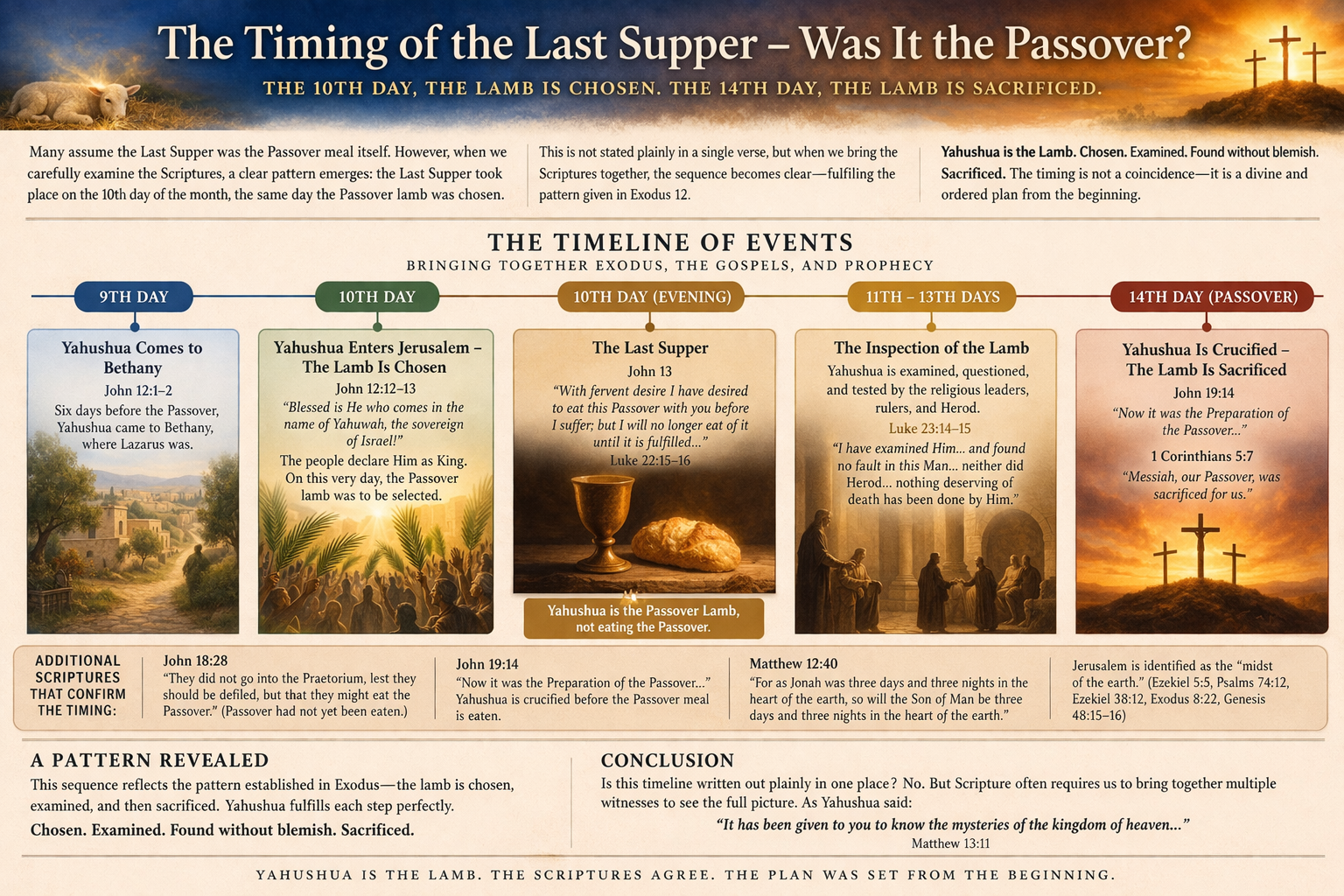
The Timeline of Events
When the Scriptures are brought together, the sequence becomes clearer:
9th day
Yahushua comes to Bethany (John 12:1)
10th day
Yahushua enters Jerusalem and is received by the people
—the Lamb is chosen (John 12:12–13)
10th day (evening)
The Last Supper takes place (John 13)
11th–13th days
Yahushua is examined, questioned, and tested by rulers and authorities
—the inspection of the Lamb
14th day (Passover)
Yahushua is crucified
—the Lamb is sacrificed
This sequence reflects the pattern established in Exodus, showing Yahushua as the Lamb—chosen, examined, found without blemish, and sacrificed.
Conclusion
Is this timeline written out plainly in one place? No it is not.
But Scripture often requires us to bring together multiple witnesses to see the full picture.
Scripture tells us that not all things are revealed at once. “The secret things belong to Yahuwah…” (Deuteronomy 29:29), yet He “reveals deep and secret things” (Daniel 2:22). Yahushua Himself said that nothing hidden will remain concealed, but will come to light (Luke 8:17). These matters are not always seen at first, but are revealed in their appointed time.
As Yahushua said:
Matthew 13:11
“It has been given to you to know the mysteries of the kingdom of heaven…”
Luke 8:17
“For nothing is secret that will not be revealed, nor anything hidden that will not be known and come to light.”
The Scriptures themselves explain that not all things are revealed plainly. Yahushua said, “It has been given to you to know the mysteries…” (Matthew 13:11), while others do not understand. Even the rulers did not perceive it, for “had they known, they would not have crucified the Lord of glory” (1 Corinthians 2:8). As it is written, “It is the glory of Elohim to conceal a matter, but the glory of kings is to search it out” (Proverbs 25:2)
The timing of the Last Supper, the selection of the Lamb, and the fulfillment of Passover all point to a carefully ordered plan established from the beginning.
Yahushua is the Lamb.
Chosen. Examined. Found without blemish. Sacrificed.
 The Calendar of Scripture
Plausible
LikeLike
Hi all,
I believe another supper was had on one of the evenings after he got to Bethany, just that it wasn’t the last supper. The last supper would be on the evening before his crucifixion.
The last supper and arrest are on the same evening.
Matthew 26:20-47
Mark 14:17-43
Luke 22:14-47
John 13:1-18:4
However earlier in the week (on the evening prior the triumphant entry) they held a dinner for him at Bethany, on which he was anointed with oil. John 12
This is my understanding and obviously there’s a lot going on in the text but I pray Father reveal to us, what we need.
LikeLike
Thank you brother. I agree that the Last Supper and the arrest are on the same evening, but I believe this is where the Exodus pattern becomes important.
Exodus 12 shows that the lamb was chosen on the 10th day and then kept until the 14th. That period was not empty time. It was the period in which the lamb was examined and shown to be without blemish.
This is what I believe we see fulfilled in Yahushua.
He enters Jerusalem on the 10th day as the Lamb chosen by the people. Then, after the supper with His disciples, He is taken and begins to be examined by the chief priests, elders, Pilate, Herod, and the rulers. This continues until the 14th, when He is finally condemned and slain as the Passover Lamb.
So when Yahushua speaks of being three days and three nights in the heart of the earth, I do not believe this refers to three full days and nights in the tomb. The Gospels repeatedly say He rose on the third day. Rather, I understand this to refer to the period in Jerusalem, in the hands of the wicked generation, being examined, accused, mocked, and judged.
That also fits the Passover pattern:
10th — the Lamb is selected (last supper that night)
11th–13th — the Lamb is examined
14th — the Lamb is slain
15th — He rests in the grave on the Sabbath
16th — He rises as Firstfruits
This harmonises the sign of Jonah, the Exodus pattern, the Gospel accounts, and the repeated witness that He rose on the third day.
So yes, there was a supper in Bethany before the triumphal entry, but I believe the Last Supper sits within this larger Passover Lamb pattern, leading into His inspection before the rulers and His sacrifice on the 14th.
LikeLike