
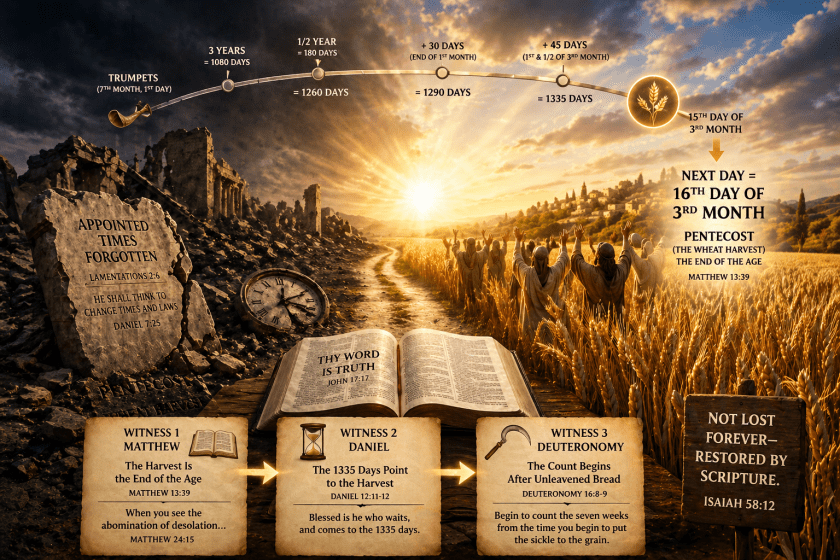
There is something important that has been lost over time—not just the meaning of Pentecost, but the timing of it.
Scripture actually tells us this would happen.
Lamentations 2:6
“Yahuwah has caused the solemn feasts and Sabbaths to be forgotten…”
So this should not surprise us. The appointed times were not only given—they were also forgotten.
Daniel also tells us:
Daniel 7:25
“He shall think to change times and laws…”
So there would be an attempt to alter what Yahuwah established. But Scripture does not leave things broken.
It also speaks of restoration:
Isaiah 58:12
“You shall raise up the foundations of many generations…
and you shall be called, The repairer of the breach…”
So the question is not only:
“What was given?”
But also:
What has been lost—and needs to be restored?
The Principle of Witnesses
Scripture does not ask us to establish a matter from one witness only.
Deuteronomy 19:15
“A matter must be established by the testimony of two or three witnesses.”2 Corinthians 13:1
“By the mouth of two or three witnesses every word shall be established.”
So when we examine Pentecost, the question should not be:
“What does one passage seem to say?”
The question should be:
“Do all the witnesses agree?”
If they do, we have confidence. If they do not, then something in our understanding needs to be re-examined.
This image will help you see each witness clearly as we walk through them. Click here to view the full image.
Witness 1 — Matthew: The Harvest Is the End of the Age
Matthew 13:39 says:
“The harvest is the end of the age, and the reapers are the angels.”
This tells us something very important. The harvest is not only agricultural. It is prophetic.
So when Scripture speaks of the appointed time of harvest, we should not treat it as merely a farming event. It points to the end of the age.
This gives us the identity of the event: The harvest = the end of the age. But Scripture does not leave us without direction.
Yahshua Himself tells us where to look:
Matthew 24:15
“When you therefore shall see the abomination of desolation, spoken of by Daniel the prophet…”
So when speaking about the end, Yahshua points us directly to Daniel.
Now we need to ask: Does Scripture give a counted time that points to that harvest? That takes us to Daniel.
Witness 2 — Daniel: The 1335 Days Point to the Harvest
Daniel 12:11–12 says:
“And from the time that the continual is taken away, and the abomination of desolation is set up, there shall be 1290 days. Blessed is he who waits, and comes to the 1335 days.”
Daniel is speaking about the time of the end. Matthew tells us the harvest is the end of the age.
So when Daniel gives a counted time connected to the end, we should examine where that count lands.
Understanding the Structure of Time
To understand the 1335-day count, we must first understand how Scripture measures time.
Throughout Scripture, a consistent pattern appears:
A year is structured as:
- 12 months
- 30 days each
Giving a total of:
➡ 360 days
We see this clearly in multiple places:
- Genesis (Flood timeline: 150 days = 5 months)
- Daniel (prophetic time periods)
- Revelation (1260 days = 42 months = 3.5 years)
So Scripture consistently uses a 360-day prophetic year.
The Difference Today
Today, we observe:
Solar year ≈ 365.24 days
Lunar year ≈ 354.36 days
So neither aligns perfectly with the 360-day structure. While the solar and lunar years average to approximately 360 days, neither matches it exactly.
However:
👉 The biblical counts (Daniel, Revelation) still use 360-day cycles
The Shortening of Days
Yahshua said:
Matthew 24:22
“Except those days should be shortened, there should no flesh be saved…”
This tells us something important:
👉 The timeline of the end is not random
👉 It is measured and controlled
👉 It is brought into alignment with Yahuwah’s appointed structure
So when we see Daniel using a 360-day framework, we are not dealing with approximation—we are dealing with divinely measured time.
Why This Matters for the 1335 Days
Daniel’s prophecy is not symbolic in its structure—it is counted.
So the question becomes:
👉 What calendar is being used?
The answer must be:
➡ The same structure Scripture consistently uses
➡ A 360-day year
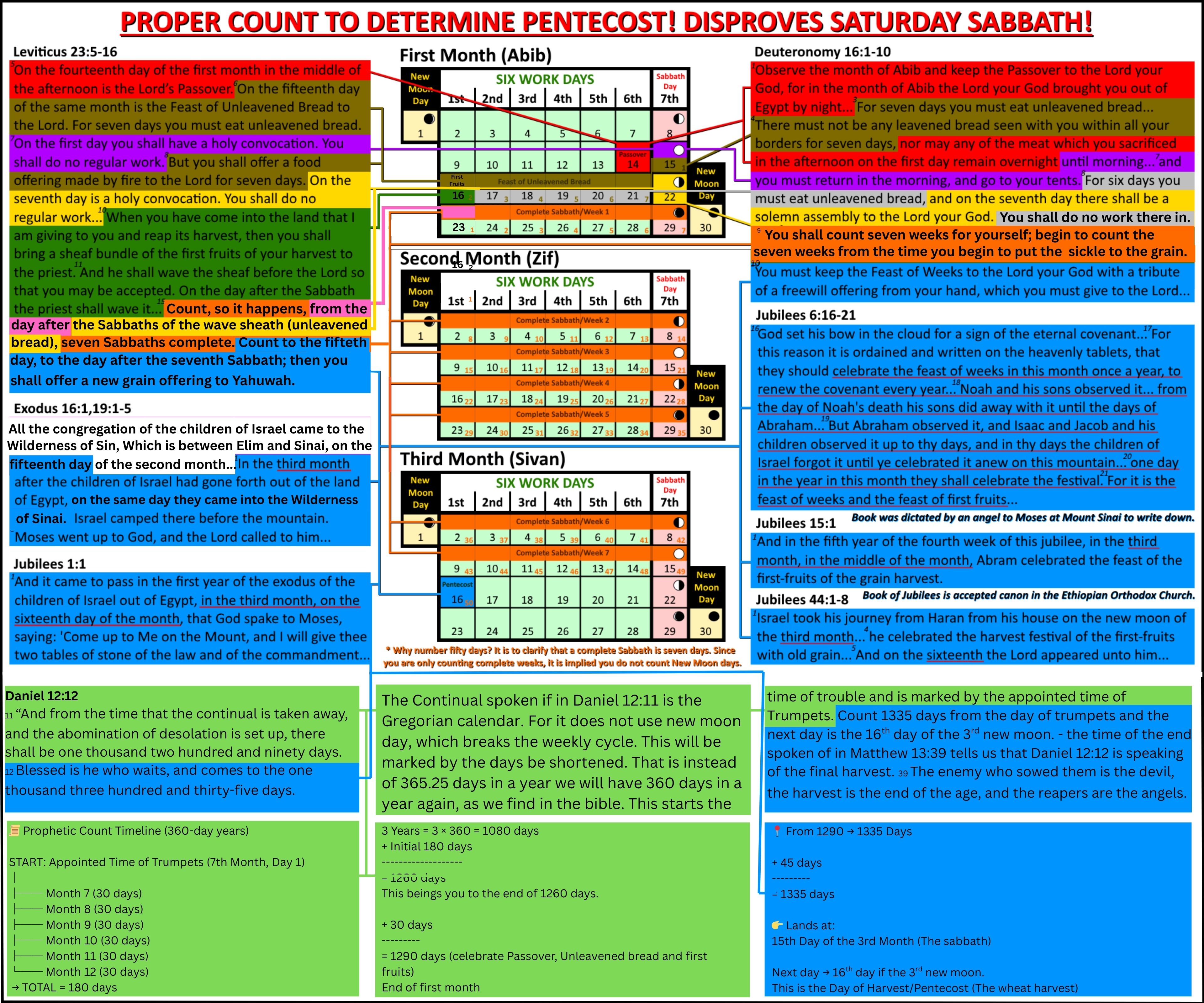
Walking the 1335-Day Count
Beginning at the appointed time:
➡ Trumpets (7th month, 1st day)
Joel 2:1 says:
“Blow the trumpet in Zion… for the day of Yahuwah is coming…”
This connects the sounding of trumpets with the approach of the day of Yahuwah—a time of judgment and transition.
Now count:
- 3 years = 1080 days
- 1/2 a year = 180 days (to complete the cycle)
= 1260 days
Then:
- 30 days (End of first month)
= 1290 days
Then:
- 45 days
- End of first and hald way through the 3rd month
= 1335 days
Where Does This Land?
Those final 45 days bring us to:
➡ The 15th day of the 3rd month
Then:
➡ The next day = 16th day of the 3rd month
Why This Is Significant
Matthew tells us:
“The harvest is the end of the age” (Matthew 13:39)
Daniel gives us:
A counted timeline to the end.
When those are brought together:
👉 The harvest
👉 The end of the age
👉 The 1335-day count
All point to the same moment:
➡ The 16th day of the third month
Witness 3 — Deuteronomy: When the Count Begins
Now we come to the Torah witness that gives the starting point.
Deuteronomy 16:8–9 says:
“For six days you must eat unleavend bread, and on the seventh day there shall be a solemn assembly to the Lord your God. You shall do no work therein.
You shall count seven weeks for yourself; begin to count the seven weeks from the time you begin to put the sickle to the grain.”
This is very important.
Deuteronomy gives us the order:
First, Unleavened Bread is completed
Then the sickle is put to the grain
Then the count begins
Harvesting is work. So the sickle is not put to the grain during the set-apart period where no work is being done.
This means the count begins after the final Sabbath of Unleavened Bread.
Walking the Count (Step-by-Step)
When we follow the instruction correctly, the count looks like this:
29th day, 1st month → 1st Sabbath
8th day, 2nd month → 2nd Sabbath
15th day, 2nd month → 3rd Sabbath
22nd day, 2nd month → 4th Sabbath
29th day, 2nd month → 5th Sabbath
8th day, 3rd month → 6th Sabbath
15th day, 3rd month → 7th Sabbath
Then the next day (the 50th day):
➡ 3rd month, 16th day → Harvest (Pentecost)
Witness 4 — Leviticus: Seven Complete Sabbaths
Leviticus 23:15–16 says:
“Count, so it happens, from the day after the Sabbaths of the wave sheaf, seven Sabbaths complete. Count to the fifeth day, to the day which is after the seventh Sabbath. Then you shall offer a new grain offering to Yahuwah.”
Leviticus gives us the count:
Seven Sabbaths complete
Then the next day
The problem is that many begin the count from the wrong Sabbath.
If the count begins inside Unleavened Bread, it conflicts with Deuteronomy 16, because Deuteronomy says the count begins when the sickle is put to the grain after the set-apart period.
But when Leviticus is read together with Deuteronomy and with , the count becomes clear:
The wave sheaf is connected to the first opportunity to put the sickle to the grain after Unleavened Bread.
Then seven complete Sabbaths are counted.
Using the same count:
29th day, 1st month → 1st Sabbath
8th day, 2nd month → 2nd Sabbath
15th day, 2nd month → 3rd Sabbath
22nd day, 2nd month → 4th Sabbath
29th day, 2nd month → 5th Sabbath
8th day, 3rd month → 6th Sabbath
15th day, 3rd month → 7th Sabbath
The next day:
➡ 3rd month, 16th day → Harvest (Pentecost)
Again, this lands on:
The 16th day of the third new moon.
So Leviticus agrees with Deuteronomy, Matthew, and Daniel when the correct starting point is used.
Witness 5 — Jubilees: Historical Confirmation
Jubilees also provides a historical witness. While not Scripture, it consistently places the feast of first fruits of the wheat harvest in the middle of the third month.
Jubilees 15:1 says:
“And in the third month, in the middle of the month, Abram celebrated the feast of the first-fruits of the harvest of grain.”
Jubilees 16:13 likewise records this same observance, and Jubilees 1:1 places it on “the sixteenth day of the third month.”
This aligns directly with the 16th day identified through the Scriptural witnesses.
When All Witnesses Are Brought Together
Matthew → what the harvest represents
Daniel → the prophetic timing
Deuteronomy → when to begin
Leviticus → how to count
Jubilees → historical confirmation
They all agree:
➡ The 16th day of the 3rd month
What Happens When Only One Witness Is Used
If only one passage is used—especially if misunderstood:
- The count can begin at the wrong point
- The Sabbaths can fall out of alignment
- The final day shifts
- The prophetic agreement breaks
And when the witnesses do not agree, there is only one conclusion:
👉 Something has been misunderstood
A Warning From Scripture
2 Peter 1:20
“No prophecy of Scripture is of any private interpretation.”
From the beginning, deception has worked the same way:
Genesis 3:1
“Has God really said…?”
Not by removing all truth—but by distorting part of it.
A Call to Examine
I understand that this can be confronting. Many of us have come to these Scriptures with an understanding we have held for a long time. And often, that understanding feels clear and settled.
But Scripture gives us an important principle:
Proverbs 18:17
“The first to present his case seems right, until another comes forward and examines him.”
This is why we must be willing to examine not just what we believe, but how we arrived at that belief.
Examining Our Starting Point
One of the key areas that needs careful attention is where the count begins.
Many today begin the count from within Unleavened Bread, often using a luni-solar calendar or a continuous weekly cycle. At first glance, this appears correct.
But when we bring in Deuteronomy 16, together with the timing established in Daniel 12, a clearer picture emerges:
👉 No work is done during the set-apart time.
👉 The count begins when the sickle is put to the grain.
👉 The harvest—identified with the end—aligns with the completion of the 1335-day count.
Harvesting is work.
So if the count begins during Unleavened Bread, it raises a question:
👉 How can the sickle be put to the grain during a time when no work is commanded?
This is not about accusing anyone of error, but about examining whether our starting point aligns with the full instruction.
The Influence of Translation and Calendar Systems
Another challenge is that most of us are reading Scripture through:
- a translated language
- and a calendar system that is not the one described in Scripture
The modern calendar has a continuous weekly cycle and no distinction for new moon days.
But Scripture defines months by the new moon, and the appointed times are structured within that framework.
Because of this, it is very easy to read the text correctly, but apply it within the wrong structure. This is not done intentionally—it is simply a limitation we inherit.
And this is why Yahshua said:
Matthew 18:3
“Except you be converted, and become as little children, you shall not enter into the kingdom of heaven.”
A child is willing to learn. A child is willing to be corrected. A child does not assume they already understand everything.
So when we come to Scripture, especially in areas where tradition and inherited systems are involved, we must be willing to set aside what we think we know and allow the Word to teach us again— and to test what we believe against His Word.
1 Thessalonians 5:21
“Prove all things; hold fast that which is good.”
Why This Matters
If the starting point is misplaced:
- The Sabbaths shift
- The count moves
- The final day no longer aligns with the other witnesses
And when that happens, something important occurs:
👉 The agreement between the witnesses is broken
Returning to the Whole Word
Psalm 119:160
“The sum of Your word is truth.”
Not one passage.
Not one interpretation.
The whole.
So the question is not:
“What have I always believed?”
But:
👉 Do all the witnesses agree?
👉 Does my understanding align with the full instruction?
An Invitation
This is not about winning an argument.
It is about being willing to:
- examine the Scriptures carefully
- consider all the witnesses
- and allow the Word to correct us where needed
Acts 17:11 says the Bereans were noble because they searched the Scriptures daily to see whether these things were so.
That is the spirit we should bring to this.
Final Question
Do all the witnesses agree?
Not one.
But the whole of Scripture.
Matthew — defines the harvest as the end of the age
Daniel — gives the counted time to that same moment
Deuteronomy — shows when the count begins
Leviticus — shows how the count is made
Jubilees — confirms it historically
When they are all brought together—without forcing them into a system foreign to Scripture, and without relying on a single interpretation—they speak with one voice:
➡ The 16th day of the third new moon
This is not drawn from one passage alone, but from the agreement of all the witnesses.
Psalm 119:160
“The sum of Your word is truth.”
So the question is no longer:
“What does one verse seem to say?”
But:
👉 Do all the witnesses agree?
👉 Does my understanding align with the whole Word?
That is why I believe Pentecost, the appointed time of harvest, has been lost—
not because it was removed,
but because it has been misunderstood.
And that is why Scripture itself restores it.
 The Calendar of Scripture