
There are some who believe that the full moon is the new moon. Others suggest the dark moon is the new moon, while another view holds that the first visible crescent marks the new moon. By the end of this article, the definition of the new moon should be clear.
One of the main reasons some believe the full moon is the new moon comes from Psalm 81:3:
Psalms 81:3 (KJV)
Blow up the trumpet in the new moon,
in the time appointed,
on our solemn feast day.
In Hebrew it reads a little different:
Psalms 81:3
Blow up (taqa) in the new moon (chodesh) the trumpet (showphar),
At the full moon (kece)
On the day (yowm) of our feasts (chag).
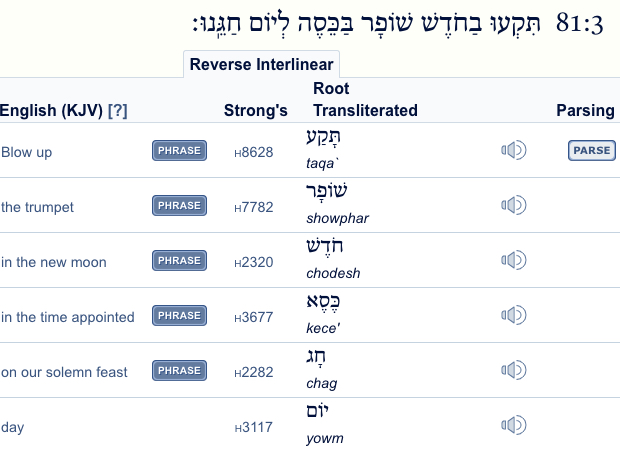
The phrase translated as “in the time appointed” in the KJV is the Hebrew word “kece,” which means “full moon.”
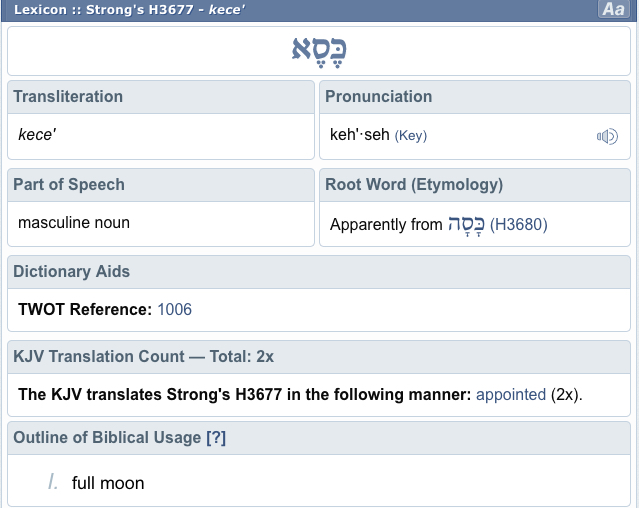
It carries the idea of being covered with light, from the root “kacah,” meaning to cover. In this context, the moon is “covered” in light—fully illuminated.
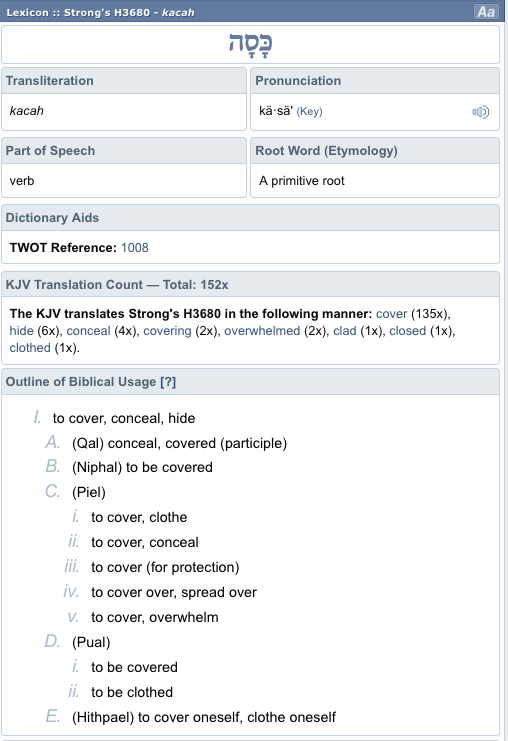
So this passage mentions three distinct things: the new moon, the full moon, and the feast day. It does not equate them as the same event. Scripture also teaches that a matter is established by two or three witnesses, so we must look elsewhere to confirm what this means.
Psalm 81 continues:
Psalms 81:4-5
4 For this was a statute for Israel, and a law of the Elohim of Jacob.
5 This he ordained in Joseph for a testimony, when he (Israel) went out through the land of Egypt: where I heard a language that I understood not.
This refers to the time when Israel was delivered from Egypt. Verse 6 confirms this:
Psalms 81:6
6I removed his shoulder from the burden: his hands were delivered from the pots.
So when did this happen? Scripture tells us clearly:
Numbers 33:1-3
1 These are the journeys of the children of Israel, which went forth out of the land of Egypt with their armies under the hand of Moses and Aaron.
2 And Moses wrote their goings out according to their journeys by the commandment of Yahuwah: and these are their journeys according to their goings out.
Verse 3 tells us which day it was they left:
3 And they departed from Rameses in the first month, on the fifteenth day of the first month; on the morrow after the passover the children of Israel went out with an high hand in the sight of all the Egyptians.
Pslams 81:3 tells us it was a full moon when they left out of Egypt. It was the time appointed.
Psalms 81:3
Blow up (taqa) in the new moon (chodesh) the trumpet (showphar),
At the full moon (the time appointed – kece)
On the day (yowm) of our feasts (chag)
If the full moon occurs on the fifteenth day, it cannot also be the new moon, which marks the beginning of the month.
We see this clearly in 1 Samuel:
1 Samuel 20:24–27
When the new moon was come, the king sat him down to eat…
And on the morrow, which was the second day of the month…
This shows that the new moon is the first day of the month, followed immediately by the second day. Therefore, the new moon cannot be the fifteenth day.
Further confirmation comes from the feast timings:
Numbers 33:3
3 And they departed from Rameses in the first month, on the fifteenth day of the first month; on the morrow after the passover the children of Israel went out with an high hand in the sight of all the Egyptians.
We know that the fifteenth day of the month, the day after the passover, is the appointed time of unleavened bread.
Leviticus 23:5-6
5 On the fourteenth day of the first monthat even is Yahuwah’s passover.
6 And on the fifteenth day of the same month is the appointed time of unleavened bread unto Yahuwah: seven days ye must eat unleavened bread.
The feast begins on the fifteenth day—again aligning with the full moon.
Exodus also confirms that the new moon marks the beginning:
Exodus 12:2
This month shall be unto you the beginning of months…
So the new moon is the starting point of the month, and the full moon occurs mid-month, on the fifteenth day.
Psalm 81:3 is therefore not equating the new moon with the full moon. Instead, it mentions separate appointed times: the new moon, the full moon, and the feast day.
Additionally, trumpets were blown at both new moons and feast days:
Numbers 10:10
In the beginnings of your months, ye shall blow with the trumpets…
This further shows they are distinct occasions.
Some also reference Sirach 43:
Sirach 43:7 (NSRV)
7 From the moon comes the sign for feast days,
a light that wanes when it completes its course.
This does not suggest the full moon begins the month. Rather, it reflects that from the full moon onward, the moon begins to wane—marking the progression toward the end of the month.
Verse 8 adds:
Sirach 43:8
The new moon… renews itself…
The appointed time of Unleavened bread and booths, both start upon the fifteenth day after the new moon. From the fifteenth day, when the light of the moon is full, the light starts to decrease.
The Hebrew word for new moon, “chodesh,” comes from “chadash,” meaning to renew or restore. This renewal begins with the first visible crescent, grows to fullness, and then wanes until it disappears, completing its cycle.
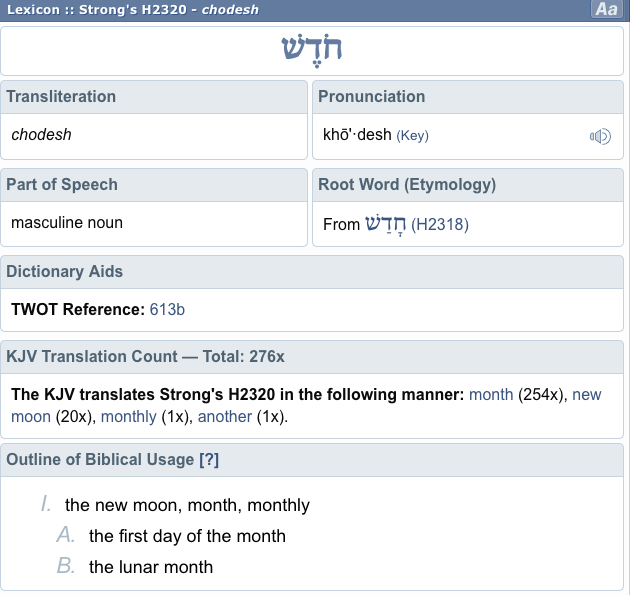
It comes from the word chadash, which tells us that it means to renew or to repair.
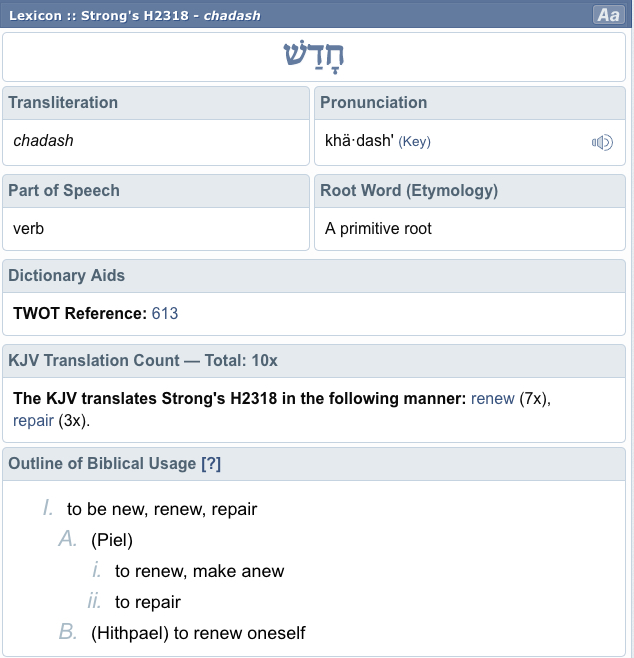
The process of repairing starts with the first visible crescent and ends when the moon is no longer seen. The new moon rebuilds itself to become the full moon – where it is completely built, from where the feasts are declared and then wanes to complete its course.
This is what the new moon looks like (It may be upside down depending upon which hemisphere you live in). It is the first stage in the rebuilding towards the full moon.

The full moon looks like this. You do not rebuild the full moon as it is fully constructed:
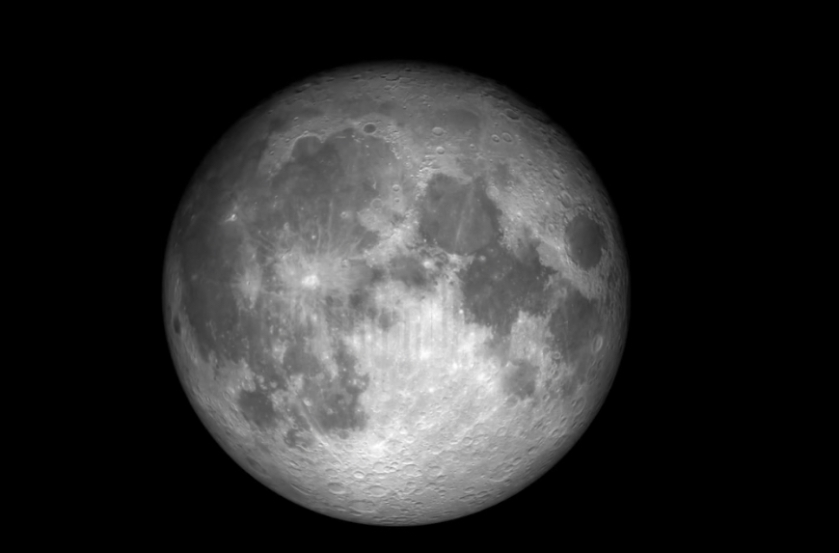
There is much more in Scripture that supports the understanding of the new moon as the first visible crescent.
Consider how Scripture consistently associates truth with light. We are told that His word is a lamp and a light, revealing what can be seen and understood. If something is marked by Him, it is brought into the light.
With that in mind, it would seem unusual for the Father to establish the beginning of a month on something that has no visible light at all.
To illustrate this, imagine a beam of light moving around a clock.
At the position of 12, there is no light visible. As the light begins to move, the number 1 comes into view. As it continues, more light is revealed—2 becomes clearer, then 3, and so on. With each step, the light increases.
By the time the light reaches 6, it is at its brightest. After that, the light begins to fade—7, 8, 9, 10, and 11 gradually become dimmer.
Then, just past 11, the light disappears completely. The position of 12 is never actually seen, yet we know it is there because of the space between 11 and 1.
In the same way, the completely dark phase of the moon is not visible. What can be seen is the moment light first returns—the first visible crescent—marking the renewal of the cycle.
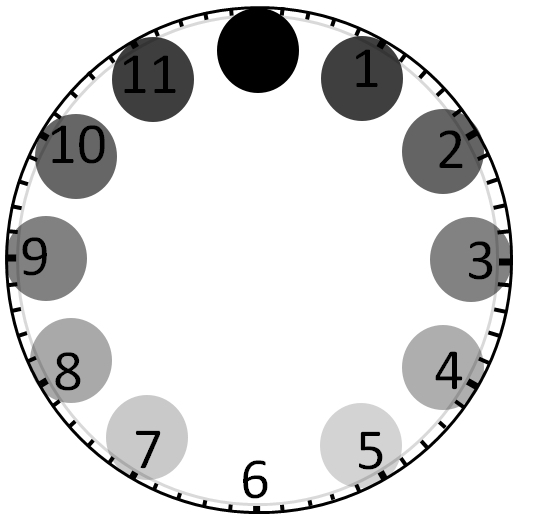
This example functions much like a parable. It highlights something that is often overlooked.
Scripture tells us:
Psalms 119:105
Your word is a lamp to my feet
and a light to my path.
If something is revealed in His word, it is brought into the light. It is something we can see, understand, and follow.
Returning to the clock illustration, every number becomes visible as the light passes over it—except for the 12. That position is never seen directly. Yet we still know it exists, not because we see it, but because of the gap between 11 and 1.
In that sense, the only “light” we have regarding the 12 is that it is not seen.
Applying this principle to Scripture, we can observe all the events that are clearly revealed—those brought into the light. But there is one event that is not directly seen. Like the 12 on the clock, it is known only by its absence.
This distinction is important: what is revealed in light is what we are meant to observe and follow, while what is unseen is understood differently—by its position, not by direct visibility.
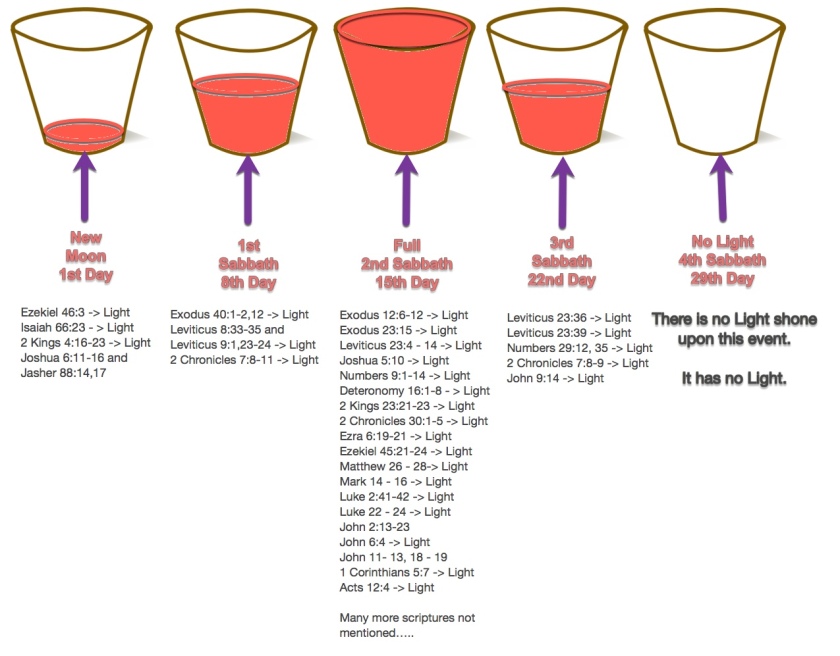
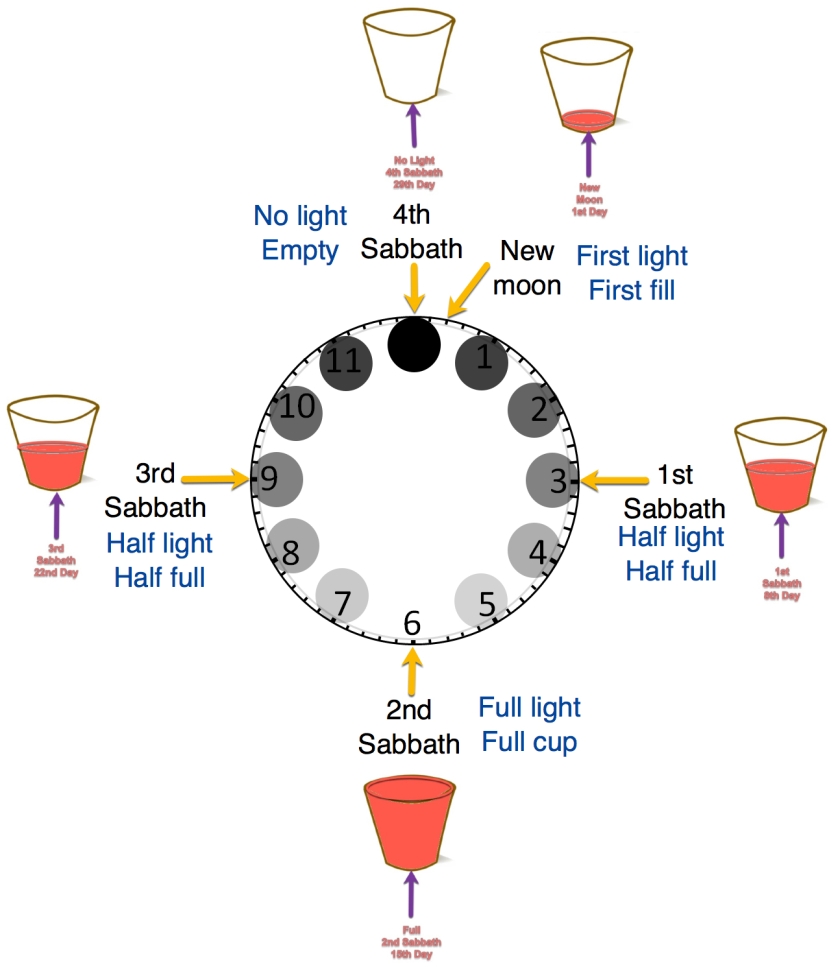
There is a clear pattern in these events. Each one—the new moon day, followed by the first, second, and third Sabbaths—has light associated with it.
Returning to the clock illustration, the new moon corresponds to the first appearance of light just after passing the unseen 12. From there, the light continues to increase.
By the time we reach the second Sabbath, the light has reached its fullest intensity—like the position of 6 on the clock. After this point, the light begins to diminish.
It continues to fade until we reach the fourth Sabbath, where once again there is no visible light.
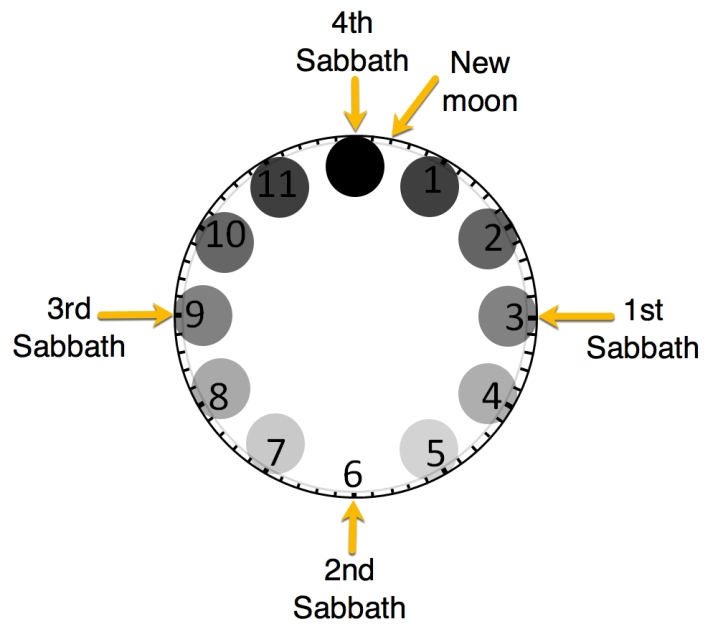
The third Sabbath is the final event in Scripture that is associated with light.
In John 9:4, we read:
John 9:4
I must work the works of Him that sent me while it is day; the night is coming when no one can work.
Here, “day” represents light, while “night” represents darkness. This reflects the same pattern—there is a defined period of light, followed by a transition into darkness.
Through His word, the Father has shown us when the new moon occurs. While there are many differing views on this topic, we are called to follow the narrow path—to be guided by what is revealed in Scripture.
Will you study this subject?
If you would like to learn more on this subject you can do so here.
 The Calendar of Scripture
Very nice update, Robert. Thank you!
LikeLike
Brother..if crescent moon new moon then are you sure that 15th day of the month would be full moon?
LikeLike
Today the cycle of the moon is 29.5 days long. In the scriptures we find that the cycle of the moon took 30 days. This means that the full moon today would be seen a little earlier than the 15th day.
Let me explain a little more fully:
We read in scripture, how Israel was given a divorce because of their unfaithfuless. The time we use to spend with the Father, upon His new moons and His appointed times, we are told, were to be removed from the people in Hosea 2:11
Hosea 2:11
11 I will also cause all her mirth to cease, her feast days, her new moons, and her sabbaths, and all her solemn feasts.
This was done by the shortening of the day. We see this in 2 Kings 20
2 Kings 20:1-3
1 In those days [when Sennacherib first invaded Judah] Hezekiah became deathly ill. The prophet Isaiah the son of Amoz came and said to him, “Thus says the Lord, ‘Set your house in order, for you shall die and not recover.’”
2 Then Hezekiah turned his face to the wall and prayed to Yahuwah, saying,
3 “Please, Yahuwah, remember now how I have walked before You in faithfulness and truth and with a whole heart, and have done what is good in Your sight.” And Hezekiah wept bitterly.
We then see something Yahuwah telling Isaiah to go back to Hezekiah, for He was going to add fifteen years to his life.
2 Kings 20:4-7
4 Before Isaiah had gone out of the middle courtyard, the word of Yahuwah came to him, saying,
5 “Go back and tell Hezekiah the leader of My people, ‘Thus says Yahuwah, the Elohim of David your father: “I have heard your prayer, I have seen your tears. Behold, I am healing you; on the third day you shall go up to the house of Yahuwah.
6 I will add fifteen years to your life and save you and this city [Jerusalem] from the hand of the king of Assyria; and I will protect this city for My own sake and for My servant David’s sake.”’”
7 Then Isaiah said, “Bring a cake of figs. And they brought it and placed it on the [painful] inflammation, and he recovered.”
And this is where we see time changed in His word.
2 Kings 20:8-11
8 Hezekiah said to Isaiah, “What will be the sign that Yahuwah will heal me, and that I shall go up to the house of Yahuwah on the third day?”
9 Isaiah said, “This will be the sign to you from Yahuwah, that He will do the thing that He has spoken: shall the shadow [indicating the time of day] go forward ten steps, or go backward ten steps?”
10 Hezekiah answered, “It is easy for the shadow to go forward ten steps; no, but let the shadow turn backward ten steps.”
11 So Isaiah the prophet called out to Yahuwah, and He brought the shadow on the steps ten steps backward by which it had gone down on the sundial of Ahaz.
This we also see reflected in Isaiah 38:
Isaiah 38:4-8
4 And the word of Yahuwah came to Isaiah, saying,
5 “Go and tell Hezekiah, ‘Thus says Yahuwah, the Elohim of David your father: “I have heard your prayer, I have seen your tears; surely I will add to your days fifteen years.
6 I will deliver you and this city from the hand of the king of Assyria, and I will defend this city.”’
7 And this is the sign to you from Yahuwah, that Yahuwah will do this thing which He has spoken:
8 “Behold, I will bring the shadow on the sundial, which has gone down with the sun on the sundial of Ahaz, ten degrees backward.” So the sun returned ten degrees on the dial by which it had gone down.
How did this affect the calendar?
By turning the shadow backward on the stairs ten steps, the length of the day was increased. Because of the information provided in the scriptures we are able to work out roughly how much time this added to a day and apply that to a year.
In a full day, we have 24 hours with each hour having 60 minutes. But in the hours of daylight, we have approximately half this amount, around 12 hours.
The number of degrees in one-hour equals:
A 360-degree circle (on a sundial) divided by 12 hours of sunlight (average day)
= 30 degrees per hour.
The number of minutes in 10 degrees is 1/3 of 30
1/3rd of 30 degrees is 10 degrees.
1/3rd of an hour (60 minutes) equals 20 minutes.
10 degrees would therefore, equal 20 minutes.
In the days of Hezekiah, it is believed that the sundial was a series of stairs that had two sides which stepped up towards each other and met in the middle. We cannot be certain how many steps there were, but if there were 360 steps, the 20 minutes would be accurate. 360 steps could not only tell you the time of day but also tell you the day of the year.
So now we know that there were an extra 20 minutes added per day. How does this affect the length of a 360 day year?
20 minutes per day x 360 days = 7200 extra minutes per year.
7200 extra minutes per year / 60 minutes in an hour = 120 hours per year.
120 extra hours per year / 24 hours in a day = 5 days per year.
The length of a year went from 360 days to 365 days. Looking at what we see in the 8th century BC, we tend to find either a year with 365 days (solar), a year with 354 days (lunar) or both.
In the later part of Hosea 2 we see the appointed times being restored. (Have a read of all of Hosea 2). This occurs at the appointed time of trumpets. We know this to be the case (that there were 30 days in a month) as the scripture also tells us that the days shall be as the days of Noah:
Matthew 24:37
37 But as the days of Noah were, so also will the coming of the Son of Man be.
We see this also in Luke 17
Luke 17:26
6 And as it was in the days of Noah, so it will be also in the days of the Son of Man.
Many look at this scripture and speak simply of the way in which man was behaving. But let me share something with you that the Father shared with me. There is something here many do not see. Let’s take a look at how time was structured in the days of Noah as that is where the scripture points us to:
Genesis 7:11-12, 24
11 In the six hundredth year of Noah’s life, on the seventeenth day of the second month, on that same day all the fountains of the great deep burst open, and the windows and floodgates of the heavens were opened.
12 It rained on the earth for forty days and forty nights.
….
24 The waters covered [all of] the earth for a hundred and fifty days.
Genesis 8:4
4 On the seventeenth day of the seventh month, the ark came to rest on the mountains of Ararat.
So from the seventeenth day of the second month to the seventeenth day of the seventh month, there were one hundred and fifty days. The number of months equals 7 – 2 = 5 months. 150 days divided by 5 months = 30 days each month.
If the number of days in the month were 30 days, then is that what we see also in Revelation concerning the time spoken of in Matthew?
Revelation 11:2-3
2 But leave out the court which is outside the temple, and do not measure it, for it has been given to the Gentiles. And they will tread the holy city underfoot for forty-two months.
3 And I will give power to my two witnesses, and they will prophesy one thousand two hundred and sixty days, clothed in sackcloth.”
Revelation 12:6,14
6 Then the woman fled into the wilderness, where she has a place prepared by God, that they should feed her there one thousand two hundred and sixty days.
….
14 But the woman was given two wings of a great eagle, that she might fly into the wilderness to her place, where she is nourished for a time and times and half a time, from the presence of the serpent.
Revelation 13:5
5 And he was given a mouth speaking great things and blasphemies, and he was given authority to continue for forty-two months.
In these scriptures, we learn that 1260 days is described as time, times and half a time, or 42 months. Here, time = 1 year. Times = 2 x Time = 2 years. Half a Time = 1/2 a year. Together that equal 3 and a half years.
So the short answer is -> at present the full moon will arrive a little earlier than the 15th. When time is restored again, it will again be the 15th day.
I pray that makes sense.
Robert
LikeLike
the no moon is the new moon. did you know that his calendar is perfect? and did you know if you go from the new moon the full moon always fall on the feast exept the day of atonement. try using the no moon
LikeLike
Is there light in His word upon the New Moon?
Is there Light in His word upon the 4th Sabbath?
Case closed.
LikeLike
Hi Robert,
If Abba has said in hosea 2.11 Lamentations 2.6 and the other scriptures mentioned regarding the feasts, new moon and sabbaths being forgotten and ceased. How are we to know that those have been restored. It seems to me that he Temple has not been restored and neither has the calander, so these things have not yet been restored. Everyone says something different regarding the moon, no one agrees. Everyone is going off their own understanding regarding what a new moon is. With no definite scriptural proof of what a new moon is. Everyone gives very good logic and some scripture for each argument (no moon, first crescent and full moon). However I cannot see anything clearly regarding this. I don’t know when the sabbath is exactly or the feasts. There is nothing to tell us definitely.
LikeLike
Hosea 2:11 says:
I will also cause all her mirth to cease,
Her feast days,
Her New Moons,
Her Sabbaths—
All her appointed feasts.
And Lamentations 2:6 says:
He has done violence to His tabernacle,
As if it were a garden;
He has destroyed His place of assembly;
The Lord has caused
The appointed feasts and Sabbaths to be forgotten in Zion.
In His burning indignation He has spurned the king and the priest.
In Romans 11 we are told of a remnant. Have a read of the whole chapter. It speaks of how israel was cut off, but a remnant was kept. And we know this is the case as he also says in Isaiah 58 :12
Those from among you
Shall build the old waste places;
You shall raise up the foundations of many generations;
And you shall be called the Repairer of the Breach,
The Restorer of Streets to Dwell In.
The temple in Israel will not be restored until He returns.
The reason that everyone says something different is because of the confusion which has been added to the pot. Some are not to know as they have had it hidden from them. But if you really want to know, He will show you.
I have been where you are and I know what you are feeling. My suggestion is to study a single topic at a time then move on.
Some guidelines I used were:
1) What calendar was used in the Bible?
2) When were the Sabbaths upon that calendar?
3) What is a day and when does it start and end in the Bible?
4) What is the new moon and what Light is given in the Bible about this subject (And in that very question is the answer as to which one the new moon is)
5) When is Passover?
6) When is the Feast of unleavened bread?
7) When is the first fruits? (The wheat harvest)
8) When is the day of Trumpets?
9) When is the day of atonement (This ties is strongly to when the day starts and ends)
10) When is the time of booths?
11) When is the appointed time known as Pentecost or also known as the time of harvest.
Answer those questions and you will be on your way. Happy to help if you need.
Robert-Aaron
LikeLike
For this very reason New Moon is always at its covering/hidden as Psalms 81:3 indicates!
Because the Crescent moon fluctuates between 24-72 hrs, it becomes inconsistent with having a Full Moon on the 15th day of the month.
conjunction New moon consistently lands a Full Moon on the 1st high Shabbat of Pesach and Sukkot!
sighted Moon is traditions of me, not supported by Scripture!
we are to walk by Faith, not by sight.
Shalom Alechem!
LikeLike
Shalom Alechem!
Thank you for your thoughtful engagement on this topic. It’s worth considering that Yahshua frequently used symbolism in His teachings, and His messages were always consistent with the scriptures. He often pointed to the rhythms of creation, using light as a metaphor for truth, clarity, and divine timing.
Scripture shows that the full moon consistently occurs on the 15th day of the lunar month, which is why this day is associated with the most light. That is it is seen the most. This fullness of light aligns with significant observances like Pesach and Sukkot, days set apart for celebration and reflection. To say there is no light on the 15th day contradicts what we see both physically and scripturally, as this day embodies the highest degree of light.
By contrast, the fourth Sabbath has no scriptural association with light. As Isaiah 8:20 says, “If they do not speak according to this word, it is because there is no light in them.” This absence of light for the fourth Sabbath supports the idea that it lacks the same divine alignment seen on the 15th day. To assert that the fourth Sabbath is marked by fullness or light, without supporting scripture, would misalign with Yahshua’s consistent use of symbolism.
As Isaiah 5:20 warns, we must be cautious not to call light darkness or darkness light. The fullness of light on the 15th day is a testimony that aligns with the scriptures, showing divine truth and timing. I encourage revisiting the passages and allowing the consistent symbolism of light in the scriptures to guide us as we walk by faith, not merely by sight.
Shalom.
LikeLike
Great illustrations and Scriptural references. Thank you brother.
LikeLike
Very much appreciated your explanations with scripture and mathematics! One minor correction is that the crescent moon cannot appear upside down (reversed or flipped) in the Southern Hemisphere. If so, how does it appear on the equator? The sun always rises in the east and so the phases of the moon are the same as viewed from anywhere. You provided great insight. Thanks.
LikeLike
No worries.
Regarding the moon appearing flipped depending upon if you are in the northern or southern hemisphere, it actually is. A good explanation can be seen here: https://www.planetary.org/articles/can-the-moon-be-upside-down
LikeLike
I believe El showed me something in regards to the new moon and in regards to sabbath a week ago. With regards to the calender we use today. So if the longer days would cause 30 days between new moons ( i believe thats what you said) How would this affect things like the sabbath? From what i believe is that jews had changed the calender at one point(If im not mistaken) to keep a sabbath from falling after atonement and that would be why we have leap years(If im not mistaken) So would sabbath still fall on Saturday regardless? If i got anything wrong please correct me this is confusing a little bit.
LikeLike
Hi Cody.
So the Calendar which you are referring to when you speak about Saturday is the Gregorian calendar. What most people don’t understand is that they have been many methods of time keeping. Some use a solar calendar (which is what the Gregorian calendar is). The down side of this calendar is it does not have any way to know when a new day starts, so they have had to create a man made date line.
Some use a lunar calendar. These calendars are good in the sense they can tell you when a new month starts and that position on the earth is where all the days are counted from. It is like a line that is seen in the sky, not drawn upon the earth.
Then some use Solar- Lunar Calendars. This is what the Bible uses. The thing we need to note however, is that when Noah was here, their years had 360 days in them. Then we read about the people going off and worshipping other gods, and so God removed the calendar from them so they could no longer abuse His appointed times. That has cause much confusion for us. You can see this by simply adding one solar year and one lunar year together and dividing it by 2 years. You will end up with 360 days.
But the bible also tells us if a time of restoration of His appointed times and that at that time the Trumpets will blow. From that time forward, there will be 360 days again in a year, with the number of solar days being shortened to bring it back to 360 days. We see this in Revelation and in Daniel.
So the answer to your question might have seemed a little long winded, but suffice to say, the new moon never aligns exactly with the international date line, so “date line” so to speak is not the same. One month for example it could be on Sunday in one area of the world and upon Monday in a different area, but according to the Bible, this is actually the same day, just that the point it is measured from is different between the two calendars. When you view the calendar from the point of view that Moses would have, you see how confusing the Gregorian calendar would have been to them as they never actually used the international date line, but instead the new moon.
Yahuwah Bless.
LikeLike
GOC has most accurate calendar. Tested it for years against things in nature, budding trees in Spring, etc.
LikeLike
Hi Jimmy,
Thank you for sharing that insight on the GOCC calendar and how it aligns with natural markers like budding trees in spring. I appreciate how thorough the approach sounds.
I’m curious, though, how do you personally align your Sabbath observance with this calendar? Since the GOCC uses a different calendar for setting the Sabbath based on the lunar cycle (with Sabbaths on the 8th, 15th, 22nd, and 29th days of the lunar month), this would mean the Sabbath “floats” through the Gregorian calendar.
Do you follow the Sabbath as it moves within the month, or do you find another way to observe it consistently? Why would you use two different calendars?
Looking forward to hearing your perspective.
LikeLike
It seems that your definition of Kacah is a flip of the coin for covering being either 1) a covering showing no light or 2) a covering of light. I couldn’t find a definition where it was a covering of light.
Also, it seems like an assumption that psalm 81:6, about the burden from Israel’s shoulder means the exact time of the Passover vs 50 days later at Pentecost at Mt Sinai.
I am not a proponent of either New Moon being dark or lighted, but it seems like the definition should be clear and not so ambiguous.
LikeLike
The word Kece literally means the full moon, and the reason I also showed Kacah is because it means to cover. It is where there word Kece comes from. Something can be covered meaning it is not seen and is hidden, or it can also mean to be covered with light so it is fully seen.
Kacah is most closely related to the word covered in English. But one can be covered in Light or darkness. Kece is speaking of the time of month when the moon is covered in light.
Scripture has light on four events. New Moon, The first, second and third Sabbaths. The only event that has not direct light is the fourth Sabbath in scripture.
So the new moon does have light. it is the FVC.
LikeLike