
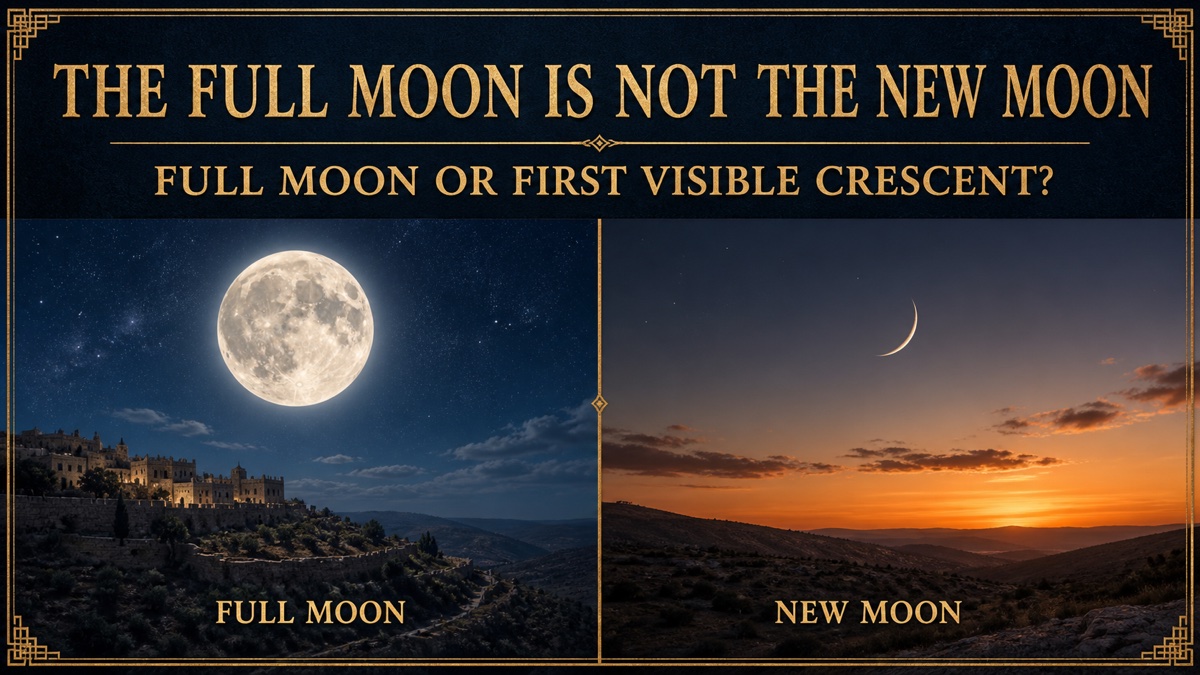
There are some who believe that the full moon is the new moon. Others suggest the dark moon is the new moon, while another view holds that the first visible crescent marks the new moon. By the end of this article, the definition of the new moon should be clear.
One of the main reasons some believe the full moon is the new moon comes from Psalm 81:3:
Psalms 81:3 (KJV)
Blow up the trumpet in the new moon,
in the time appointed,
on our solemn feast day.
In Hebrew it reads a little different:
Psalms 81:3
Blow up (taqa) in the new moon (chodesh) the trumpet (showphar),
At the full moon (kece)
On the day (yowm) of our feasts (chag).

The phrase translated as “in the time appointed” in the KJV is the Hebrew word “kece,” which means “full moon.”

It carries the idea of being covered with light, from the root “kacah,” meaning to cover. In this context, the moon is “covered” in light—fully illuminated.

So this passage mentions three distinct things: the new moon, the full moon, and the feast day. It does not equate them as the same event. Scripture also teaches that a matter is established by two or three witnesses, so we must look elsewhere to confirm what this means.
Psalm 81 continues:
Psalms 81:4-5
4 For this was a statute for Israel, and a law of the Elohim of Jacob.
5 This he ordained in Joseph for a testimony, when he (Israel) went out through the land of Egypt: where I heard a language that I understood not.
This refers to the time when Israel was delivered from Egypt. Verse 6 confirms this:
Psalms 81:6
6I removed his shoulder from the burden: his hands were delivered from the pots.
So when did this happen? Scripture tells us clearly:
Numbers 33:1-3
1 These are the journeys of the children of Israel, which went forth out of the land of Egypt with their armies under the hand of Moses and Aaron.
2 And Moses wrote their goings out according to their journeys by the commandment of Yahuwah: and these are their journeys according to their goings out.
Verse 3 tells us which day it was they left:
3 And they departed from Rameses in the first month, on the fifteenth day of the first month; on the morrow after the passover the children of Israel went out with an high hand in the sight of all the Egyptians.
Pslams 81:3 tells us it was a full moon when they left out of Egypt. It was the time appointed.
Psalms 81:3
Blow up (taqa) in the new moon (chodesh) the trumpet (showphar),
At the full moon (the time appointed – kece)
On the day (yowm) of our feasts (chag)
If the full moon occurs on the fifteenth day, it cannot also be the new moon, which marks the beginning of the month.
We see this clearly in 1 Samuel:
1 Samuel 20:24–27
When the new moon was come, the king sat him down to eat…
And on the morrow, which was the second day of the month…
This shows that the new moon is the first day of the month, followed immediately by the second day. Therefore, the new moon cannot be the fifteenth day.
Further confirmation comes from the feast timings:
Numbers 33:3
3 And they departed from Rameses in the first month, on the fifteenth day of the first month; on the morrow after the passover the children of Israel went out with an high hand in the sight of all the Egyptians.
We know that the fifteenth day of the month, the day after the passover, is the appointed time of unleavened bread.
Leviticus 23:5-6
5 On the fourteenth day of the first monthat even is Yahuwah’s passover.
6 And on the fifteenth day of the same month is the appointed time of unleavened bread unto Yahuwah: seven days ye must eat unleavened bread.
The feast begins on the fifteenth day—again aligning with the full moon.
Exodus also confirms that the new moon marks the beginning:
Exodus 12:2
This month shall be unto you the beginning of months…
So the new moon is the starting point of the month, and the full moon occurs mid-month, on the fifteenth day.
Psalm 81:3 is therefore not equating the new moon with the full moon. Instead, it mentions separate appointed times: the new moon, the full moon, and the feast day.
Additionally, trumpets were blown at both new moons and feast days:
Numbers 10:10
In the beginnings of your months, ye shall blow with the trumpets…
This further shows they are distinct occasions.
Some also reference Sirach 43:
Sirach 43:7 (NSRV)
7 From the moon comes the sign for feast days,
a light that wanes when it completes its course.
This does not suggest the full moon begins the month. Rather, it reflects that from the full moon onward, the moon begins to wane—marking the progression toward the end of the month.
Verse 8 adds:
Sirach 43:8
The new moon… renews itself…
The appointed time of Unleavened bread and booths, both start upon the fifteenth day after the new moon. From the fifteenth day, when the light of the moon is full, the light starts to decrease.
The Hebrew word for new moon, “chodesh,” comes from “chadash,” meaning to renew or restore. This renewal begins with the first visible crescent, grows to fullness, and then wanes until it disappears, completing its cycle.

It comes from the word chadash, which tells us that it means to renew or to repair.

The process of repairing starts with the first visible crescent and ends when the moon is no longer seen. The new moon rebuilds itself to become the full moon – where it is completely built, from where the feasts are declared and then wanes to complete its course.
This is what the new moon looks like (It may be upside down depending upon which hemisphere you live in). It is the first stage in the rebuilding towards the full moon.

The full moon looks like this. You do not rebuild the full moon as it is fully constructed:

There is much more in Scripture that supports the understanding of the new moon as the first visible crescent.
Consider how Scripture consistently associates truth with light. We are told that His word is a lamp and a light, revealing what can be seen and understood. If something is marked by Him, it is brought into the light.
With that in mind, it would seem unusual for the Father to establish the beginning of a month on something that has no visible light at all.
To illustrate this, imagine a beam of light moving around a clock.
At the position of 12, there is no light visible. As the light begins to move, the number 1 comes into view. As it continues, more light is revealed—2 becomes clearer, then 3, and so on. With each step, the light increases.
By the time the light reaches 6, it is at its brightest. After that, the light begins to fade—7, 8, 9, 10, and 11 gradually become dimmer.
Then, just past 11, the light disappears completely. The position of 12 is never actually seen, yet we know it is there because of the space between 11 and 1.
In the same way, the completely dark phase of the moon is not visible. What can be seen is the moment light first returns—the first visible crescent—marking the renewal of the cycle.

This example functions much like a parable. It highlights something that is often overlooked.
Scripture tells us:
Psalms 119:105
Your word is a lamp to my feet
and a light to my path.
If something is revealed in His word, it is brought into the light. It is something we can see, understand, and follow.
Returning to the clock illustration, every number becomes visible as the light passes over it—except for the 12. That position is never seen directly. Yet we still know it exists, not because we see it, but because of the gap between 11 and 1.
In that sense, the only “light” we have regarding the 12 is that it is not seen.
Applying this principle to Scripture, we can observe all the events that are clearly revealed—those brought into the light. But there is one event that is not directly seen. Like the 12 on the clock, it is known only by its absence.
This distinction is important: what is revealed in light is what we are meant to observe and follow, while what is unseen is understood differently—by its position, not by direct visibility.

There is a clear pattern in these events. Each one—the new moon day, followed by the first, second, and third Sabbaths—has light associated with it.
Returning to the clock illustration, the new moon corresponds to the first appearance of light just after passing the unseen 12. From there, the light continues to increase.
By the time we reach the second Sabbath, the light has reached its fullest intensity—like the position of 6 on the clock. After this point, the light begins to diminish.
It continues to fade until we reach the fourth Sabbath, where once again there is no visible light.

The third Sabbath is the final event in Scripture that is associated with light.
In John 9:4, we read:
John 9:4
I must work the works of Him that sent me while it is day; the night is coming when no one can work.
Here, “day” represents light, while “night” represents darkness. This reflects the same pattern—there is a defined period of light, followed by a transition into darkness.
Through His word, the Father has shown us when the new moon occurs. While there are many differing views on this topic, we are called to follow the narrow path—to be guided by what is revealed in Scripture.

Will you study this subject?
If you would like to learn more on this subject you can do so here.


Leave a Reply