

This article has been written to bring light to an area of Scripture many place in darkness.
In this article, we are going to look at some of the different methods used. We shall be looking to His word to see if the things spoken are true. To do this, we shall use His word and shall not add to nor remove anything found in His word.
You can listen to a discussion about this here.
Psalms 119:160
160 The entirety of Your word is truth,
And every one of Your righteous judgments endures forever.
Deuteronomy 12:32
32 Whatever I command you, be careful to observe it; you shall not add to it nor take away from it.
What Are the Different Methods Used?
Here, we outline the primary methods people use to determine which day is New Moon Day.
Method 1: The Dark Moon Is the New Moon
This method utilizes the dark moon as the new moon. People who use this method wait until the moon is no longer visible and either declare that day or the following day as new moon day.
Method 2: The First Visible Crescent Is the New Moon
This method utilizes the first visible light seen upon the moon as the new moon. It is for this reason the method is called the “first visible crescent” method. People who use this method wait until they can see the first signs of the moon and either declare that day or the day following as new moon day.
Method 3: The Full Moon Is the New Moon
This method utilizes the full moon as the “new” new moon. Again, people who use this method either declare new moon day as the day the full moon is seen upon or the day following.
What Do the Scriptures Say?
It is an interesting question: no matter which of these three methods you use, you will find those who quote scriptures that they believe support their view. However, if the scriptures are correct, there can only be one method which stands true.
I remember searching through the scriptures, looking for something which might point me in the direction to understand which day was new moon day. You see, understanding this underpins the entire calendar of scripture. If you can’t declare the beginning of the month, then you can’t declare any day in scripture.
Exodus 12:1-2 – The First Day of the Month
In Exodus 12:1-2, we see Yahuwah telling Moses and Aaron what day was to be the first day of the month:
Exodus 12:1-2
1 Yahuwah spoke to Moses and Aaron in the land of Egypt saying:
2 “This new moon is the beginning of new moons. It is the first new moon of the year.”
Whilst we are looking at this verse, you will see the words “new moon.” This comes from the word chodesh, which means:

Something many people do not stop and think about when reading this is that here, Yahuwah is telling us that the year, the month, and the day were all to start upon the new moon.
That is important to see and understand, as the new moon does not align with the commonly used Gregorian calendar. The Gregorian calendar uses a fixed, man-made dateline. Here, however, we see that the days were counted from the new moon, which is not the international date line.
Leviticus 23 and the Appointed Times
For example, in Leviticus 23, we find a list of events known as the appointed times of Yahuwah. Each of these events occurs over different days, and each of these days is counted from the new moon.
- The Passover was counted as the fourteenth day at evening, after the new moon.
- The fifteenth day after the new moon was the start of the appointed time of Unleavened Bread and was also the Sabbath.
- The day after the Sabbath, the sixteenth day, was the appointed time of First Fruits.
Leviticus 23:5-6, 10-11
5 On the fourteenth of the first new moon in the evening is Yahuwah’s Passover.
6 On the fifteenth day of the same new moon is the Feast of Unleavened Bread to Yahuwah; seven days you must eat unleavened bread.
10 Speak unto the children of Israel, and say unto them, When ye be come into the land which I give unto you, and shall reap the harvest thereof, then ye shall bring a sheaf of the first fruits of your harvest unto the priest:
11 And he shall wave the sheaf before Yahuwah, to be accepted for you: on the morrow after the sabbath the priest shall wave it.
Passover and the Sabbath
Scripture shows us that the day after Passover was the Sabbath, and the day after that Sabbath was the first day of the week.
- The day of Passover – the 14th day after the first new moon and the sixth day of the week. (This is the day they prepared for the Sabbath.)
Mark 15:37-42
37 And Yahushua cried out with a loud voice, and breathed His last.
38 And the veil of the Temple was torn in two from top to bottom.
…
42 And when evening had come, because it was the preparation day, that is, the day before the Sabbath…..
Luke 23:53-54
53 And taking it down, he wrapped it in linen, and laid it in a tomb hewn out of the rock, where no one was yet laid.
54 And it was the preparation day, and the Sabbath was approaching.
John 18:39-40
39 “But you have a custom that I should release someone to you at the Passover. Do you therefore want me to release to you the King of the Jews?”
40 Then they all cried again, saying, “Not this Man, but Barabbas!” Now Barabbas was a robber.
John 19:30-31, 42
30 So when Yahushua took the sour wine He said, “It has been accomplished!” And bowing His head, He gave up His spirit.
31 Therefore, since it was the preparation, and the bodies should not remain on the stake on the Sabbath….
…
42 Therefore because it was the preparation of the Jews, they laid Yahushua, because the tomb was near.
- The day after the seventh-day Sabbath was the first day of the week. This was the 16th day after the new moon.
Mark 16:1-2
1 And when the Sabbath was past, Miryam from Magdala, and Miryam the mother of Yaʽaqoḇ, and Shelomah bought spices, to go and anoint Him.
2 And very early on the first day of the week, they came to the tomb when the sun had risen.
Matthew 28:1
1 Now after the Sabbath, toward dawn on the first day of the week, Miryam from Magdala and the other Miryam came to see the tomb.
Luke 24:1-3
1 And on the first day of the week, at early dawn, they came to the tomb, bringing the spices which they had prepared,
2 and they found the stone rolled away from the tomb.
Luke 24 and the “Third Day Since These Things Happened”
One scripture often overlooked, which pins this down so that no man can change it, is found in Luke 24. Here, Yahshua is walking with two of the disciples, and we are told that the day this is said upon was the third day since these things happened.)
Luke 24:13-21
13 Now behold, two of them were traveling that same day to a village called Emmaus, which was seven miles from Jerusalem.
14 And they talked together of all these things which had happened.
15 So it was, while they conversed and reasoned, that Yahshua Himself drew near and went with them.
16 But their eyes were restrained, so that they did not know Him.17 And He said to them, “What kind of conversation is this that you have with one another as you walk and are sad?”
18 Then the one whose name was Cleopas answered and said to Him, “Are You the only stranger in Jerusalem, and have You not known the things which happened there in these days?”
19 And He said to them, “What things?”
So they said to Him, “The things concerning Yahshua of Nazareth, who was a Prophet mighty in deed and word before Elohim and all the people,
20 and how the chief priests and our rulers delivered Him to be condemned to death, and crucified Him.
21 But we were hoping that it was He who was going to redeem Israel. Indeed, besides all this, today is the third day since these things happened.
22 Yes, and certain women of our company, who arrived at the tomb early, astonished us.
As we read in Leviticus 23:10-11, the day after the Sabbath was the day known as First Fruits, which was the 16th day after the new moon.
So What Is So Important About the New Moon?
As we have seen, the new moon is the point from which the days in scripture are all counted. Passover, Unleavened Bread, First Fruits, the Harvest—also known as Pentecost—Trumpets, the Day of Atonement, and Booths are all counted from the new moon.
So How Is the Sabbath Ever Counted from the International Dateline?
The truth is, it is not counted from this location. The days in the scriptures are counted from the location where the new moon is. Yes, even the Sabbath day.
Genesis 1:14
Elohim said: “Let there be Lights in the firmament of heaven to separate the day from the night and be for signs, appointed times, days, and years.”
Yahuwah never tells us to use a man-made dateline to know His appointed times, days, or years. He tells us we will know these times using the Lights in the firmament of the heavens.
In Psalms 104:19, He goes even further, specifically telling us that it was to be the moon which was to be used for the appointed times:
Psalms 104:19
He created the moon for the appointed times. The sun knows its going down.
You see, the sun was to tell us the start of each day. The moon, however, tells us where the day is counted from.
What Is a Sign and How Were They Used?
The word “sign” comes from the Hebrew word ‘owth. It is also the same word we see translated as “mark.” It represents a warning or proof of an event and is designed to bring that event to remembrance.
It is important to understand that ‘owth refers to a sign. A good way to think about a sign is to consider a “give way” sign on a road:

Now, I am going to point out something that might seem obvious, but it appears that many people flip this idea around when it comes to the scriptures:
- A give way sign is seen before you reach the intersection. Its purpose is to warn you that if you proceed and do not give way, an accident may occur.
In the scriptures, a sign is the same. It is something given before an event so that people are aware of the event approaching. Just like a train whistle in the distance, so you know the train is coming, or a red light at an intersection, so you know you must stop, a scriptural sign warns beforehand so you do not become a statistic.

In Genesis 1:14 we read that the Lights were to act as a sign. That is, the Lights were to show us events before they arrived, for a sign given after the event is of no use.
Genesis 1:14
Elohim said: “Let there be Lights in the firmament of heaven to separate the day from the night and be for signs, appointed times, days, and years.”
So, in other words, the Lights show us events before they arrive, because a sign given after the event is of no use. There is going to be an accident.
So What Is the New Moon?
Here, we will start to lay out the items which scripture provides, so we can know which day is new moon day and which days are not. We already know the sun, moon, and stars were to be used as signs. We know that a sign is seen before an event. So, what is the sign of the new moon?
When I started studying this, I found Deuteronomy 16:1, which is similar to what we read in Exodus 12:1-2. Here in Deuteronomy, it says:
Deuteronomy 16:1
1 Observe the new moon called Abib and keep the Passover of Yahuwah Elohim.
The word “observe” comes from the Hebrew word shamar. It means “to keep, to guard, to observe, or to watch for.”

If we sat in a room with no light, we would not see anything, nor would we know what time of the day it was. We would be lost. We would quickly realize that in order to see anything, you need light.
If we are to guard something, observe something, or watch for something, we need light. These things cannot be done in the darkness. To observe the new moon, then, it would seem that we are going to need light. Scripture says that we should avoid the rulers of darkness.
Ephesians 6:12
For we do not wrestle against flesh and blood, but against principalities, against powers, against the rulers of the darkness of this age, against spiritual hosts of wickedness in the heavenly places.
Scripture confirms this in the following passages:
Isaiah 9:2
“The people who walked in darkness have seen a great light; those who dwelt in the land of the shadow of death, upon them light has shined.”
Appointed Time of Trumpets (Leviticus 23)
When we view Leviticus 23, we see the appointed time of Trumpets spoken of. The appointed time of Trumpets occurred on the first day of the seventh new moon. Here is the scripture:
Leviticus 23:23-24
23 Yahuwah spoke to Moses, saying,
24 “Speak to the children of Israel, saying: ‘In the seventh new moon, on the first day of the new moon, you shall have a sabbath-rest, a memorial of blowing of trumpets, a holy convocation.’”
As we are aware,Day is Light (Genesis 1:5). The trumpets were to sound all day upon the appointed time of Trumpets, which was the first day of the new moon.
In order for this to occur, one must know before the day starts that the following day is to be the appointed time of Trumpets. Knowing in the evening, after the sun has set that the day that has just past was the appointed time of Trumpets, is no help. And what if they celebrated it, and then found the new moon was not seen? They would have celebrated it too early.
So, we have already ruled out one method of determining the new moon. The method which uses the darkness. It cannot be the new moon, as it cannot be seen. Also, we can see that the new moon was seen before the day occurred. It was given as a sign.
Can You See New Moon Day in Scripture?
Consider, when we sit in the light, we can see all the things which the light reflects off. It works as a lamp to our feet. New Moon Day is an event we see in the scriptures. If we were to say there is no light upon the new moon, but in His word we see it, then we are quite literally flipping around what He shows us.
That is, we would be saying the new moon is in darkness when He provides it to us as light in His word. We find that His word is light in Psalms 119:
Psalms 119:105
“Your word is a lamp to my feet and a light to my path.”
If we are to follow the Father, then we need to recognize what is in Light and what is in Darkness. And herein is the way to know what the new moon is, and what it isn’t. What is in light in His word and what is not seen (note: – Not what is in darkness, but what is not seen – that it, it is hidden).
And Then There Were Two…
The only two methods left to distinguish between are the first visible crescent and the full moon. How do we know which one is the new moon?
Witness 1:
One thing I like about the scriptures is that the same verses can be used. For example, let us go back again to Psalms 104:19, where it says:
Psalms 104:19
“He created the moon for the appointed times. The sun knows its going down.”
When we look at this scripture, we see that the moon is going to become visible when the sun goes down. There is only one time of the month when this occurs.
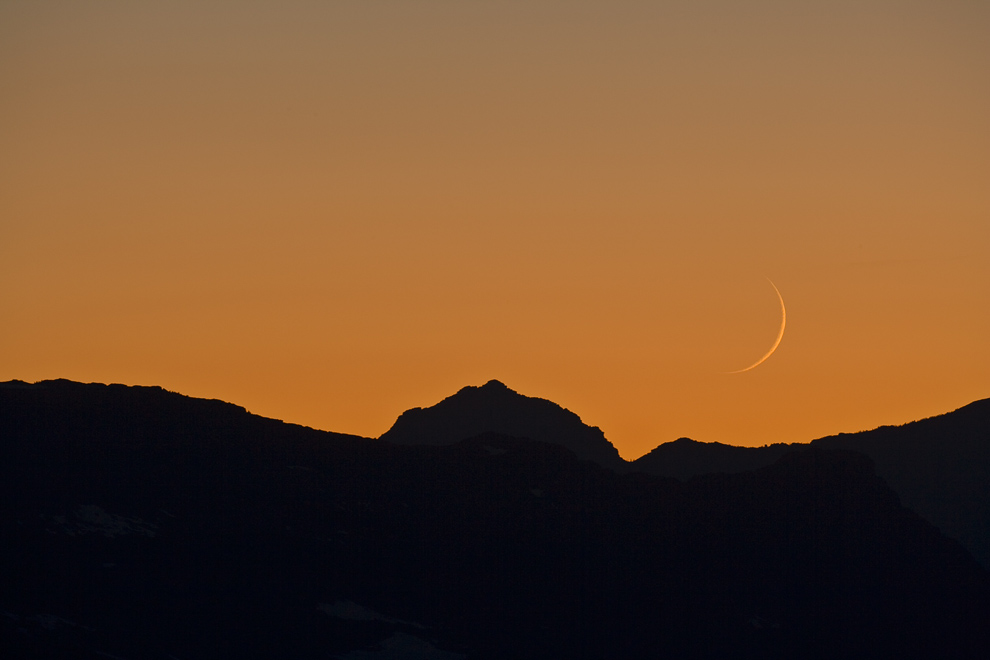
On the evening of the 29th or 30th day, look towards the west just as the sun sets, and you shall see the sign spoken of in this scripture. The moon becomes visible for 20-30 minutes after the sun has set. The moon is normally seen around 10-30 degrees in the air close to where the sun just set (depending upon the time of year, it could be on the southern or northern side in the westward direction).
Now, some may say that the full moon is visible in the east just after the sun sets in the west as well. Witness 2 will finalize this for us.
Witness 2:
We are going to be using the following scriptures with this witness. Let’s read them first, then discuss how they apply to the new moon:
Psalms 119:105
“Your word is a lamp unto my feet, and a light to my path.”Isaiah 5:20
“Woe to those who call evil good, and good evil; who put darkness for light, and light for darkness; who put bitter for sweet, and sweet for bitter!”Isaiah 8:20
“To the law and to the testimony! If they do not speak according to this word, it is because there is no light in them.”Genesis 1:14
“Then Elohim said, ‘Let there be lights in the firmament of the heavens to divide the day from the night; and let them (the lights) be for signs and for appointed times, and for days and years.’”John 9:1-5
1 Now as Yahshua passed by, He saw a man who was blind from birth.
2 And His disciples asked Him, saying, “Rabbi, who sinned, this man or his parents, that he was born blind?”
3 Yahshua answered, “Neither this man nor his parents sinned, but that the works of Elohim should be revealed in him.
4 I must work the works of Him who sent Me while it is day; the night is coming when no one can work.
5 As long as I am in the world, I am the light of the world.”John 12:35-36
“You are going to have the light just a little while longer. Walk while you have the light, before darkness overtakes you. Whoever walks in the dark does not know where they are going. Believe in the light while you have the light, so that you may become children of light.”Psalm 89:15
“Blessed are those who have learned to acclaim you, who walk in the light of your presence, Elohim.”John 8:12
“I am the light of the world. Whoever follows me will never walk in darkness, but will have the light of life.”
Each of these scriptures speaks of Light. Psalms 119:105 tells us that His word is a light meant to show us how to walk, so we may see where we are going. Take a moment to think about what this means when we are searching for when the new moon is.
When it tells us His word is a lamp, a lamp is used so one can see where they are walking. Here, like in many scriptures in the bible, we are given a metaphor suggesting a similarity or analogy between the two.
The things we read in scripture are to be considered a light source, a way of knowing right from wrong, a way of knowing how to walk with the Father. If there were no light in the scriptures, we would not know how to walk with the Father. In fact, one might say there would not be any words from the Father at all if His word was not light. Why?
Think again of a room with no light. Can you tell which direction is the way out? It is impossible, as there is no light to see with. In the same way, the Father’s word is light, showing us how we may follow Him. That is why we are told His word is a Light. It shows things not only that we can see, but that we may be able to act upon what we see.
The scriptures quite literally show light upon specific events in scripture and they do not show light upon ONE event and ONE event alone. That is, it is hidden.
Consider for a moment that we have been looking to find when is new moon day and we know also that there is a time of the month that the new moon is hidden as well. The moon reflects light from the sun, just as the Father reflected His light to the Son.
Events with Light in Scripture
That is how His word works as well. Go and take another look; you will find Light shone upon the following events in scripture:
- New Moon day
- The first Sabbath
- The second Sabbath
- The third Sabbath
The single event which you will not find in His word is the fourth Sabbath. It does not have any light shone directly upon it for us to see. That is how you “shine a light” upon His appointed times when there is no Light: it becomes a Light because of its absence. It is a Light you cannot see directly but know is there!
Here are some scriptures which show the Light the Father has provided us, shining upon specific events. You will note something interesting when looking at this as well. One event, in particular, is spoken of far more than any other event.
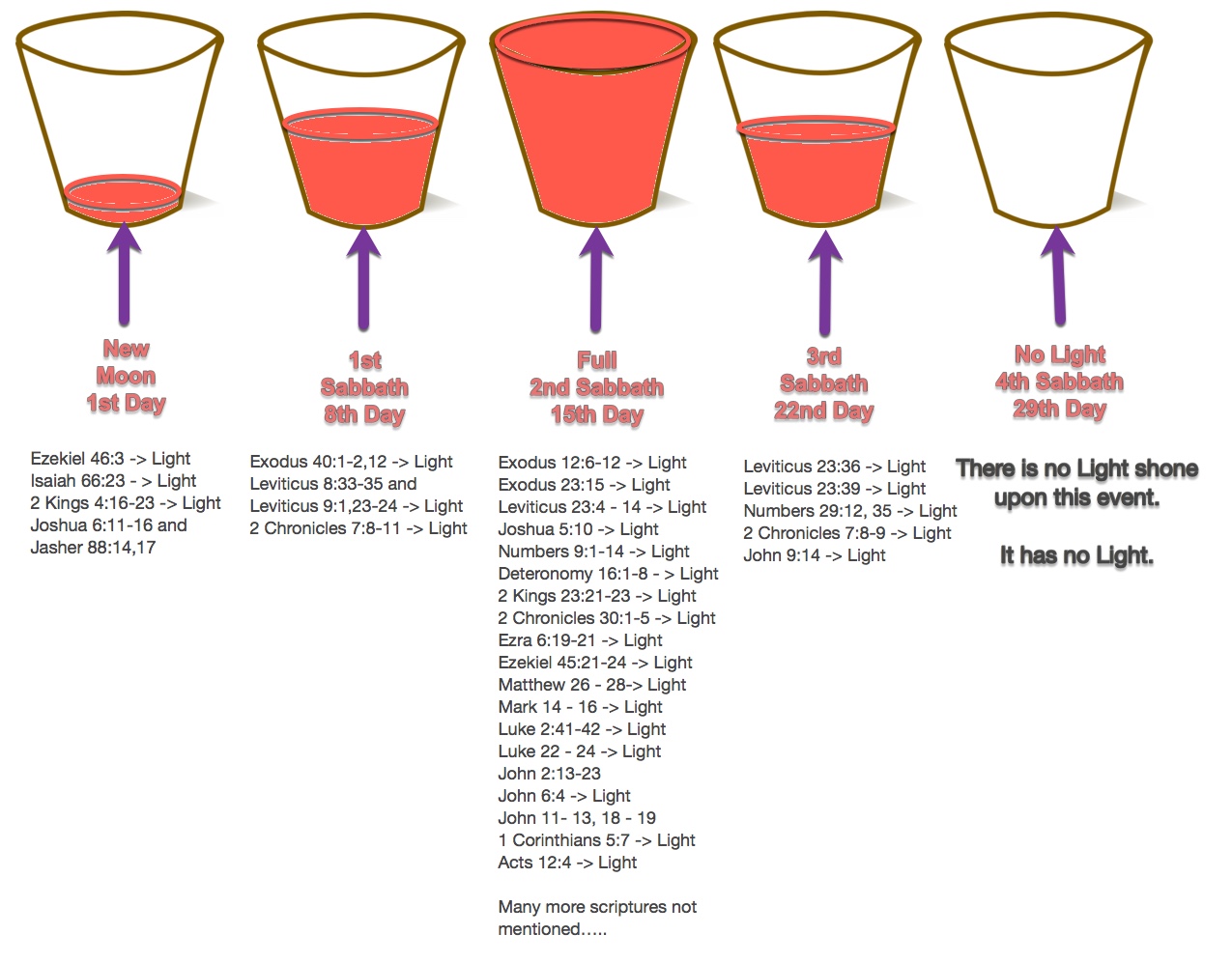
Just as the light of the moon becomes brighter, the Light of His word shines the most upon this day. Those days are the 14th through 16th of the month. We find in scripture this being spoken of as the Sabbath which fell upon the 15th day after the new moon. It was the day that Yahshua rested after the crucifixion. It was also the first day of the appointed time of Booths.
You see liquid in the cup above reflects the number of times we see Light in His word upon a specific time of the month. The Light upon the 15th day actually has many more scriptures, but I stopped there as the list is by far the greatest out of all the events. Each of these events is a Light source. Gathering many lights together, you have a great light. This is reflected in the moon as well: just as we see certain events, the Light intensifies as more Light is provided.
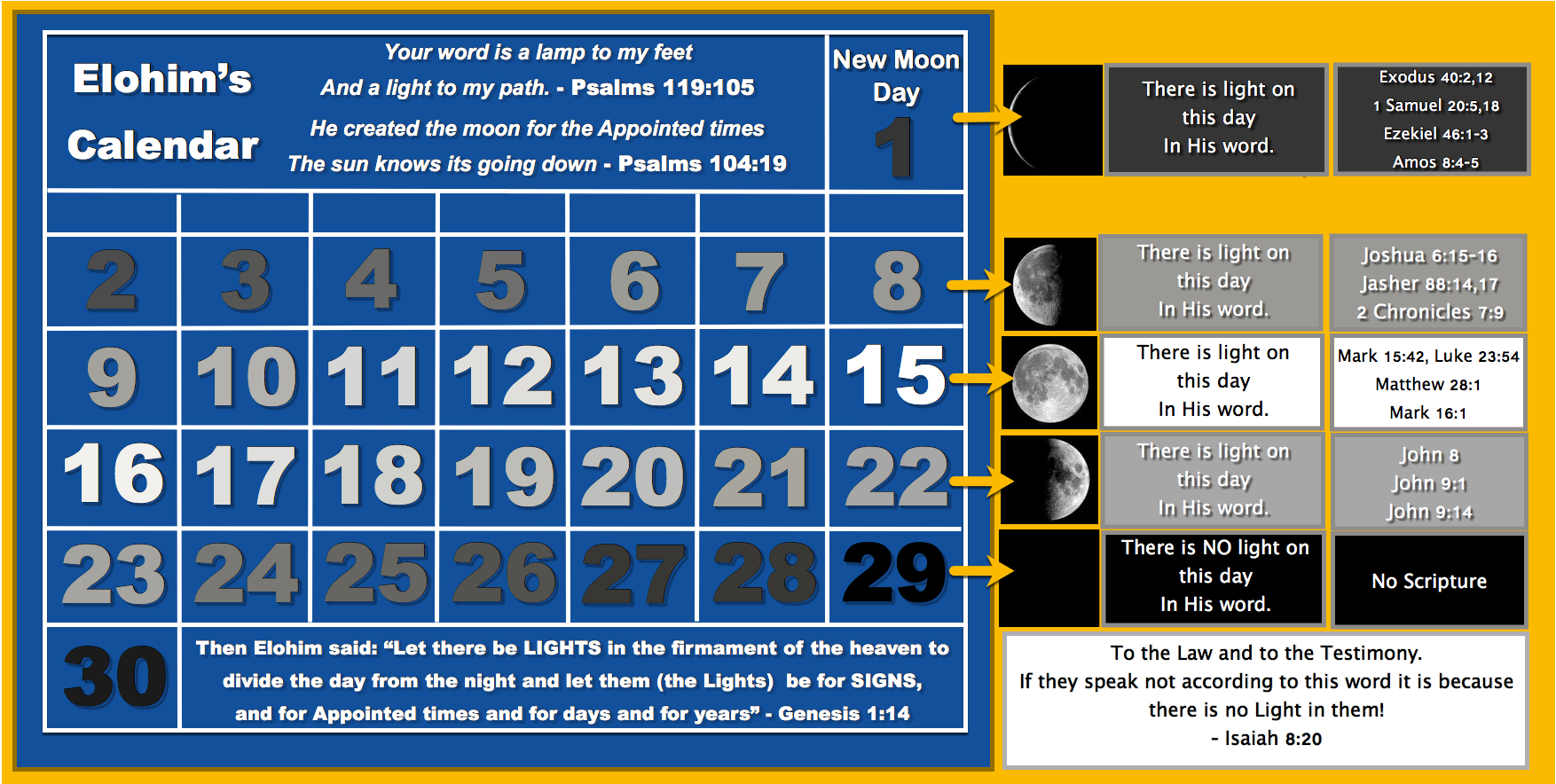
Looking at the Last Sabbath
Now, I wanted to have a look at the last Sabbath for a moment and explain something else. For anyone on Earth, looking at the moon at that time of the month, we cannot see any light. Light is similar to faith. What do I mean?
I would presume that because you have read this document this far, you have faith that the Father exists. But have you ever considered if you have ever seen Him directly? The answer would be no. Scripture tells us that no one has seen Yahuwah at any time, but the son, who is in the bosom of the Father, has declared Him (John 1:18).
You see, this Sabbath is not seen in the scriptures, but we know it exists. We know it exists because He has provided us with evidence of it in the other events He has shown. He tells us there are six work days and then the Sabbath, so the last Sabbath must be upon the 29th day, the day which has no Light—the day not directly seen in His word.
Exodus 10:21-23 – Darkness and Light
In the scriptures, we read of what occurred upon the ninth plague, when darkness fell. The reason I highlight this is we have a people who follow Yahuwah who see during this time, even though there is no Light.
Exodus 10:21-23
21 Yahuwah said to Moses, “Stretch out your hand toward heaven, that there may be darkness over the land of Egypt, darkness which may even be felt.”
22 So Moses stretched out his hand toward heaven, and there was thick darkness in all the land of Egypt three days.
23 They did not see one another; nor did anyone rise from his place for three days. But all the children of Israel had light in their dwellings.
You see, when you follow the Father, you will have Light even when there is none. For just a moment, imagine you were not on this planet, but on the other side of the moon. Upon the fourth Sabbath, the moon would be full of Light. In the same way, the people of Israel had Light in their dwellings, even though there was no Light provided by the sun or the moon. The light is there, but is is hidden.
Walking in His Light
If we use the Light—that is, the things we see in scripture—then we will not be walking in darkness, but instead, we shall have the Light of the Father.
Ephesians 5:8-14
8 For you were once darkness, but now you are light in Yahuwah. Walk as children of light
9 For the fruit of the Spirit is in all goodness, righteousness, and truth,
10 finding out what is acceptable to Yahuwah.
11 And have no fellowship with the unfruitful works of darkness, but rather expose them.
12 For it is shameful even to speak of those things which are done by them in secret.
13 But all things that are exposed are made manifest by the light, for whatever makes manifest is light.
14 Therefore He says:
“Awake, you who sleep,
Arise from the dead,
And Messiah will give you light.”
Witness 3:
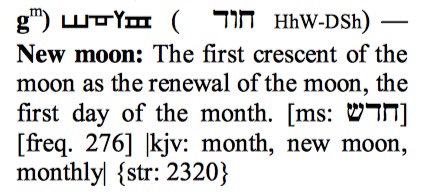
The third witness comes from the word we see as “new moon” or “month” in scripture — Chodesh. When we read the translation of Chodesh in Strong’s Concordance, we see it explained like this:
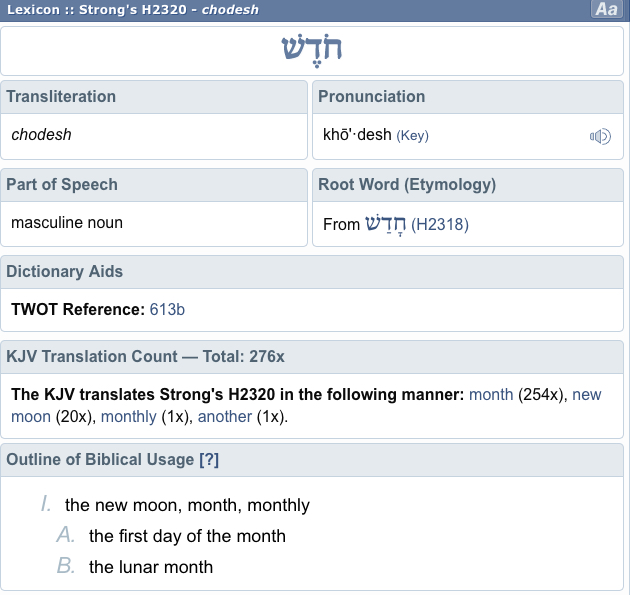
Whilst the translation here is correct, the Hebrew interpretation leaves no doubt as to what the new moon actually is.
We are going to use the letters found in this PDF:
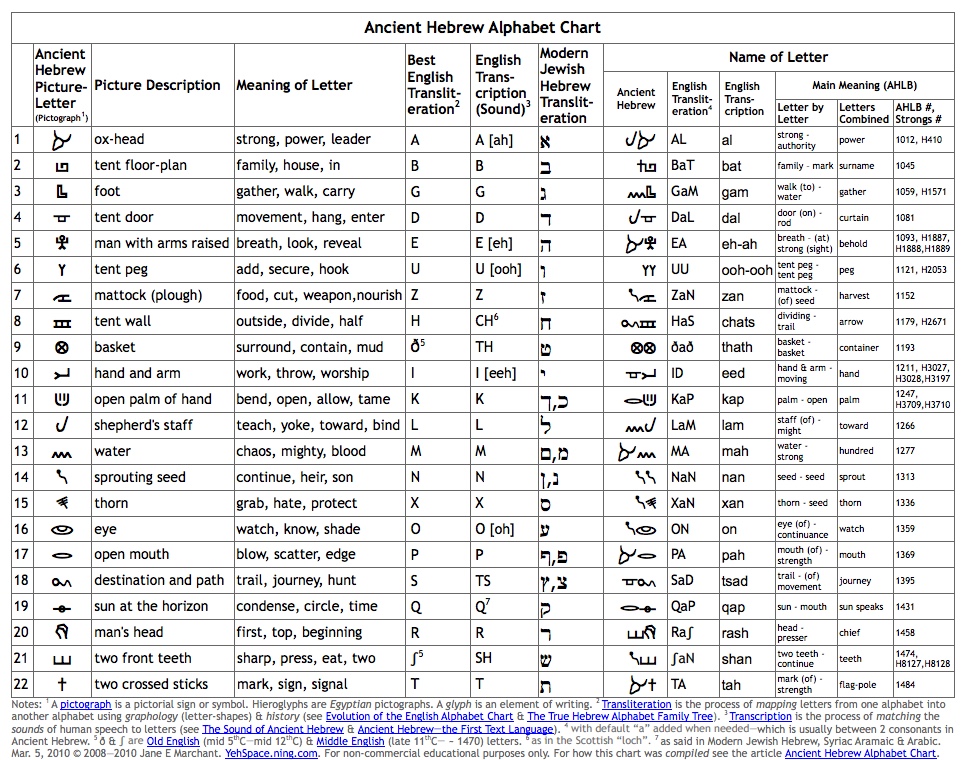
1. The Hebrew letter Het or Chet is a Tent wall pictograph.
It is the first letter in the word Chodesh. If you were looking down at the tent from above, it would appear as an edge.

2. The Hebrew letter Dalet is a tent door pictograph.
It is the second letter in the word Chodesh. If you were looking at the tent door from above, it would also appear as an edge.

3. The Hebrew letter Bet is an image of a tent floor plan pictograph.
This letter is not in the word Chodesh, but it helps to see it as the tent is made up of walls and a door. The point where the door and the wall meet is a sharp point.

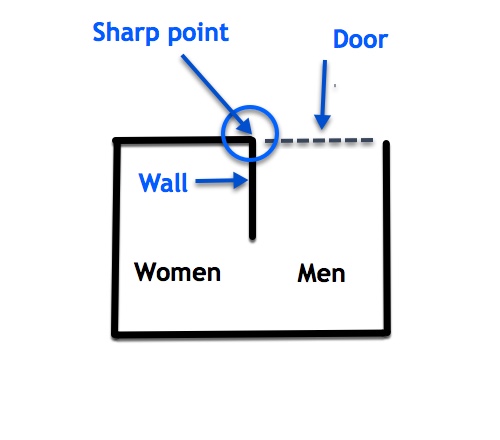
Similarly, there are two edges of a sword which meet at a sharp point.

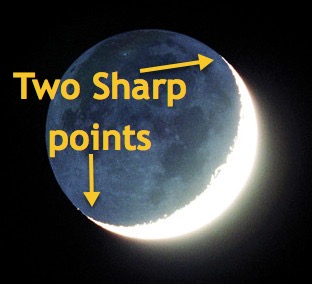
When we add the tent wall to the tent door, they meet at a sharp point. Thus, the ancient two-letter word ChaD means a “Sharp point” – H2299:
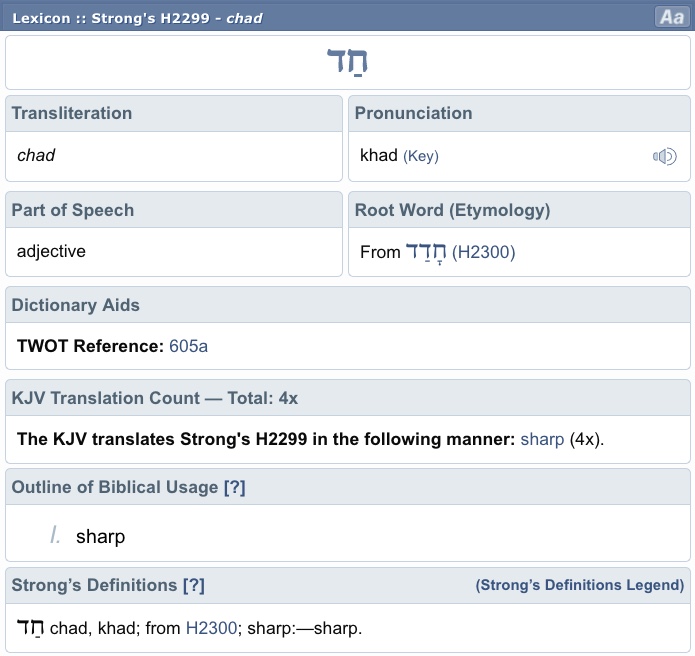
You will find this word in scriptures such as the following:
Proverbs 5:4
But her end is bitter as wormwood, sharp as a two-edged sword.
Isaiah 49:2
And he hath made my mouth like a sharp sword; in the shadow of his hand hath he hid me, and made me a polished shaft; in his quiver hath he hid me;
At the point of the sword, we have unity where the two points meet into one, and that is where the word Yachad comes from. When I think of Yahchad, I think of Yahuwah (Yah) bringing the two together (chad) in unity. That is the tip of the two-edged word coming into one point.
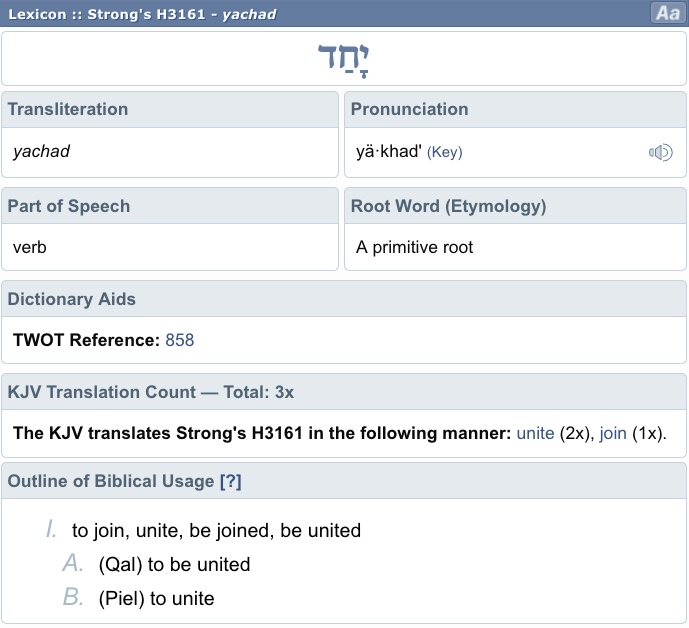
4. In the letter Yahchad, the first letter is the tent peg. The tent peg is known as the Vav and makes the UU sound. It means to add, secure, hook, or to join. So when we add the UU to the Chad, we get the word Chud, which literally means “a joined sharp point.”

5. The letter Shin is a two front teeth pictograph and is pronounced as SH. This letter means sharp, press, eat, or two.

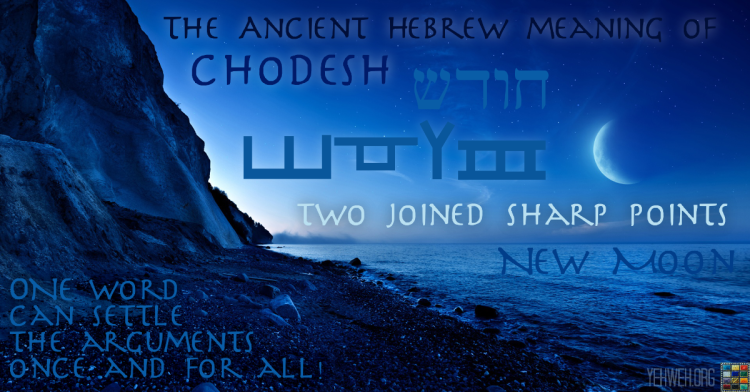
6. When we add the two front teeth to the end of the root word Chud, we get Chodash (Ch uu Dal Sh). This literally means in Hebrew: “two joined sharp points.”
The Hebrew Lexicon, however, does not go this deep into the meaning nor does it mention the Vav. When you look at the Ancient Hebrew Lexicon by Jeff Benner, you will find this entry when looking up the word Chodesh. Here, you will find the Vav silently joining the two points (under Hhets – 2150):
Two joined sharp points is exactly what we see in a new moon. It describes the crescent moon with accuracy and is the concrete ancient Hebrew meaning of the word Chodesh. Words in Hebrew have three different meanings: Concrete (an object), Action (a function), and Abstract (how the word applies to people). In Ancient Hebrew, the context of a word determined its meaning, not vowel points (as these did not exist).
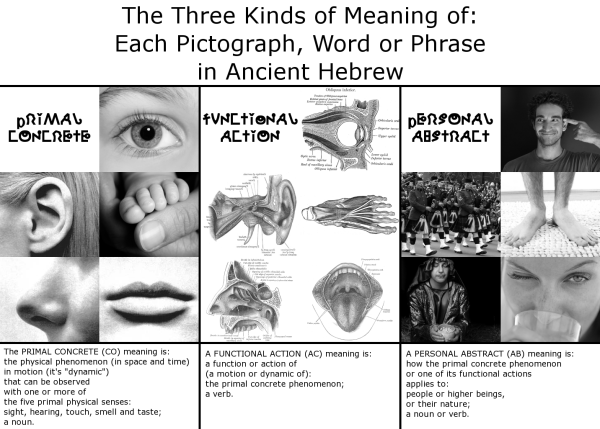
7. The action meaning of Chodesh is “to Renew” because the function of the crescent moon is to renew the month. The Ancient Hebrew Lexicon states that chadash (without the Vav) means to Renew in the action sense. The action gave rise to the abstract meaning.
The abstract meaning of Chodesh is “New,” because it can be applied to human nature when people are made new from being renewed, restored, or repaired.
Some Common Objections and the Responses to Them:
These are responses to an article on another website, where they propose the Full Moon is the new moon. Below, you will find the statements and scriptures used. Below that, you will find the reply.
Claim: The Creator ordained the moon to rule ALL night, east to west.
(Genesis 1:15, Jeremiah 31:35, Psalms 136:9)
Let’s take a look at these scriptures first, to ensure that the statement is true and has not been added to.
Genesis 1:15
15 and let them be for lights in the firmament of the heavens to give light on the earth”; and it was so.
Jeremiah 31:35
35 Thus says Yahuwah,
Who gives the sun for a light by day,
The ordinances of the moon and the stars for a light by night,
Who disturbs the sea,
And its waves roar
Yahuwah of hosts is His name:
Psalms 136:9
9 The moon and stars to rule by night,
For His mercy endures forever.
Immediately, one can say by reading these scriptures that firstly, they never refer to the moon ruling ALL night; rather, the scripture refers to the moon ruling BY night.
Answer:
The word “by” as an adverb means:
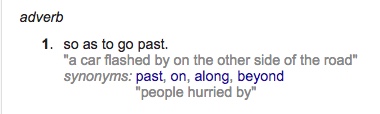
When I view a train or a car go past me, it does not mean that I will see it all night. It means I will see it for a period of time as it goes by.
Secondly, none of these scriptures ever mention east to west. That is adding to the scriptures to make something fit which it was never designed for.
(People use this argument to try to support the full moon as the new moon, but as one can see, the scriptures support the first visible crescent, as it is also seen in the night. The Light it gives on the new moon, the first, second, and third Sabbaths, matches the Light we see in His word upon these same events.)
Some people may not be aware that when you use the full moon as the new moon, what you are in fact doing is placing the event which we see the most light upon (the Sabbath upon the 15th) in darkness. You are essentially taking the event which is full of Light in scripture and saying that it is in darkness.
Scripture contains a solemn warning about doing this in Isaiah 5 and Isaiah 8:
Isaiah 5:20
Woe to those who call evil good, and good evil;
Who put darkness for light, and light for darkness;
Who put bitter for sweet, and sweet for bitter!
Isaiah 8:20
To the law and to the testimony! If they do not speak according to this word, it is because there is no light in them.
(Here, the Father tells us not to take the Light in His word—in this situation, we are speaking of the Sabbath upon the 15th—and place it in darkness. He also tells us not to take the darkness (the Sabbath upon the 29th) and place it in Light. He tells us that if they do not speak according to the testimony of the scriptures—that is, the Light of the word—then there is no Light in them.)
Claim: It must be a fully constituted lunar phase on the night it rules.
Proverbs 4:18-19, chadash #2318 renewed or [rebuilt]
Proverbs 4:18-19
18 But the path of the just is like the shining sun,
That shines ever brighter unto the perfect day.
19 The way of the wicked is like darkness; They do not know what makes them stumble.
Answer:
The scripture above speaks of the renewal process the moon goes through until it arrives back at the full moon, where we have the most Light. The new moon has Light, and the full moon has the most Light.
The word chadash does not refer to something rebuilt; instead, it refers to the process of renewing. Just like a child who starts off small and grows to maturity, and then starts to fade away, the moon also has a renewal process whereby it starts off small, grows to maturity, and then fades away.
Here is the definition from Strong’s Concordance:
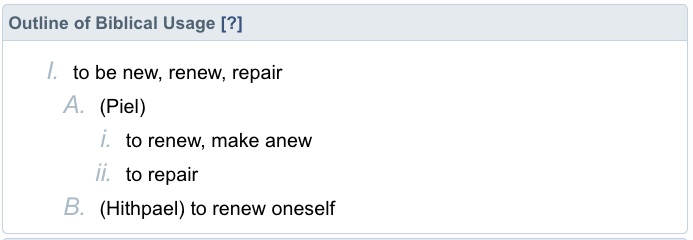
The word chadash (H2318) is related to the word chadash (H2319), which specifically refers to something new or fresh—like the first visible crescent—and is also related to the word chodesh, which refers to the new moon.
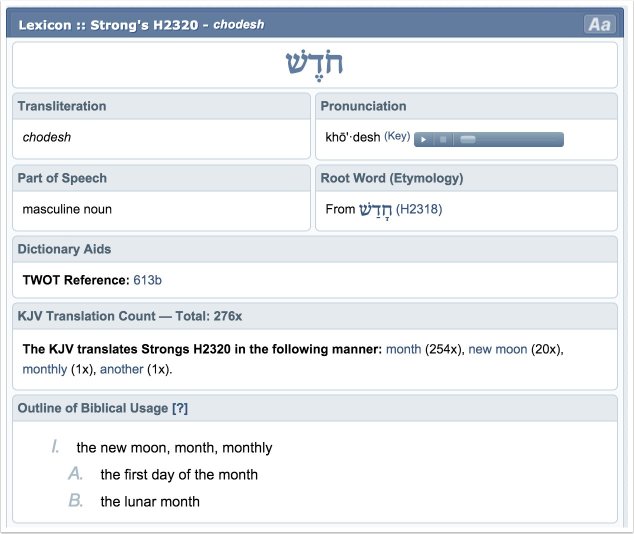
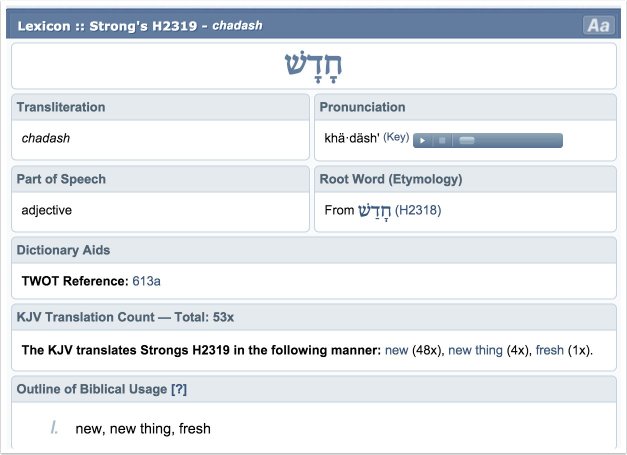
This can only refer to the first visible crescent, as the full moon is 15 days old—hardly “new”—and the dark moon is not yet seen.
Claim: As all ruling luminaries arise in the east and shine unto the west, it synchronizes the east gate of the Temple.
(Matthew 24:27, Ezekiel 46:1)
Answer:
The assumption here is that these scriptures refer to luminaries arising in the east and shining unto the west. While the sun itself does indeed rise in the east and sink in the west, the new moon is seen in the west as the sun sets.
Ezekiel 46:1
1 Thus saith the Sovereign Elohim; The gate of the inner court that looketh toward the east shall be shut the six working days; but on the sabbath, it shall be opened, and in the day of the new moon it shall be opened.
Matthew 24:27
27 For as the lightning comes from the east and flashes to the west, so also will the coming of the Son of Man be.
Matthew 24:27 does not refer to the sun or the moon, but rather to lightning flashing from the east and moving to the west. Lightning is not the sun or the moon, but something we see in a storm. There are many other scriptures which refer to lightning as being from the Father. The direction here tells us where to look. Changing the meaning of lightning to mean the sun and the moon is changing the scriptures. Lightning occurs in the day and in the night; its timing is not specific.
Claim: It is the “brilliant moon” (#4582 selene) under the woman’s feet when standing upright as an announcement of New Year’s Day.
(Revelation 12:1)
Revelation 12:1
1 Now a great sign appeared in heaven: a woman clothed with the sun, with the moon under her feet, and on her head a garland of twelve stars.
Answer:
This is a sign I have some familiarity with. A sign such as this was seen on the 23rd of September 2017. At that time, the woman was clothed in the sun, she had the moon at her feet, and she had on a garland of 12 stars. The moon which was at this woman’s feet was not the full moon, but rather the first visible crescent.
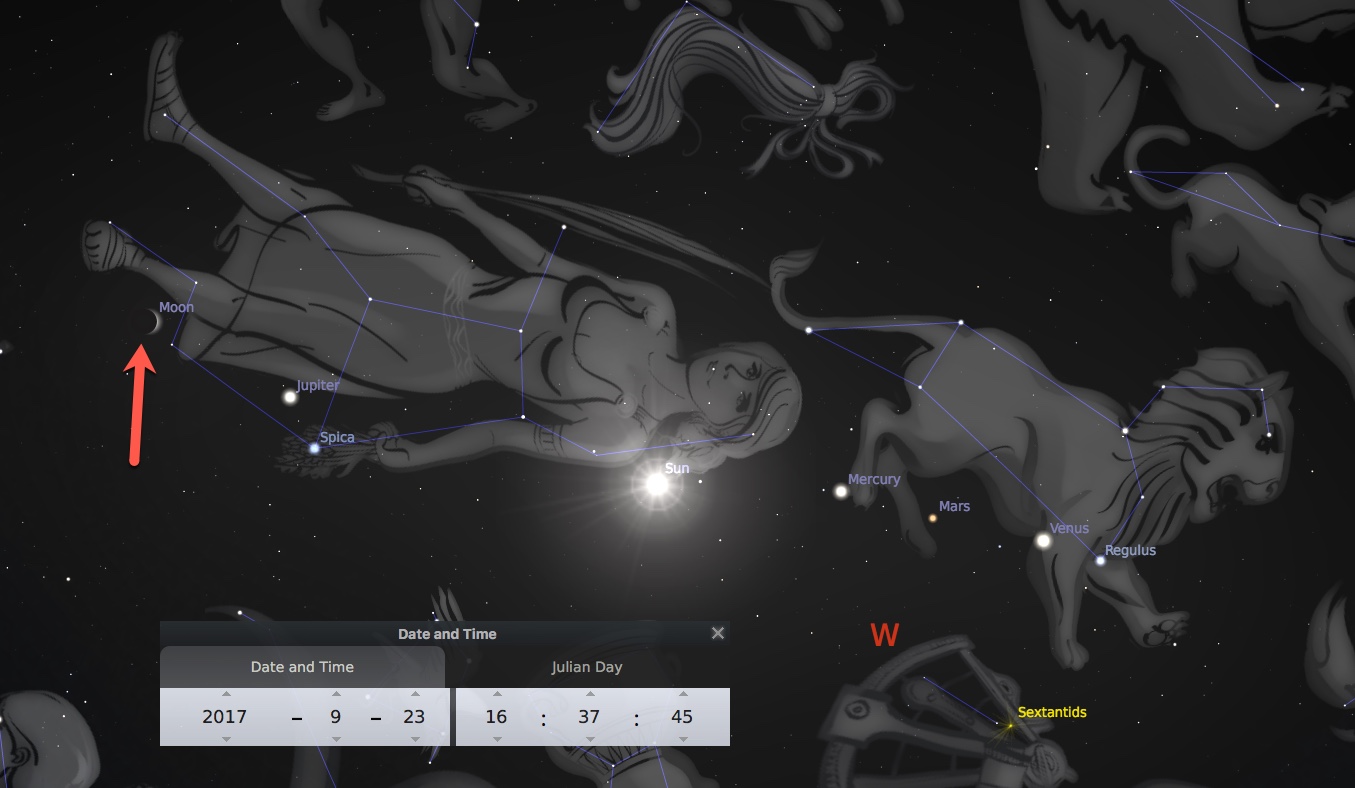
The word referred to as “selene” in the scripture is the Greek word for moon. In fact, in Matthew 24:29, Mark 13:24, Luke 21:25, Acts 2:20, 1 Corinthians 15:41, Revelation 6:12, Revelation 8:12, and Revelation 21:23, the same word is used to denote the moon. Notably, many of these scriptures refer to the moon as not giving Light (Matthew 24:29, Mark 13:24), being blood red (Acts 2:20, Rev 6:12), or the moon not providing a third of its light (Rev 8:12).
The word for brilliancy is a different word—selas—and has to do with attractiveness. It is not the word used here.
Claim: He apportions the face of the “full moon” (keceh #3677) as an ordained statute of set time.
Answer:
I have listed the above scripture twice, as you will find it translated in a couple of different forms. The words we see above as “full moon” is also translated as the word “throne,” as in the throne of Elohim. Something we learn in scripture is that Yahuwah is Light, and it is Yahuwah who sits upon the throne (Revelation 21:5-6 and Revelation 21:23). The same way in which the full moon is full of Light, so is the throne of Elohim, as this is where He sits.)
Job 26:9
He covers the face of His throne,
And spreads His cloud over it. (NKJV)
Job 26:9
He covers the face of the full moon
And spreads His cloud over it. (AMP)
In this scripture, there is a cloud put in place to cover the full moon, the moon which has all the Light.
While discussing this, it is important to highlight another scripture in Psalms 81:3, which many who say the full moon is the new moon use as proof. In this scripture, the word “keceh” is also used. The other word used in this scripture is Chodesh, which we know as the new moon. People who use this scripture twist it to say that the scripture says the new moon is the full moon, when in fact the scripture refers to the trumpet being blown upon the new moon and upon the full moon.
Psalms 81:3
3 Blow the trumpet (showphar) at the New Moon (chodesh) and at the full moon (keceh), on our feast day (chag yowm).
Let’s look at the evidence:
- Chodesh means: The new moon.
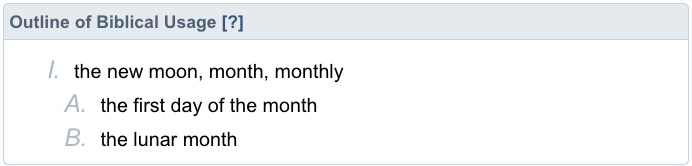
- Keceh means: The full moon

Psalms 81:3 is referring to what occurred in the seventh new moon. Specifically, it refers to the appointed time of Trumpets and the appointed time of Booths.
Upon the appointed time of Trumpets, which was the first day of the new moon, the trumpets were to sound throughout the day. We see this in Leviticus 23:
Leviticus 23:23-24
23 Yahuwah spoke to Moses, saying,
24 “Speak to the children of Israel, saying: ‘In the seventh new moon, on the first day of the new moon, you shall have a sabbath-rest, a memorial of blowing of trumpets, a holy convocation.’”
Then again, upon the 15th day of the month, which was the appointed time of Booths and was the day of the full moon, the trumpets were to sound again. This is seen in Numbers 10, where it talks about the different times when the trumpets were to sound:
Numbers 10:10
10 Also in the day of rejoicing at your appointed feasts (the 15th-21st), and at the beginnings of your months (the 1st), you shall sound the trumpets over your burnt offerings, and over the sacrifice of your peace offerings; They shall be as a reminder of you before your Elohim. I AM Yahuwah Elohim.
The word keceh has had a very misunderstood meaning. Instead of speaking about the new moon, it speaks of the full moon which occurs fifteen days after the new moon.
Claim: The “Father of Lights” is represented only by luminaries when there is no shadow or a turning orbit.
Answer:
(This scripture refers to the Father as the Father of Light. Interestingly, it does not refer directly to the moon, in which there is a variability in the amount of Light it receives from one new moon to another. Rather, the Father is the same yesterday, today, and tomorrow, and will always be.)
James 1:17-18
17 Every good gift and every perfect gift is from above, and comes down from the Father of light, with whom there is no variation or shadow of turning.
18 Of His own will He brought us forth by the word of truth, that we might be a kind of firstfruits of His creatures.
Claim: Observed in both hemispheres in one orbit of the moon, it is in sync with the new Jerusalem New Moon day.
Answer:
The new moon is seen on either the 29th day at evening or upon the 30th day at evening. This means that once the new moon is seen, within a 24-hour period, the entire earth will have seen the new moon. This is because the current time from one new moon to another is 29.5 days long. Some areas will have 29 days between new moons, while others will have 30 days between new moons—a 24-hour period of difference.
Exodus 20:8
8 “Remember the Sabbath day, to keep it holy.
Ezekiel 20:12
12 Moreover I also gave them My Sabbaths, to be a sign between them and Me, that they might know that I am Yahuwah who sanctifies them.
It should be pointed out, however, that the scriptures quoted do not actually mention that the new moon is observed in one orbit. Rather, the scriptures simply tell us to observe—to watch and wait for—the new moon. If the new moon was the full moon, there would be endless arguments over whether the moon was truly full between different observers. But there can be no argument if the new moon is just seen after a day of not seeing it; it is either there or it is not.
Deuteronomy 16:1
“Observe (shamar) the month of Abib, and keep the Passover to Yahuwah Elohim, for in the new moon of Abib, Yahuwah Elohim brought you out of Egypt by night.”
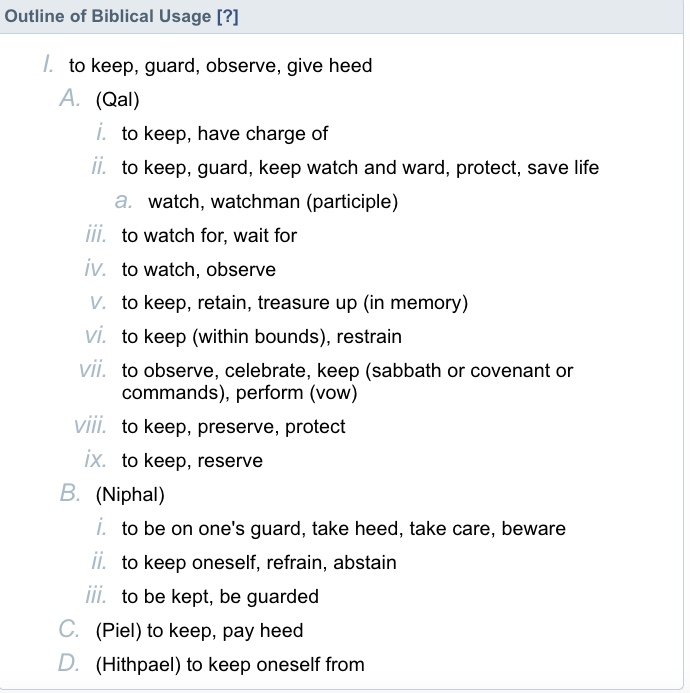
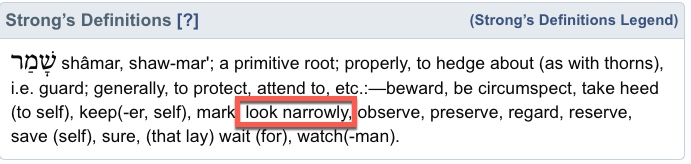
It is important to note that the word “shamar” also means “to look narrowly for.”
Claim: This New Moon occurred 14 days and one night prior to the darkened (skotizo #4654) sun on the day of the crucifixion.
(Luke 23:44-45, Matthew 24:29, Amos 8:9-11)
Answer:
(The argument here is that the full moon was seen fourteen days and one night before Passover, citing the darkening of the sun as evidence. The problem with this view is twofold:)
a. These events are seen clearly in the scriptures. The crucifixion of Yahshua is seen and is spoken of more than any other event in the scriptures. We see the days this occurs over; they are Light. Indeed, there is so much Light upon this event that it is recorded in many different scriptures, from Exodus (before the event) through Matthew, Mark, Luke, and John.
b. It was the sun which was darkened at the crucifixion. The scriptures do not mention the state of the moon. Read Luke 23:45 again:
“The sun was darkened…”
Without the Father, there is no Light.
Luke 23:44-45
44 Now it was about the sixth hour, and there was darkness over all the earth until the ninth hour.
45 Then the sun was darkened (skotizo), and the veil of the temple was torn in two.
Matthew 24:29
29 “Immediately after the tribulation of those days the sun will be darkened, and the moon will not give its light; the stars will fall from heaven, and the powers of the heavens will be shaken.
Amos 8:9-11
“And it shall come to pass in that day,” says Yahuwah Elohim,
“That I will make the sun go down at noon,
And I will darken the earth in broad daylight;
10 I will turn your feasts into mourning,
And all your songs into lamentation;
I will bring sackcloth on every waist,
And baldness on every head;
I will make it like mourning for an only son,
And its end like a bitter day.11 “Behold, the days are coming,” says Yahuwah Elohim,
“That I will send a famine on the land,
Not a famine of bread,
Nor a thirst for water,
But of hearing the words of Yahuwah.
c. Matthew 24:29 speaks of what was to occur after the tribulation. This is not referring to the crucifixion:
“Immediately after the tribulation….”
On the last Sabbath of the month, the light of the moon is hidden, in the same manner we do not see the last Sabbath spoken of in scripture. It has no Light. But did you notice what this scripture says?
“…the sun will be darkened, and the moon will not give its light;”
Before the sun was darkened, the moon was giving its Light as the moon acts as a reflector of the sun’s light. That is different from when the moon is hidden by the sun’s Light while the sun is still shining.
They are at opposite ends.
d. Amos 8 also speaks of after the tribulation, as it is referring to the appointed time of Harvest:
Amos 8:1
“Yahuwah Elohim showed me: Behold, a basket of summer fruit.”
Importantly, the harvest is midway through the scriptural month. (See this article for proof from scripture.)
Claim: The rejected cornerstone of the Temple services symbolizes both the Messiah and the Full moon.
Answer:
This is a great scripture, and I would agree that it speaks of the Light. Scripture tells us that His word is a lamp to our feet and a Light to our path. So anyone can see, there is only Light shone upon specific events, and the fourth Sabbath is the one event which does not have any Light shone upon it. The time when Yahshua came and died for us is written about in His word many times, and it has more Light upon it than any other event.
Psalms 118:18-24
18 Yahuwah has chastened me severely,
But He has not given me over to death.
19 Open to me the gates of righteousness;
I will go through them,
And I will praise Yahuwah.
20 This is the gate of Yahuwah,
Through which the righteous shall enter.
21 I will praise You,
For You have answered me,
And have become my salvation.
22 The stone which the builders rejected
Has become the chief cornerstone.
23 This was Yahuwah’s doing;
It is marvelous in our eyes.
24 This is the day Yahuwah has made;
We will rejoice and be glad in it.
1 Peter 2:4-10
4 Coming to Him as to a living stone, rejected indeed by men, but chosen by Yahuwah and precious,
5 you also, as living stones, are being built up a spiritual house, a holy priesthood, to offer up spiritual sacrifices acceptable to Yahuwah through Yahushua ha Maschiach.
6 Therefore it is also contained in the Scripture,
“Behold, I lay in Zion a chief cornerstone, elect, precious, and he who believes on Him will by no means be put to shame.”
7 Therefore, to you who believe, He is precious; but to those who are disobedient,
“The stone which the builders rejected has become the chief cornerstone,”
8 and,
“A stone of stumbling and a rock of offense.”They stumble, being disobedient to the word, to which they also were appointed.
9 But you are a chosen generation, a royal priesthood, a holy nation, His own special people, that you may proclaim the praises of Him who called you out of darkness into His marvelous light;
So, in actual fact, these scriptures only support a single version of the new moon: the first visible crescent—the first event we see every month in scripture.
From Worlds Last Chance:
Claim
World’s Last Chance is overjoyed to share what we sincerely believe to be advancing light on our Creator’s calendar. In His great mercy and longsuffering, Yahuwah has borne long with us as we espoused what we now recognize to be an error. Praise His Name! Since we first accepted the glorious light of Yahuwah’s luni-solar calendar and its divine role in determining all of the Feast Days, including the Seventh Day Sabbath, we have in our ignorance proclaimed that New Moon Day was determined by the first visible crescent. We now, after much prayer and study, repent of this error and would like to humbly share our conviction that New Moon Day is to be observed, beginning at dawn, on the day following the moon’s conjunction with the sun (as opposed to the day following the first visible crescent).
Answer:
Advancing light is just that: light which shines forth from His word to show us how we should walk. I find it sad that Worlds Last Chance would espouse such a thing, saying in one breath that they have been given advancing light, and that light is that New Moon Day is hidden. This suggestion by Worlds Last Chance is not in line with the Light provided by scripture. I would ask Worlds Last Chance to show the Light which they now see upon the fourth Sabbath and also show how New Moon Day is hidden in the scriptures. This is flipping around the Light He gave us and taking what He gave us as Light, making it darkness, and taking the darkness and making it Light.
Isaiah 5:20
Woe to those who call evil good, and good evil;
Who put darkness for light, and light for darkness;
Who put bitter for sweet, and sweet for bitter!
(Conclusion/Summary)
Throughout this detailed exploration, we have seen multiple scriptural passages and historical understandings that point to the first visible crescent as the sign of the new moon. By examining the Hebrew word chodesh, the timing of biblical events, and the role of the moon in Yahuwah’s calendar, it becomes clear that a visible sign—rather than darkness or a full moon—marks the beginning of each month in Scripture. Ultimately, recognising this pattern helps us align more closely with Yahuwah’s appointed times, days, and years, keeping us in the Light of His word.
 The Calendar of Scripture
Shalom🙏Sorry but you took too long to get to your point. I had to st
LikeLike
Cheers for the feedback. The article is written as an all inclusive post rather than a simple overview
LikeLike
Moses warned the stiff-necked rebellious people he led out of Egypt, just before he died, NOT to look to the sun, moon, and stars. But of course, as in the case of other warnings, (such as in the warning in the Garden of Eden) the warning was never heeded, and is not yet today. Rosh Hashanah is only three days later this year on the pope Greg’s calendar and of the First Year which was three days before the first season, which is the fall harvest season. On the 3rd. Day all vegetation was made with its fruit and seed in place ready to feed Adam and the animals that week. The flood began as soon as Noah had filled the ark with that year’s harvest. Israel left Egypt soon after the locust ate Egypt’s summer fruit. Israel entered The Promised Land when the fall harvest had storage places filled and wheat ready to harvest. The Passover Lamb of Yahweh was separated (born) from Mary, of Yahweh’s flock five days after Ceasar’s birthday which is Sept. 23rd on Greg’s phony calendar. Etc., Etc..
LikeLike
Hi Donald,
Regarding what you said here -> Moses warned the stiff-necked rebellious people he led out of Egypt, just before he died, NOT to look to the sun, moon, and stars. <- I wanted to point something out.
There is a right way and a wrong way to use the sun moon and stars. God told us not to worship them. However he also said they were there to set His appointed times.
It is like one person worshipping numbers on a clock, as opposed to using the clock to know when to worship. One is using it wrongly. The other is using it correctly.
God said in Exodus 12:1-2
Now Yahuwah spoke to Moses and Aaron in the land of Egypt, saying, 2 “This new moon shall be your beginning of the new moons; it shall be the first new moon of the year to you.
Yahuwah never says here to worship them, but that the moon was the clock that set the appointed times of Yahuwah.
All the times in the Bible are set by the new moon, which sets it apart from the gregorian calendar, for the day starts when the new moon is seen, however on the Gregorian calendar the day starts at the international date line.
Rosh Hashanah better known as Yom Teruah or the day of trumpets for the majority of the world, falls on the day after the new moon is sighted, which it is expected to be seen the evening of August 24th 2025 for most of the world and August 25th for some of the world. New Moon day will be August 25th for most of the word with some on August 26th.
Now that will be all worked out by sight from August 24th when the sign is expected to be seen.
LikeLike
Yes, the sun and moon were time Pices from creation until the flood, when that world was destroyed. This destroyed world had 28 days added per year to its rotation on its axis as it orbits around the sun, one week to each season, “He changed the seasons.” He also changed the times, He Added a day to an existing day, making one double day and added 6 hours to a day for a sign for king Hezakiah, thus since the moon was not involved there has been ever since a 29 1/4 day cycle of the moon. Now the sun is the only time marker It sets in the evening of every day. The word moon is not found is Exodus. It was from Deut. 4:19 not mentioned again until king Saul looked to it after he fell into rebellion.
Brother Donald Vander Jagt
donvj1934@outlook.com
LikeLike
Brother Donald,
I appreciate your thoughts on the changes in timekeeping, but the idea that the moon is no longer a timepiece does not align with scriptural evidence. The word “chodesh” (חדש) is repeatedly used in the Torah to refer to the new moon and the beginning of months (e.g., Exodus 12:2, Numbers 10:10, 1 Chronicles 23:31). The notion that the sun alone determines time contradicts the biblical record, which consistently references the moon in relation to months and appointed times.
Your claim that the word “moon” is not found in Exodus is incorrect. While “yareach” (ירח, moon) may not appear in Exodus, the concept of lunar months (chodesh) is clearly outlined (Exodus 12:2). Moreover, Psalm 104:19 explicitly states that God made the moon for appointed times (moedim), reinforcing its role in the biblical calendar.
I encourage you to read this article, which goes deeper into the Hebrew terms “chodesh” and “yareach” and how they demonstrate that the moon is indeed the biblical timekeeper:
🔗 Chodesh or Yareach?
Looking forward to your thoughts!
LikeLike
Thank you for this article – it is excellent. But can I ask how you know that the Feast of Trumpets falls in August in 2025 and not in September? Where do the Feasts fall relative to the equinoxes or is this not a relevant question?
LikeLike
Dear Erica,
Thank you for your message — that’s a really good question which took me a while to figure out as well.
The reason the Feast of Trumpets fell in August rather than September in 2025 was because of how the biblical year was determined. Scripture teaches that the first month of the year, called Abib, must be tied to spring in Israel. This is done by ensuring that the vernal equinox (also called the spring equinox in the northern hemisphere) occurs on or before the first day of the first month. If it does not, at present, that year will have 13 months.
The vernal equinox is the point in the year — around March 19–21 on the modern calendar — when day and night are of equal length all over the earth. It marks the beginning of spring in the northern hemisphere. Because the biblical calendar is luni-solar (based on both the sun and the moon), the sun determines the start of the year, while the moon determines the months.
As you reach the end of the year, the setting sun is moving from the south towards the north (setting in the west of course). As soon as it sets beyond the west (that is heading towards the north) the new year will begin at the start of the following new moon. If you reach the end of the 12th month, and the sun is setting still on the southern side of west, then there will be a 13th month.
Thus, the month of Abib is the month when Passover falls on or after the vernal (spring) equinox. Once that first month is properly anchored, the rest of the appointed times simply follow by counting lunar months.
Since the Feast of Trumpets occurs on the first day of the seventh month, if the first month begins earlier in the year, the seventh month — and therefore Trumpets — will also arrive earlier. That is why in 2025 it fell on August 23rd instead of September.
This natural turning point in the lunar cycle further confirms the timing and keeps everything aligned with Genesis 1:14, which tells us that the sun, moon, and stars are given for signs, appointed times, days, and years.
Yahuwah Bless
LikeLike
Thanks for this review may YAh continue reveal his secrets to u brother. I have been observing the moon since I realized that it’s for appointed times. I noted that each month has 30 days not 29days. But after three months the third month has 31 days , I knew that the 1 day is there to separate every three months. 30days defined by the creator not as the world count
LikeLike
Whilst the scriptures show that Yahuwahs calendar does indeed have 30 days in it each month, it also shows that he removed the appointed times from the people who were abusing them, and it also says that these times will be restored in the future never to change again.
So my suggestion is to walk in his steps and follow from one new moon to another and from one Sabbath to another. Then, no matter what happens… even when the number of solar days in a year are shortened, you will still be following his appointed times.
LikeLike
Tried to leave a comment but it seems it didn’t work.
LikeLike
It worked ok….
LikeLike
Do you have a post on when a new day actually starts? Thank you for all your work, it reveals the joyous glory of the Father and it makes me smile.
LikeLike
Yes. You can find it here: https://calendarofscripture.com/2015/05/30/when-does-a-day-begin/
LikeLike